Is it your responsibility to make your wife or girlfriend happy?
Version 1.0.0
Do you treat her like a partner or an authority who gives you permission to do things?
And do you speak up for what you want or keep quiet to avoid rocking the boat?
Athlete, model, mother, and wife to Laird Hamilton, Gabby Reece is here to let us behind the curtain of her life while crushing the illusion of a fairytale marriage.
Dubbed one of the world’s sexiest athletes, former Women’s Beach Volleyball League star and fitness icon Gabrielle Reece, also known as Gabby, possesses a look that conveys both athleticism and feminine beauty. At 6’3”, Gabby is a dominate force on and off the pro beach volleyball circuit. Her commanding presence, passion for healthy living, and fitness expertise makes her a popular public speaker on the subjects of health and wellness. She routinely provides advice and guidance on fitness, nutrition, and active living, via gabbyandlaird.com. An avid proponent of empowering people to take responsibility for their own health, plus truly authentic example of healthy living, Gabby has become a role model to women worldwide regarding how to achieve peak fitness, good health, and overall well-being for themselves and their entire family.
Passionate about fitness throughout her life, Gabby has released and produced her own health & fitness products: “Bell Express 15” Workout Kits, “Gabrielle Reece Fit & Healthy Prenatal Workouts” DVDs and “Gabrielle Reece: The Complete Fit & Healthy Pregnancy Workout” 2 DVD set — The “Bell Express 15” Workout Kits for time-crunched consumer. The “Gabrielle Reece Fit & Healthy Prenatal Workouts”, as well as the “Gabrielle Reece: The Complete Fit & Healthy Pregnancy Workout” covering all three trimesters and the three months post-partum. Workout kits and DVDs, as well as her book Big Girl in the Middle, can be found on Gabby’s fitness site gabbyandlaird.com and on Amazon.com.
Women’s Sports & Fitness named Gabby one of the ‘20 Most Influential Women in Sports’ (August 1997). Regarding their choice of Gabby for the issue’s cover, the magazine’s editor wrote, “Because I believe she represents, finally, the answer to all the image-questing pendulum swinging of the decades gone by. Who is the female athlete? She is everything once thought to be an inherent contradiction. She is strong and beautiful, sweaty and feminine, tough and ladylike.”
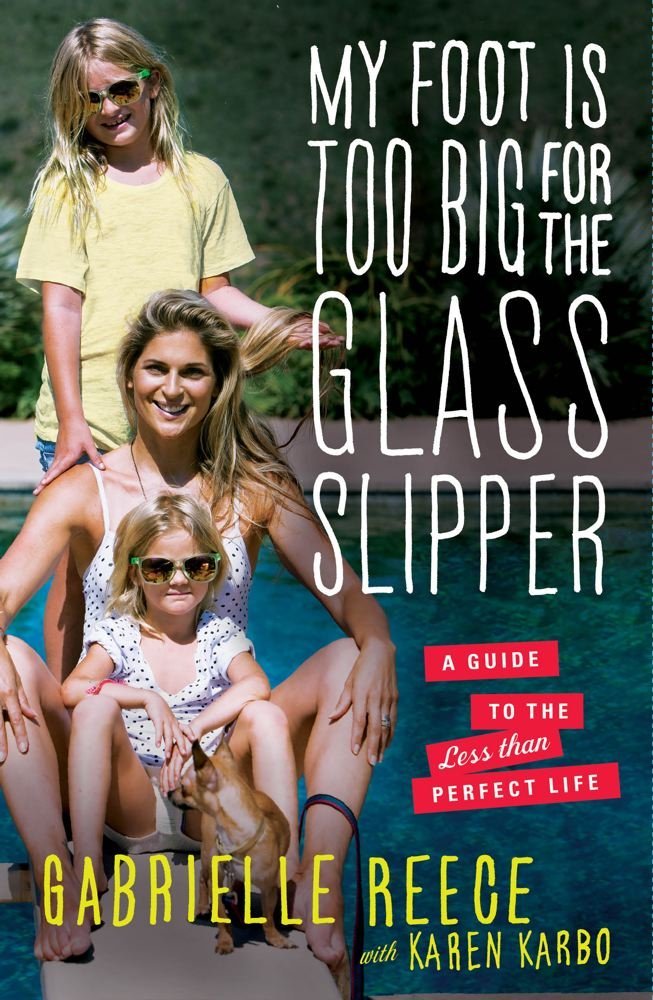
Tripp: All right, you've done a lot. Pro volleyball, modeling, mother, wife to Laird Hamilton, who we recently had on the show. And now you're promoting your new book, *My Foot Is Too Big for the Glass Slipper: A Guide to the Less Than Perfect Life*. Gabby, thanks for being on the show.
Gabby: Oh, thank you for having me.
Tripp: So looking from the outside in, it's easy to project that you and Laird have this fairy tale life. You're splitting your time between Malibu and Kauai. You've got beautiful children, amazing careers, amazing looks, but you're letting us in behind the curtain here with your book because it's not a fairy tale.
Gabby: I use my life and my life with Laird as a reference for the conversation about the unfair tale that's put on us, especially on women, that someone's gonna come along and rescue us and then everything's gonna be fine. I think it's an unrealistic expectation. And then I think we, in turn, put it on our male partner, which is unfair. So that was the idea behind the book. And first of all, my life is my reference. But in certain ways I can make the point even better because we're perceived as, "Well, that seems all very perfect over there." I've had people say to me, "Well, you're really tall and you're an athlete, and Laird's really tall and he's an athlete, and you're blonde, you're the perfect couple." And I was like, "And that is what makes a marriage work." So I think it was a really good jumping-off point to be like, "Well, let's look at it. What does make it work? If a woman is physically perfect or the man makes a certain amount of zeros, is that gonna make it work?" I think it's a bigger thing.
Tripp: It sounds like a trap where we're chasing an ideal of success and somehow that's gonna translate to a solid relationship.
Gabby: Everything gets defined by "this is success." Success is a big house and shiny cars and 2.3 kids. And it's a bit of a rat race, the whole grind of it. So both of us, separately and together, have gone, "Well, what's our success as individuals, and what makes us really happy?" And personal accountability and responsibility. I think that's what started this whole thing. I used to write a blog called Death by Domestication, as a joke. Hitting all the marks for domestic living can be very uncreative.
Tripp: Doesn't mean you're gonna be happy, right?
Gabby: Well, yeah. And also, just because you're now with somebody, their job actually isn't to make you happy. And remember, I'm a female, so I'm speaking from that side. But I'm a huge advocate of men. I have a great husband who's a great friend and a great person, and I've learned a lot about men by being in sports, the good and the bad, and by living with Laird. I recently did an interview, and the woman said, "Let me ask you a question. Do you think it's okay to be subservient to your husband?" about another part of the book. And I was like, "You mean if I choose to serve my family, and my husband being a member of that family? Yes, I do." I think that dynamic, me as the female and him as the male, works really well when I play to my strengths and he plays to his. And she goes, "Now, a lot of feminists are gonna get their back up about this." And I go, "Okay. I don't know of a bigger feminist than me." And why can't we talk about it? I think it's become confusing. I think men are very confused. They're like, "Should I tell you you look pretty? Should I open your door? Shouldn't I?" And I think we don't even teach young men about being men.
Tripp: Yeah.
Gabby: I mean all the great qualities of what masculinity is. Sometimes people go, "Oh, men and women," but the real essence of both of those is wonderful. And some of it is funny. There are always jokes. I'm obviously not a mind reader. So I say in the book, be really clear about what you need and what you want, because your guy actually wants to help you, he just doesn't know what. Just because it's obvious to you doesn't mean it is to him.
Almost divorced: resentment and going all in
Tripp: Well, I want to get back to this idea of what I call the princess syndrome, where the guy's gonna come along and save you, the woman. Did you grow up with that story, even if subconsciously, like, once I get the guy and we get married, that's the storybook happily ever after?
Gabby: I think what happened to me was, when I met Laird, who is, in obvious ways and not obvious ways, a pretty extraordinary man, I sort of thought, "Oh, that'll take care of itself now." And it was also the skill set about, well, what happens after? That's where the book starts. Okay, so you have the guy on a big white horse, but now what?
Tripp: Yeah, 'cause you filed for divorce, right? It wasn't a few years in, you were like, "I'm outta here." So what shifted there for you? What had you on that verge?
Gabby: I was 25 when I met Laird, and I didn't have the skills. You're still acquiring skills, I still am, but the skills to maneuver certain things in my personality with his, and his with mine. A few years in, I kind of walked around Laird, around his intensity. At the time, he could be quite moody, and I didn't say very much. Through time I grew to resent that, because I thought, "Now I'm curbing my personality to be with this person instead of speaking up," because I didn't wanna rock the boat or have a five-minute argument.
Tripp: You talk about it in the book, about sucking it up, kind of from an athletic perspective. You play through it. But sucking it up in a relationship just sounds like it leads to that resentment, and that's what had you leaning out the door. Is that right?
Gabby: Yeah, I think that was part of it. And I have my own things, my lack of ability to really be vulnerable. Obviously it always takes two. So I was doing things, or not doing certain things, that would have enhanced the relationship, and that brought us to that point.
Tripp: Yeah.
Gabby: It was pretty rugged. But because we were able to endure it and work through it, we were not only much better off for it, but I think our appreciation for the opportunity to be together got in focus. And I think it still is that way. Both Laird and I understand that we're fortunate to be in our relationship, so we should treat it like that, versus having a chemical reaction with somebody, you get together, and all of a sudden the thing's on its own. It's not.
Tripp: Well, I imagine there are a lot of people listening to this who've got one foot in, one foot out. You can only really speak from your own experience, but looking back, what had you decide, "You know what, I'm all in, I'm gonna really do this now"?
Gabby: Well, to use an analogy from sports, I've been beaten when I played really well and left everything on the court, and I didn't mind that so much. It's when you walk off the court and you're like, "I was tentative," or "I held back." And with a marriage, the time to really try is when you're in it. That means even if you're thinking you want to be out of it, because this is the opportunity. What happened for me was Laird sort of went, "Okay, well, I guess I'm moving on." And when he was almost out of my range, it dawned on me: "Did you really give it everything you had?" And I hadn't. So maybe that's another difference now. I don't just assume that Laird is gonna be with me because we have daughters and a life together. Every day I work for it, and I don't mean that in a brutal way. I'm in this relationship, so why not try to make it the best one I can right now, even though it's the same guy? There he is, same guy. In the book I don't actually give advice. I just share my side, and every situation is different. But first and foremost is honesty and communication, even the really ugly and uncomfortable stuff. I think there's just no way around it.
Tripp: Gotta get it out there.
Gabby: You do, and not building up resentment. And I think the roles and the expectations have to be really clear. If I say to Laird, "I really need this from you," he can say to me, "Well, I can't do that," or "I can do that." And I even think with men and women, men's need for intimacy is different than women's, and it's communicated in a different way. I think that's a very big point between men and women. With my husband it isn't demanded, but I understand it. It's like, here are the eight things I need from you, can you do it?
Core traits versus what you let go
Tripp: Let's talk about that, because you talk about this foundation and having a list of these traits. It's very conscious. My wife and I were very conscious about this going in, but not everybody sits down and says, "What do I really want? What do I gotta have in a relationship or this thing just isn't gonna work?" And if we don't communicate that, how do our partners know? It's a moving target for them. So talk about that list of traits. Was that something you came up with after you'd been together, or something you knew coming in?
Gabby: No, mine's after. Laird was a surprise for me. I wasn't looking for something. I certainly wasn't anticipating meeting him. So this is something that came into focus when you're in a relationship with somebody and you go, "This person has all of the qualities that are imperative to me." Honesty, humor, whatever anybody's thing is. Some people, it's financial or spiritual, whatever it is. So I really came into touch with the core qualities that I felt were important for me in a partner. And then I learned to let everything else go. The other things, I was getting worked up about or overanalyzing.
Tripp: Can you give us an example of what had to be there, what was essential, and what was something where you thought, "You know what, I'm not gonna sweat that"?
Gabby: Yes, and they're connected. Laird is a very intuitive and genuinely strong person, male, who is connected to nature, to his environment. I grew up in the Caribbean, and for me that felt really important because it felt very grounding and really real. It's something I could look at whether we lived in Malibu or we were in a forest or whatever we were doing. I knew it would withstand all the environments we live in. And what's connected to that is that he's a very restless, yearning, and frustrated person, not in his personal life, but with his connection with nature.
Tripp: Right.
Gabby: I've learned I don't take any of that personally anymore, and I just try to be supportive, and I give him his space. I'm not like, "Oh, I know, it's too flat, it's hot, there's no wind." I don't do that. I don't even get involved. I just silently give him room. It's not about me. So I've learned through time. In my younger time with Laird, I used to think, "If he was really happy with me and in love with me, he wouldn't be frustrated right now." And one is not really connected to the other. As long as he treats me with respect while he's going through that thing that he goes through, that's fine for me.
Tripp: Well, that's a huge turning point. I can imagine for somebody listening, it's like, "I'm not responsible for their happiness." You talked about this a little while ago. We don't really drill it in that if they're not happy with XYZ in their life, somehow it's my fault or I'm to blame. It's so liberating.
Gabby: Well, men wanna fix it and women take it really personally, right? So I think it's a dangerous thing. Now, if you're saying, "The sight of you makes me sick to my stomach," okay, that's a different story. But if someone's just going through it, or they have something going on in their life, or they're making a change, like going from one career to the next, I think sometimes we can't really fix it for them or make it about us. We can be there as silent supporters. Because how many things are we all gonna go through if we're gonna be in a long relationship? Tons.
Supporting each other without power struggles
Tripp: Yeah, you're in it for the long haul. Let's talk about you being supportive, because when Laird was on the show, I asked him about that. It's one thing to support your man if he's playing music, but he's out there doing stuff that could get him killed. So we talked about that. Does Gabby ever get in the way? Is there a cost for you to be supportive, or does it somehow strengthen you too? Because I think for some of us, we think there's this give and take, that if I get what I want, somehow she is worse off. Or is it a both-and for you guys?
Gabby: It's definitely both. And hey, there's a price to pay as it shines the other way back at me. There's a price to pay to be with a guy like Laird. Living with him, the amount of life and energy and passion that he brings into every single day is a gift to everyone around him. But you fly where you fly. You're not gonna be like, "Okay, and now I'd like to have you act like this." It's just not gonna happen. And to be frank, I've learned through being with Laird that I'm not happier because he's doing what I want him to do. Because, again, it goes back to, "Oh yeah, it's my thing." Laird is tough, and it's very clear he's not gonna be talked to in a certain way or dictated to. But I have no interest in that. I want him to be fulfilled in his own life and in his personal expression and with his talents and gifts. And the other side of it is how he handles it. The guy prepares endlessly. He's the consummate professional when it comes to approaching his sport. You never saw somebody more careful, actually, than Laird. So he's also created an environment where I know he's doing everything he can.
Tripp: Right.
Gabby: To be safe, even though his level is, you know, radical.
Tripp: Right, right. Well, I'm coming back to this. Many guys fall into this trap where they treat their wives as their mother or an authority. They say things like, "Well, my wife won't let me do that." And I'm thinking, no wonder you're not getting laid. What woman wants to have sex with her son? Because you've created this power struggle and this rebelling and resentment. But it sounds like for you, avoiding that kind of power struggle is actually a gift. It opens the door for him to really serve you too. Does that make sense?
Gabby: Yes. 100%. And granted, I would like to restate that we didn't get there like we slid into home plate with no problem. We definitely learned through trial and error. But Laird told me once, "I had a mother and she died." And he made it very clear that that was not the dynamic that was gonna work for him. And the dynamic that doesn't work for me is that I don't want to be treated like your wife. I would like to be treated like your woman. It sort of swings both ways.
"Wife" versus "woman"
Tripp: What does that mean, to be treated like your woman?
Gabby: Sometimes when they go, "Have you met my wife?" I understand the point of reference, I get that. But I would say, listen, I'll do everything that a great wife does and beyond. I'll work my tail off for you, but I'd rather you treat me like your girlfriend. Obviously we've been together 17 years, so we're not gonna be like we're in a brand-new relationship. But don't treat me like I'm the old cat that's on the couch. I am your wife, I will act like your wife, I will work hard like your wife, but I look to you to treat me like a woman in my home, by my husband who I am trying to treat well. I always tell my friends, if you want a king, treat them like a king. If they're gonna rise to the occasion, you can help them.
Tripp: Yeah.
Gabby: But I'm not gonna come home and be like, "Something for dinner?" That's not gonna fly with me. So I think it's a two-way street, and Laird is perfectly willing to surrender, kind of. It's just not in his makeup. He had a very strong mother who worked very hard and took care of the house, so his understanding and respect for that is pretty high. I cook quite a bit and put a lot of effort into preparing meals for Laird. But guess what? More times than not, Laird will say, "Gabby, thank you. It was a beautiful meal." And it's not like, "Okay, cue, go." He means it.
Tripp: Yeah.
Gabby: And so what happens is I'm inspired. I always say the language for men is sex and food. How do you show them that you really love them? It's sex and food. And people are like, "It's sex and food?" I'm like, "It's sex and food." I could bring home a big check or do whatever, and it's like, that's nice. But if I make him food or organize food, even if chicks are like, "I hate to cook," I get it, okay, whatever, you're taking care of that part of it. And with the sex, the guy's like, "My chick loves me," and don't nag him for that. It's pretty simple stuff. It's not rocket science. I don't mean bad guys, good guys. I mean guys that are saying, "Hey, I'm in it." Not guys that are in it but have six girlfriends. That's a different deal.
Tripp: Yeah, yeah. Well, I just love that whole "she's my woman." There's an appreciation. There's this person there. "Wife" is a role, like you said, just fill in the blank: here's the woman that does these roles.
Gabby: Well, and by the way, your wife's not going anywhere. In your mind, it's like, "Oh, my wife."
Tripp: Yeah, it's safe, it's over, we did that, that's locked down now.
Gabby: Yeah. But if it's your woman, then if you can nurture that dynamic with your partner, a woman will continue to blossom. Is she gonna be perfectly 25 forever? No. But will she continue to blossom in all of the great things that women can be and are? 100%. So I think it goes both ways. Having said that, it doesn't mean we're on our game every single day. We do have weeks where we're stepping on each other's feet and we're out of rhythm. That happens. But it's more about where you're trying to get to.
Is it a battle? Choosing the harder way
Tripp: How did you arrive at this mindset? Because looking at you, it's not like you came from the Cleaver household. You've been a professional athlete, you've been very independent, you have your own identity, you've been this big star, you've done all this stuff. And then to step into this role and carve out, "No, I'm his woman and this is how I prefer to be treated as a woman, and I cook meals and the sex and all this." I can see the feminists getting their back up a little bit, like, "Don't lose yourself, Gabby, come on, we're rooting for you." Does it feel like a battle? Like you're giving something up?
Gabby: It is a battle. It's a battle not to become a wife and a mother, for sure. But I can handle it. It's pretty rugged. I've been there for my family pretty solidly for the last 10 years, and certainly in my mind I'm like, "Okay, I'm ready to start to branch out." And I'm gonna have to get them prepared and ready. But yeah, it's tough, and there are days where I'm like, hmm. But I wouldn't have it any other way. I consciously chose this path and this situation, so I want to make it as good and positive and happy and peaceful and honest as I can. Listen, it's always the harder way.
Tripp: Yeah.
Gabby: I don't know that the easy way is ever like, "Oh, it was easier and better." It's like, "Yeah, right."
Tripp: Well, when you started out and we talked about the divorce, there was that "I'm not speaking up for myself, I'm not saying, 'Hey, this hurts, don't do it.'" And now I can feel you really claiming your space in the relationship, and that's what has it thriving. Is that fair to say?
Gabby: Well, yeah. I'm in it and I want to do something with it. I don't want it to stay the same. I want it to keep changing and growing, so I have to participate. I have to be thinking about it. What do they say, the one thing that's for sure is that everything's gonna change? So you have to be paying attention. "Oh, that worked. Oh, that didn't work. How could I do that better?" And I don't feel less powerful, because I'm actually trying to make his life better. And what I say to Laird, and Laird says this to me, is, "I'll worry about how I'm acting, and I'm gonna hope that you're making good choices too." Because I can't control them anyway, so I might as well say, "Hey, I'm gonna try really hard on my side, and I really hope Laird is gonna do the same." And of course I picked a person who has that in common with me, so that works out. It's not healthy when one's busting their hump and the other one's like, "Good job." That doesn't work. Eventually someone will walk out the door, or there's resentment. I just wanna leave it all on the court, even in my marriage.
Tripp: I like that.
Gabby: And again, it's like I say about training. I don't wake up every day like, "I am so excited to go work out, I can't wait." No. Some days I'm just getting it done. And in my marriage, it's not like it's so perfect and the birds are chirping and "Okay, darling, have a wonderful day." It's not about that.
Two whole individuals, co-creating the relationship
Tripp: Yeah. Well, that foundation you talk about in the book, this idea of two whole individuals coming to it. What I'm hearing you say is you've gotta be paying attention. You can't rely on this other person to fill in the blanks for you, to figure it out for you, to be three steps ahead for you. You've gotta be the one saying, "What's working? What's not working? Where do I wanna go? Where do I wanna take things?" And then bring that to the relationship. Have the guts to bring that to the relationship. That's how you co-create this thing. It's not, "Okay, we're done, he's responsible for me and I'm responsible for his happiness."
Gabby: No, exactly. And I know your listeners are male, but at the core of it, I actually think a woman who is on it is probably the one who really saves the male. If she's got a good guy, he can be a great guy if he's got a great woman. Because she'll see and go, "Wow, he's really good. I'll help him over here and also create a great environment for him." People might say it's unfair, but I think it's just nature. I don't think the guy's brain is working like, "How can I make my wife thrive?" He might say, "She looks tired today, and these kids are crazy, I'm gonna go take 'em." Okay, good. But on the grand, big picture, as women do 50 things at once and take all things into consideration, I think that's the thing. I've had teammates that made everyone play better. I think Michael Jordan's a great example. So why not be someone in your house that makes everybody else play better?
Tripp: Yeah, how can I contribute? How can I help lift things up instead of me, me, me?
Gabby: Well, and also help people live in their strengths. I'm an imperfect person who makes tons of mistakes. If I was with a different person, I'd probably be a terrible partner. So the point is being with people and helping each other live in your strengths, versus living in your weaknesses. Who wants to do that? I've been a terrible girlfriend to certain people. Terrible.
Tripp: Yeah.
Gabby: So I want to be with somebody who forces me to live in my better side.
Wrapping up
Tripp: Got it. Love it. Hey guys, go check it out. It's a great book: *My Foot Is Too Big for the Glass Slipper: A Guide to the Less Than Perfect Life*. It's available, I imagine, everywhere all over the world. Is that right, Gabby?
Gabby: Yeah, it's out on the 16th, but Amazon's the easiest, I would think.
Tripp: Yeah, Amazon. And if you just go to thenewmanpodcast.com, we'll have a link there for you as well. It's just great to get an insight into this type of relationship. You talked it straight, you use all the good words, and I just love that you're bringing this insight instead of "Hey, I've got it all figured out and now I'm gonna solve all your problems." I just think this is so much more helpful.
Gabby: Well, thanks. You know, I'm fumbling through it, so.
Tripp: There's much to learn. So thank you so much, Gabby Reece. *My Foot Is Too Big for the Glass Slipper*. We'd love to have you back, and please send my best to Laird too.
Gabby: I will. Thank you. Aloha.
Tripp: Aloha. Bye-bye.
Some links on this page are affiliate links, which means we may earn a small commission at no extra cost to you. As an Amazon Associate I earn from qualifying purchases.