
Podcast: Download
How to Be Ultra Spiritual with JP Sears
 When was the last time you laughed at yourself for being a moron?
 Do you feel powerful when you lash out at someone who has offended you?
And what makes judgmental people awful people?
Enlightened author, coach, and YouTube comedian JP Sears is here to talk about laughter, getting offended, and how you can be better than everyone else.
In this interview:
- Why getting offended is therapeutic
- The sexy truth about Tantra and Acro Yoga
- How to tell if you have a “junk food purpose”
- Why you should bury your feelings and stop being needy
- Why you need a male guru
About JP Sears
From JP Sears Website: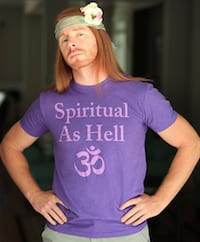 I’m an emotional healing coach, international teacher, world traveler, and curious student of life. My work is intended to empower people to empower themselves to live more meaningful lives.
I run a very busy one-on-one client practice (most sessions are via skype) where I’m fortunate enough to work with people everyday on healing their hearts, resolving self-sabotage, and stepping into their true power.
I also lead retreats around the world on different healing and personal empowerment themes for like minded and like hearted people to come together and learn, grow, and heal.
I also make videos. I’m very active on my YouTube channel, where I regularly release videos to help people help themselves. I also make comedy videos known as my ‘Ultra Spiritual’ series. Aside from the entertainment value of these humorous videos, they also carry important underlying messages (at least I think so, but I’m biased because they’re my videos).
And if the formal credential side of things is important to you, I hold certification as a Holistic Coach Advanced Practitioner through the Holistic Coaching Institute in Columbus, OH. I also served as a faculty member for the C.H.E.K. Institute from 2006-2013. Most importantly, I have red hair, blue eyes, a caring heart, and a warped sense of humor.
Click here for JP Sears book How to Be Ultra Spiritual: 12 1/2 Steps to Spiritual Superiority.
Transcript
Warming Up
Tripp: Hello. Hello.
JP: My intuition and caller ID tells me this is Tripp.
Tripp: Wow. You're for real. You really do have these special powers. That's amazing.
JP: Yeah. I can read caller ID. How are you doing today, my friend?
Tripp: I'm good, man. I'm really glad to have this call.
JP: Awesome. Well, I'm honored you would invite me into one of your offerings for the world, so thank you for reaching out and making this happen.
Tripp: For sure, man. Is there anything that you need from me before we get going?
JP: Oh, brother. I need so much.
Tripp: I'm not gonna say I'm gonna deliver. I'm just gonna throw it out there.
JP: Yeah. What expectations should I have of you that you'll fail to meet?
Tripp: Let's get that out. And then I'll just crush those. Just a crushing disappointment by the end of the talk.
JP: Yeah. I think I'll be able to resent you without needing to share my expectations.
Tripp: Alright. Good.
JP: Awesome, brother. I'm looking forward to diving in with you.
Tripp: Cool. Okay. Here we go. Welcome to The New Man. Today we're talking with JP Sears. He's an author, a coach, a teacher, but he's probably best known for his hilarious ultra spiritual YouTube videos. He's got a new book called How to Be Ultra Spiritual: 12 and a Half Steps to Spiritual Superiority, and you can get that everywhere. If you wanna learn more about JP, just go to awakenwithjp.com. JP Sears, thanks for being here today.
JP: You're welcome. Appreciate you having me, Trent. And you crushed that introduction. You didn't stumble over a single word. That is impressive. It would've taken me, like, ten times longer to ramble out an introduction. I'm really impressed with your reading abilities so far.
Tripp: Thanks. I appreciate you coming on the show, and maybe we'll have you back again some other time.
JP: Well, thank you for having me. I think we've all learned a lot. It's been good talking with you.
The Persona and Humor as a Tool
Tripp: You've got this, I don't know if you'd call it a persona, a split persona. There's the guy who's the coach and the teacher, and then there's the headband with the flower in his hair, enlightened guru type, little deer in the headlights kinda look that we see on YouTube. What had you create this persona? Who's this character to you?
JP: Yeah. It's a condition called schizophrenia, Tripp, and I'm offended.
Tripp: Hold on.
JP: How do you spell that?
Tripp: S-k…
JP: Skits. I think skits starts with a z. Z. Then there's x. Silent x. So I'm offended already. The persona was kinda created by accident, and I think it was an easy thing to create by accident because the persona is just a natural part of me. It's not all of me, but it's a part of me. Slap a headband on that aspect of me, and we have a character. My natural sense of humor has always been dry wit, satirical-ness, if that's a word, and it is now, and deadpan humor. So I just kinda discovered, wow, when I'm doing that, it seems like a character, so let's roll with it. Now I look at the character as a tool in the toolbox to pull out at the right time, in the right situations, rather than every time, every place.
Tripp: Well, I like that you use the word tool, because when I write a book…
JP: I feel insulted. Tool too.
Tripp: It takes one to know one, right? But the thing is, it's one thing for your videos to be funny, but you go that extra step where there's a hint of, I see you. I see our thing that we're doing to fool ourselves, the thing that holds back our personal growth. So you're not just poking fun at some of this stuff, you're actually making a point. I'm curious if you integrate that with the people you work with. I've lived in Boulder, I've been around these ultra spiritual folks. I've been one. And I know when I'm being one is when I completely lose my sense of humor and I'm taking things so seriously. So how do you integrate humor into the work you do with people?
JP: In my earlier life, my childhood, teenage years, my twenties as well, I used humor to escape myself. And I look at humor as a very powerful alchemist. It can be used for good, bad, construction, destruction. So it was very important for me to use humor for the greater good, to help me find more of myself and help other people find more of themselves. I am very intentional with when I use it. And I appreciate you seeing the deeper underlying messages that I embed with the comedy, sort of like the "I see you" kind of thing. That means a lot. Because I do find comedy is a language that connects to a lot of people. I don't watch videos online that aren't funny. Even if it's deep and meaningful, it's boring. People will pay attention to comedy. So what I do my best to do is use the language of comedy to deliver deeper perspectives for consideration.
Tripp: Yeah. I've been in lots of places where I've been facilitating workshops, or people have been helping me work through something, and I always find that when I come up against a big thing, it might be anger that shows up, it might be sadness, but a lot of times it's a big laugh, like, oh my god, you're right. You found me, you saw me. There's a natural expression of laughter there, even when there's tears. I just appreciate that. When I look at somebody like Louis CK or Chris Rock, their way of truth telling produces laughter. They're not just going for, hey, dick joke, dick joke, whatever. They tell the truth so powerfully that the only thing we can do is laugh because it's so on point.
JP: The fool is an archetype that serves the kingdom very well. The fool helps trick us out of our own delusional thinking, helps trick us out of our current truths so that we can find deeper truths. And there's a lot of comedians present day who are acting out archetypally the fool, which is a great service to humanity.
Being Spiritually Competitive
Tripp: I agree. Well, let's dive into some of the bits from the book, because one of the things I wanted you to help us with today is to feel like we're better than everybody else. Already we're talking high level about humor and everything, and we're just like, man, this makes me better than other people, just the fact that I'm sitting here with you. I want my listener to get off this podcast and know that he's better than everyone around him. So what…
JP: Did you say listener, singular? You only have one listener, Tripp?
Tripp: It's Dale. He's in Oklahoma.
JP: So you're going for quality over quantity. Dale, I appreciate you being on this podcast. Wonderful to have you there.
Tripp: Dale's car's broken down. He's not able to go anywhere, so he just listens.
JP: Made my day. I really am worried about it.
Tripp: So let's help him out. You've got this thing in the book, being spiritually competitive. I'm gonna laugh at some of this because it's so outlandish, but what does that mean?
JP: To me it means we're using our spirituality as a trump card to assert our dominance over other people. It implies the purpose of spirituality is to be better at it than other people, so we have to compete at it. It might mean we're meditating longer than them. It might mean we need to tell them how much more enlightened we are than them. It might mean…
Tripp: Which is very enlightened in and of itself, right?
JP: Isn't it though? It's so meta. It might mean we talk in a lighter tone of voice than someone else.
Tripp: Or we do these deep, like…
JP: Mhmm. So yeah, competitive spirituality isn't anything to do with becoming more connected to ourselves, but becoming much more superior to other people via our spirituality.
Tripp: It's like we left New York or LA in that lifestyle to climb the ladder, and then we see the ashram as the next ladder. Like, okay, cool.
JP: For sure. It's like I'm driving down Beverly Hills, you see a Rolls-Royce, so you need to get a car slightly better. It is like that, only it's less expensive.
Tripp: Okay. Wow. There's a big thing about feelings and being needy. I got into spirituality and meditation early on because I wanted to get away from my feelings. I wanted to escape these feelings of uncertainty and discomfort. One of the things you say in here is "burying your feelings alive makes you thrive." How does that help me be more spiritual?
JP: Tripp, it rhymed.
Tripp: So you know, right?
JP: Yeah. Burying feelings alive helps you thrive. What else do we need to say? But I will explain it for you. Our feelings and our emotions are part of what makes us human. And whatever makes you human makes you less spiritual. Therefore, your feelings work against your spirituality. So the best way to rise above your feelings is to pretend they're not there, disconnect from them, and then feel pretend emotions like bliss, ecstasy, nirvana, euphoria, rather than being unevolved and feeling these low vibe things.
Tripp: I'm better than those feelings. I don't even feel those anymore because I'm so spiritual. I don't feel anger or jealousy or sadness, because I'm just beyond that now. Is that what you're saying?
JP: Bury them alive and you will thrive.
Tripp: What about neediness? You talk about amputating our needs so that we're no longer needy. It's really dark, being needy or having needs. What's that about?
JP: When someone's needy, it basically means they're a flawed, defective human being making the lives of everybody around them worse. It's like if someone's drowning and you come up and try to use them as a life preserver. That's basically what you're doing to people when you're needy.
Tripp: Oh, got it. So you're just a drag. Everybody just looks the other way while you're in the pool flailing around because you're so…
JP: So developing the need to not be needy is a good solution to neediness.
Tripp: Developing a need to not be needy. Okay. I can see a little paradox there. If being spiritual means I'm carefree and easygoing, then why, if I wanna be more spiritual, do I have to become obsessive compulsive about the food I'm eating?
JP: Yeah. And specifically, Tripp, obsessive compulsive about eating a vegan diet.
Tripp: Excuse me. I'm sorry.
JP: Developing your veganness is very important because it's more spiritual. The gurus living in India, who've been eating a plant based diet because there's no animals around, are very spiritual, and therefore we need to eat what they eat.
Tripp: Does it make us more spiritual, or does it just help us assert a level of dominance and superiority over others because we don't eat other animals?
JP: Yeah, absolutely. A hundred years ago, disagreements and superiority would be settled by a gun duel, like high noon. Back to back, walk ten paces, turn and shoot each other. And that exact same thing is now executed by asserting to other people how long you've been a vegan.
Tripp: So this is how we'd settle it now. We walk outside and we talk about being vegan.
JP: Yeah, absolutely. I've been a vegan since birth. I refused to be breastfed by my mother because the breast is just vile carnivorosity. The human body is not meant to eat meat or milk or dairy. Therefore, the idea of mothers producing breast milk is just God trying to test our will to strengthen our resolve as vegans.
Tripp: Powerful. I've already seen where I've just thrown away this whole lifetime. I gotta start from scratch on the next one.
Yoga, Gurus, and Judgment
Tripp: Let's talk about yoga. You say that true yoga is only about one thing, and it's ass, aesthetics, and seduction. What do you mean by that? True yoga is only about ass.
JP: Yeah. The false yoga from the Eastern cultures is all about, oh, spiritual development. And they have no regard for wearing skin tight yoga pants that cost $200, which is insulting to the very premise of yoga. They have no regard for the idea that how you look during yoga is more important than the yoga. And they have no idea that a seductive, free spirited personality that manipulates other people is a very meaningful part of yoga. Nor do they know the thrill of being in yoga class. Everybody's in downward dog, you look up, and you see the woman in front of you greeting you with her Lycra-encased genital silhouette. They don't know about it. They don't.
Tripp: They just don't get it. Therefore they're limited. Is that what you're saying? Okay. Tantra yoga is a way to increase our self worth through sex in a spiritually justified way. Explain that.
JP: Yeah, it's good to have sex.
Tripp: Really? So it's not a dirty thing?
JP: No. It's not a dirty thing, and predatory sexuality is best justified as a spiritual practice.
Tripp: Predatory sexuality as a spiritual practice?
JP: Well, it's best to be justified as a spiritual practice. Otherwise, it just looks like predatory sexuality.
Tripp: Right, right.
JP: So tantra yoga is a wonderful expression and cover-up. Bikram yoga is a great way to do it as well.
Tripp: And then it seems like if I'm not quite ready to step into full blown Tantra Yoga, there's Acro Yoga. You say if you crave sexual contact that you can call connection because you lack the self confidence to do Tantra Yoga, then Acro Yoga is for you. What is Acro Yoga?
JP: Acro Yoga is basically the minor leagues of Tantra. You're touching other people, but pretending you're doing it just because you like to stand upside down, balanced off someone's feet. Really, who does that? That's not enjoyable. But you get to touch someone else and, better yet, be touched by someone else while you act like you don't care about the touch.
Tripp: You act like you're not getting views of genitals and butts and stuff.
JP: I have noticed that.
Tripp: Got it. Let's talk about gurus. You say gurus aren't teachers because they have nothing to teach you, and that's exactly what they're trying to teach you through their illuminated teachings: that you already carry your enlightenment inside. You just need a guru to stand in the way between you and your inner illumination to help teach you how to discover it. That's a beautiful way. I didn't realize I needed a guru until you told me I didn't need a guru, and then that's why I need a guru. Is that what you're saying?
JP: Exactly. It's just like when someone's in a low vibe place, like a religion, where they have their priests and their other middlemen. The priest is just getting in the way between you and God. So let's evolve past that into the realm of being spiritual and have a guru who you don't need. And as you pointed out, that's exactly why you need him. And emphasize the him. There's been no female gurus invented. Some estimate that by the year 2043 there will be a female guru. That's, I don't know, a little iffy at this point.
Tripp: Why do you believe that we don't have any female gurus?
JP: I don't orchestrate the whole thing, but this isn't a judgment, it's just an observation: it appears that men are simply more spiritually evolved than women. That's really a metaphor, not to be taken literally.
Tripp: Not to be taken literally. I can see where that might be upsetting to somebody.
JP: Yeah, to some. They're getting connected to their unevolved emotions that should be buried alive, which is just the evidence, case in point, that they're not as evolved.
Tripp: Wow. Love how you just spun that around so that anyone who'd be triggered by that statement is not evolved, and you're more spiritual than them. That was ninja level.
JP: Thank you.
Tripp: Talking about meditation, you say when you're properly meditative, you'll also enjoy the results of having your presence-crushing enthusiasm, ambition, and interesting personality traits heavily sedated. Is that to say that being enthusiastic and ambitious and interesting is getting in the way of us being spiritual?
JP: Yeah. Always acting peaceful, calm, stoic, half asleep is definitely more spiritual. If you're acting excited, it's like, well, bro, you're not really on the ball of your inner peace right now.
Tripp: Okay. Wow. I didn't know that. And I love this thing about judgments. You say in the book that all judgmental people's judgments come from them being awful people. It's not that they're bad people, it's just that they're awful people. I need your help with this. I'm not getting this one.
JP: Yeah, that's all a fact. It's not opinion, it's a fact, and it's my opinion that it's a fact. Judgmental people judge because they judge themselves to be awful people. They just project it out. And the reason they judge themselves to be awful people is because they're awful people. Judging is a very low vibrational, low consciousness frame of mind to be in. Personally, I judge myself to be very nonjudgmental. And because I judge myself to be very nonjudgmental, I get to think I'm nonjudgmental. And therefore, if I were to judge, which I won't, but if I were to judge, I would judge my nonjudgmental self to be superior, more evolved than judgmental people. But that's all hypothetical, because I'm not even saying anything, I'm just talking about how I would judge, but I'm not actually doing it. Because I don't even know how to judge.
Tripp: Wow. It's so powerful that you're able to own that, your not being judgmental and others being judgmental. I'm getting such a transmission right now. I'm kinda getting in tears.
JP: It takes a lot of humbleness for me to be able to notice how nonjudgmental I am, and I'm actually more humble than anybody else I know.
Losing Yourself on the Spiritual Path
Tripp: Oh, man. We just picked through a handful of my favorite quotes from the book. I laughed a lot while I read this, but I also got just how much you get it, how much you really understand how people will take even the things we're learning on the personal growth or spiritual paths and use them to mind fuck ourselves. I think that's the correct term. If anybody wants to really understand our path, they would do well to have a laugh and read this book. It's fantastic.
JP: Thank you for that. With the book and with virtually any comedy video I make, one of my strategies is to shine the light on the hiding places where we lose ourselves. It's for the purpose of self awareness and for us finding ourselves more. Everything I talk about in my book is important to me. Meditation's important to me. Yoga's important to me. And these are things I've spent years of my life losing myself in. Being able to shine the light on, wow, here's how I've lost myself in the meditation world, here's how I've lost myself in the competitive spirituality mindset, is therapeutic for me, and it just so happens that apparently other people do it too.
Tripp: How did you lose yourself? What did it look like? I could imagine a guy out there who's on his path, reading the books, doing this and scheduling an extra retreat, and he doesn't see that he's lost it. Give us something practical. What did it look like for you to lose yourself in one of those places?
JP: A lot of it would be my self righteous judgmental mindset. I'd look at people around me or, god forbid, I go visit my family, and it's like, well, these unevolved people, the way they live, they're eating this crap food, and they're so unconscious, and they're so caught up in the material world. After, I don't know, ten years of doing that, I'm like, holy shit. I'm a judgmental bastard. And I really pretended I wasn't, because the self righteousness blinds me to my judgment. The self righteousness that says, I've got it figured out. I'm living the right way. They're not. And then having this condescending attitude, looking down on people. I'm like, holy crap. I think I'm the spiritual guy, but that's the most unspiritual thing I can do. So I do believe the path people take will become the path they lose themselves on unless they bring new levels of self awareness to wherever they're at. One of the challenges of losing ourselves on this spiritual path is that, one, we don't see it, and two, we think we're finding ourselves more while also losing ourselves. We're probably simultaneously getting benefit from whatever the hell our spiritual practice is. But what's the shadow side? How are we losing ourselves while thinking we're finding ourselves exclusively? That's why it took me ten years to even remotely consider, wow, am I losing myself a little bit here? It's an interesting sleight of hand. There's no bell that goes off, ding, ding, ding, hey, JP and Tripp, you're losing yourself. It's just a very subtle sleight of hand. It's so hard to recognize, and it's very humbling to see it once we're able to. And I think that's why some people need to get offended. It's like, I'm gonna get offended because that's very true for me, and I'm not ready to look at how that's true for me, and I'm not really ready to own it. So instead I'll get offended so I can deflect outward and be angry at you instead of being humbled about me.
Why We Get Offended
Tripp: I wanna dive into that, because there is this rash of, as if being offended was somehow a real crime. There are people who say, that offended me, and it's like, oh my gosh, we'll call the authorities. We don't get curious about that. And what you're saying is some of us need to get offended because it's going to help us see where we got our head up our ass.
JP: Jesus Christ, yes. I think it's therapeutic to get offended. We all feel insecure about stuff. Welcome to the human condition. And when we bump up against one of our insecurities, being offended is a natural reaction. It can be a call to look deeper inward. If we feel offended, we can say, okay, let me own this. What's this say about me? Or we can completely deflect, play the role of the victim, and say, how dare you have a different opinion than me? How dare you see this thing differently than I see this thing? I'm a victim. You owe me an apology. And you mentioned there's a rash, and I 100% agree. We live in a culture of connoisseurs of outrage. People love to get offended. And I think when people get offended, they are giving their power away. They really are.
Tripp: I think they're giving their power away, but this is also the smallest form of feeling empowered, to rise up and say, you offended me, how dare you? It's this breadcrumb game, instead of realizing, wait a second, that's not real power.
JP: Yeah, our emotions are powerful freaking forces of nature. I think to the degree that we're disconnected from our real core emotions is the degree that we need to feel something, even if it's a junk food emotion. When we get offended, there's a very strong, angry energy that comes through us. And that feels powerful. It feels far more powerful than having zero source of passion in our life. So instead of actually becoming passionate about our fucking life purpose, we get passionate about other people being different than us. How dare you see this? We get very passionate about being offended because we crave the energy of passion. I think we live in a society where we helicopter parent ourselves. When we're offended, instead of fucking owning it, we need to maybe threaten a lawsuit against someone who said something we didn't like. Oh, you think my penis makes me a man, so how dare you? How dare you think I'm what the dictionary defines me to be? You have no right. And it's like, well, maybe, or maybe you just need to be angry because that's how you feel emotions. And talk about me for a second. This is how hypocritical I am. Right now I'm feeling offended by how many people feel offended. I'm fucking angry about it. Tripp, I need therapy.
Tripp: Jesus.
JP: Send the medication my way.
Tripp: There you go.
JP: Have you seen the video I did a few months ago called "How to Get Offended"?
Tripp: No. Haven't seen that one.
JP: It's a parody video that's educating people on how to get offended.
Tripp: Oh, cool.
JP: So I'm playing with this exact topic, revealing the deeper intricacies of why we get offended, and essentially looking the fire breathing, angry, offended dragon right in the eyes and saying, I see you. I loved it. I think it needed to be done, thus I did it. And then, just being immature, there's a video I put out recently on gun control. Did you by chance see that?
Tripp: No. I value my life.
JP: You didn't watch it?
Tripp: You know…
JP: I make videos. I'm offended you don't watch every one.
Tripp: I saw the gluten one. I've seen the bold one. I've seen a few. I haven't seen these two, though.
JP: No. I'm just playing with you.
Tripp: So that you don't think I'm a good host. Wow.
JP: So I put out a video on gun control, and of course a lot of people have dogmatic, emotionally charged opinions about guns. It's like their version of religion. They're so self identified with it, which is cool. But nonetheless, I put out a video calling out some of the dogma. And obviously I knew shit would hit the fan. A lot of people would be offended. Second Amendment right. How dare you? How dare I? I'm exercising my First Amendment right. At the very end of the video, I'm looking right at the camera and I say, if you've been offended by this video, please click on the link below to watch my video called "How to Get Offended" so that you can get more offended. I like how I can use that video as a little pawn in the chess game of not trying to avoid people getting offended, not trying to be intimidated by them, and letting them know, it's okay, you're offended. I don't want to hurt you, but I do want you to look deeper into why you're offended. Otherwise, I think offense and outrage will always be a path of losing yourself when it can actually be a rich path of self discovery, in my opinion.
Purpose, Identity, and Getting Bigger Than the Fight
Tripp: Well, the thing I keep coming back to as you're talking is, if I don't have something in my life that is meaningful and purposeful, then I'm going to seek these small little battles. I'm gonna attach my self worth to things like gun control or whether you're male or female, and I'm gonna use those as battlegrounds to stake my claim and say, hey, I matter and what I think matters. We lose the perspective of what's most important, and we allow ourselves to get tripped up there and get into these pissing matches. I think it's so powerful to recognize, hey, that's not the big deal here. We're bigger than that. If we're getting offended by this stuff, we need to say, what is this really about? It's not about topic X. I've attached my self worth and my identity to this thing, and I've forgotten just how big I am. I'm bigger than those things.
JP: 100%. I think the worst crime against ourselves is when we think we're something that we're not. You mentioned self identification, and we're so self identified with our beliefs, amongst other things. When we're shown, hey, you're not that, you're bigger than that belief, then it can either be liberating or we can react as though our life is in danger. Because if we think we're the thing that we're told we're not, then it's like, okay, now I have to fight for my life. And then we get a sense of purpose: my purpose here is to save my life. It's saving who I'm not, which is also who I think I am. And the idea of scouring the internet, scouring anything to find something to get offended about, gives us something to crusade against, which is…
Tripp: This is where I get to matter.
JP: Yeah. It's your purpose. Again, it might be junk food purpose, but having a junk food purpose feels better than being completely purposeless. Now, just a call to humanity: I don't think any of us are purposeless. I think we all have a very important purpose, yet life feels pretty empty when we're not connected with what our purpose is.
Tripp: Right, so we'll go find that thing that we think is important, attach ourselves to it, and forget that we're bigger than that.
JP: Yeah. And I think we're all guilty of doing that. My intention isn't to criticize people who do that, because I do that. I have compassion for it as part of the human condition.
Taking Yourself Less Seriously and Being Polarizing
Tripp: But it's great to recognize that. It's great to have people around you who recognize, look, this is the thing you're getting triggered about, this is what we all do, and can we laugh at this? For sure. There was a point in my career as a coach where I started to really take myself so seriously. People were contacting me and giving me feedback about stuff, and I was like, oh my god, I'm taking this too seriously. I'm getting worried about offending people. So I created this video as if my computer had been hacked, like the camera on my computer had been recording video of me coaching clients, and it revealed that while coaching clients, I'm drinking Jack Daniel's, I'm watching porn, and I'm advising my clients, like Brett Favre and, what was the guy? Anthony Weiner. I'm like, yeah, you need to send dick pics. This is what goes on. I'm advising Dick Cheney, and these are my clients, and I'm giving all this terrible advice. I remember being so nervous about letting it go and putting it out there, but it was my way of saying, back off. We've got to laugh about this shit. We cannot take this shit too seriously. And I needed that. Since then, I remember there was one guy who was on the fence about working with me. He was getting ready to send the check, and then he went online to look for reviews on me, found that video, and watched it. He said, that's when I knew you were my guy. And I was like, that's what I want. If you don't get the joke, this isn't gonna work.
JP: 100%. It's very authentic to you to be a jokester. And I know you are more than a jokester, but in my opinion, the people who are truly the right clients for you are the ones who will appreciate that joke, because they're a good fit for you. The ones who wouldn't appreciate that joke are probably a better candidate to work with another coach. To me it was very similar when I released my first ultra spiritual videos. I thought they'd be bad for business, because I thought I was supposed to be, rather than who I actually am, a serious guy, a coach working with people emotionally, a spiritual teacher sort of thing too. And then when I released my first comedy video, my schedule got flooded. And I think it's the same phenomenon: people who were truly a perfect fit as a client, who also like to not take their life entirely seriously, who like to laugh at themselves, now they could find me. The perfect clients could find me. There were a lot of them.
Tripp: And it pushes away the people who aren't a fit, which makes your life easier. The thing I'm getting is how it takes guts, it takes fortitude, to be willing to polarize in this scenario. But for me, I find it a much better path than walking on eggshells out in the world, thinking, oh, I hope I don't do anything to offend anybody. I'm actually gonna be more effective, more valuable to others if I walk my path and I'm willing to break a few eggs along the way. Not to be aggressive or try to hurt people, but to not tiptoe around those people who are seeking injustice, who are seeking a reason to be offended.
JP: Man, I 100% agree with you, and it was a journey for me to even halfway embody the beautiful posture that you just described, the posture of, I'm gonna be me, and I'm not gonna apologize for it. Walking on eggshells, people pleasing, to me those are postures of apologizing for who we are. When we hide elements of who we are, when we hide our perspectives, that's essentially us apologizing: yep, this part of me isn't good enough, so I apologize, world, that this part of me is alive, let me try to hide it. But when we just walk, it's like, yep, if there's eggshells that break, then so be it. I'm gonna be me. And I think you had a beautiful checks and balances statement a second ago, which is being intentional. You're not out to hurt people. Some people are, and some people could justify it, like, oh yeah, I'm just being mean, when they're actually intentionally trying to hurt people to get a power trip, or intentionally trying to offend people, rather than just unapologetically representing their truth. So I like that checks and balances system, because someone who's out to hurt other people could easily say these same words: yeah, I'm just unapologetically being myself. It's like, well, maybe you're also acting out the role of the punisher.
Tripp: Yeah, that's powerful. I'm so glad we got into this part of it, because it's one of the things I've admired about you. It's one thing to be funny, it's one thing to know this stuff, but it's another thing to walk it. And that's what I find most of us just want, to give ourselves permission to walk our own path, whatever that might be. Not to be a rebel just to piss on other people and what they're doing because we're tired of how that feels, but to really have the guts to walk our own path. And that's what I see you doing, and I love that it's so entertaining too. So I appreciate you doing that work.
JP: Oh, man. Well, thank you for that, Tripp, and I dare say you and I were cut from a lot of the same human material. I think there's a lot of commonalities in what we do, how we do it, and how we see life.
Tripp: Right on. Alright, this is JP Sears. He's got his new book, How to Be Ultra Spiritual: 12 and a Half Steps to Spiritual Superiority. It's available everywhere, and go to, what is it, awakenwithjp.com to learn more about him. Thanks so much, man. I've really enjoyed connecting with you today.
JP: Absolutely, brother. I'm a little offended that you didn't have my website 100% memorized. But yeah, brother, it's been an amazing discussion with you. Thank you for being you and inviting me along for the ride.