
Podcast: Download
Subscribe: RSS
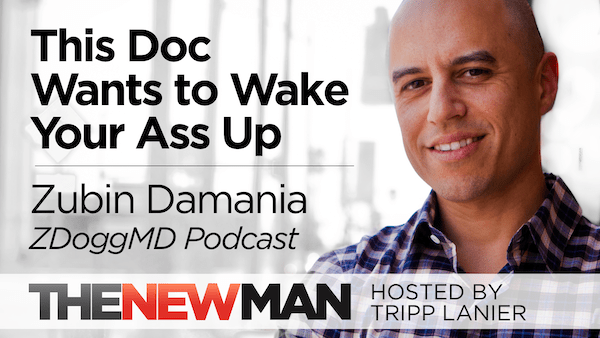
ZDoggMD Zubin Damania Interview
If you say what you truly believe could you lose your career?
Are you playing a role in hopes that one day you’ll finally be free to be yourself?
And is there more to life than seeking and striving for something we don’t already have?
Dr. Zubin Damania is better known as ZDogg MD or to his true fans, Doc Vader. After rejecting the burnout cycle of modern medicine, he broke the mold, found his sense of humor, and started creating some crazy ass videos on YouTube.
Then Covid hit, and he started challenging the way we think about the virus, our tribe, and eventually our understanding of reality.
ZDogg is messy, full of contradictions, and willing to own his biases in service of a greater truth. Today we explore a whole range of topics including overcoming burnout, using playfulness to stay true to ourselves, and waking up to our essential nature.
In this interview:
- Being willing to be hated and misunderstood
- Challenging people to think
- Having fun when triggering people
- Being afraid to say what we believe
Plus:
- Where is your sense of humor in your work?
- How does playfulness make us stronger?
- Rick and Morty’s purge culture
- What’s it like to become a doctor?
- Partnering with Tony Hsieh in Las Vegas
And:
- Dr. Angelo Dilullo’s take on awakening
- Eckhart Tolle’s The Power of Now
- Are you staying alive or coming alive?
- What happens when we allow ourselves to be in the present moment?
Click here to learn more about ZDoggMD.
Tripp Lanier Exposed — The Video That Ended My Career
About Dr. Zubin Damania

I’m a UCSF/Stanford trained internist and founder of Turntable Health, an innovative primary care clinic and model for Health 3.0. During a decade-long hospitalist career at Stanford, I experienced our dysfunctional health care system firsthand. As a way to address my own “burnout” and find a voice, I started producing videos and live shows under the pseudonym “ZDoggMD” that have since gone epidemically viral. This launched a grassroots movement — over a billion views and a passionate tribe dedicated to improving healthcare for everyone. Join the ZPac and help us reclaim our calling!
Click here to learn more about ZDoggMD.
Tripp Lanier Exposed — The Video That Ended My Career
Transcript
Becoming a lightning rod for COVID hate
Tripp: I found out about you through this whole COVID thing, and it was really great to, A, find a voice in the world that was willing to be informed instead of, like, "I'm gonna take a position and then shove it down people's throats." But it was also really relatable. I love that you had some mastery. It was just like, wow, he's taking this really complex information and trying to make it so a guy like me can understand it. But then at the same time, you're wading into these waters where you're just begging to be hated and misunderstood. How did you deal with that? Because I didn't know of you before that. So was life different before that? And then you're like, okay, I'm just gonna become this lightning rod for misunderstanding on both the left and the right as I just try to have a more whole, complete conversation about this topic.
Zubin: Oh man, well, it was interesting because COVID introduced what I was doing to what I call the muggle audience, the non-magical, non-medical audience, right? So we have our little tribe of healthcare professionals who fancy themselves something special. They speak a special language, they trained in a certain way, but it's really a way of distinguishing themselves or separating from the non-magical people. But we all know we're all the same people, right? So early on, my platform was really aimed at those folks, to try to trigger, first of all, laughter. Like, oh, we suffer a lot, let's communalize our pain, let's get together and laugh at the things that are hurting us, but then also let's come up with solutions. So I ran a clinic in Las Vegas, did some different things to say, hey, how can we innovate in a very holistic, disruptive way, using all the usual keywords that people use, but in reality, we're actually trying to do it on the ground. So that was one thing. The hate I would get in that world pre-COVID was very technical hate, like, "Well, but how will you fund a primary care capitated model that focuses on prevention?" Okay, so there's that. But then COVID happens and now I'm like, oh, I can actually use this platform that we've built to educate a broader audience. It wasn't a conscious decision, it just started happening. And then it's almost like you go from the science fair, where you're hanging out with the nerds and they're giving you nerd hate, but it's all done with love, to the state fair, where people are throwing literal feces at you and you're like, oh, this is a different kind of space. At first it's very off-putting because you might take it a little personally and your ego's all offended: these people don't understand what I'm trying to say. And then within five minutes you realize, oh, this is a lot of fun, because what you're doing is triggering people to think about it enough that they're hurling anger at you in a tribal way, in a way that we've encouraged already on social media, this very fragmented, atomized, siloed kind of world we've created. Now you score points socially by leaving that incisive comment. For example, my favorite incisive and very on-point comment left on one of my YouTube videos about something in COVID was, "Why you act gay?" Which I thought was just right on.
Tripp: Why do you? I mean, we've all been wanting to know.
Zubin: I have to keep some things close to the vest. You either act gay or you don't act gay. It's a very binary thing in a world where there's a lot of gray, you know?
From fear-based to authentic
Tripp: Well, you said it was fun and I'm curious how you got there, because I've heard how people are walking on eggshells. They're so afraid to take a position on this virus, for instance, the treatments or whatever, because they're part of an institution. It seems like you've positioned yourself where they can come after you, but they can't cancel you. They can't tear you down, or it only builds you up. I wanna understand this, because you found a way to embrace this friction without it being something that can hurt you. Whereas most people are like, no, I've gotta play this role. It's not really who I am, it's not even really what I believe, but it's too scary to really own what I believe and put that out there, much less change my mind two months later when the data is different. So I've watched you navigate this much differently than other people in your industry.
Zubin: Oh man, you kind of struck at the heart of what I've been evolving towards. When I was a full-time hospital medicine doctor at Stanford for about a decade, you could not deviate from the dogma of that industry, because first of all, you're conditioned in it. You're trained in it, like, this is who you have to be. It's not even, "Hey, who are you? Figure out where you fit in all this." No, this is who you're going to be and you don't deviate from it. Healthcare people are very conditioned. They're also afraid of failure, because failure means somebody gets hurt or you get sued, or whatever it is. So there's a lot of conditioning that generates the inertia that we see in healthcare, and I was definitely deep in it.
When I started doing videos, they were really a kind of cry for help. It was, oh, this is my side hustle, I'm never going to make any money doing this, it's purely to blow off steam. I created this character, ZDoggMD with two Gs, because one is necessary but not sufficient to be a gangster, and all this nonsense, yo yo yo and all that garbage. Even that is a character, right? It's not authentically me, it's a fragment of me. I did that for a long time. Then after I built my clinic in Vegas, we started developing credibility and I started doing talks around the country about this idea of Health 3.0, which is an integral healthcare system, more holistic-minded, prevention-minded, team-based, technology-enabled but not technology-enslaved. We're bringing the human relationship back to the foreground. I realized, you know what, I may actually have something to say that's authentic and unique. But still, I have to find sponsors for the show. I have to be careful, because I monetize it by doing talks for big groups and healthcare systems. If I say the wrong thing, and it's happened to me before, they'll cancel the talk and you lose all this revenue. So you're still fear-based, inertia-based, not being authentic, because you're worried it's going to hit the bottom line and you're going to hurt your family and your team, whose salaries you're paying.
Then something happened. I think it was really once my clinic closed in 2017, because I think we were a little early. Our partners, by the way, who operated the clinic, just merged with One Medical in a $2,100,000,000 deal. And I'm like, shit, I should have stayed with that. But it wasn't me. So we went full Monty on the video thing, starting our show, using Facebook Live and YouTube and all that, in 2017. That's when this slow, inevitable shift to true authenticity started. Where it really pivoted was just prior to COVID. I had people paying subscription fees to be part of an exclusive group where we do live shows, where we just shoot the breeze in a very authentic and personal way, interactive with comments, and that grew to over 10,000 people. At that point, I'm like, I actually don't need sponsorships. The ad revenue from Facebook, where they're gaming for clicks and clickbait, I don't even need that. I can just do this, so guess what? I get to be me. Once COVID hit, that was fully the case. You're never beholden to a health system or an employer, you're only beholden to the audience, and the audience is pretty alt-middle, meaning they just want to look at all aspects of truth. So you may come hard on one thing and then the next week go, "You know what? I was actually only partially correct on that, and here's what I've learned." And they're into that. They actually want what I authentically am to begin with. That was a huge release.
I think the timing of when COVID happened allowed me to do that, in a way that, yes, triggers a lot of hate from people who are siloed, and hate from my own tribe. If I say things early on like, cloth masks don't have a lot of evidence to work in the public, oh man, I got people telling me I was a dangerous criminal for even opening my mouth about that. But I didn't care, because I think this is true. It's still a struggle, because you still have to question what unconscious beliefs and biases you have that are preventing you from saying what you really think is true in that moment, and then owning it when what you thought was true later turns out to be bullshit and you were wrong. And then you have to own that, right? In an authentic way.
The finish-line mentality
Tripp: I think that's where this peace of mind comes from, which is, I'll be okay. Most of us are only in this place of, "I'll be okay once I've got enough money in the bank, once I've got the sponsorships, once I've reached this level. Then I can finally be who I really am. I can finally be whole. I can finally bring my voice to the world." But it sounds like you built this community from a place of venturing into the unknown or the uncertain and speaking what's true for me that day, knowing I can come back and say, "Hey, I've got new information. This is where I stand now." Not "once I get there, once it's all settled and fine and I've built my castle on the hill, then I can finally be okay." Most of the guys I talk to are in that finish-line mentality. I'm going to get there one day, and then I can finally get out of this costume that I wear and give myself permission to be all of who I am.
Zubin: That's a really good insight, in that a lot of people do that, and I'll say I did that, because I went through four years of medical school, three years of residency, and ten years of career thinking, I've got to get to this point where I can be me, and one day it will happen. But you know what happens, Tripp? At some point you realize it's not going to happen. This is a treadmill, this is a hamster wheel. I'm constantly chasing a carrot of this ideal. It's purely a belief in an idea that one day I'll get to be me, or be valued for who I am, or value myself for who I am instead of having to be something else. And it never happens. I think people just continue in their careers, and I could easily have done that and been miserable, where you just play that game and hope for retirement. Well, surprise, when you retire, now you're spinning your wheels wondering, wait, what? You're doing your life review going, what did I do? Or something happens and you realize, now it's not a choice. Either I can be me in some fashion or I'm going to die. I'm not going to survive this, or I'm going to destroy my family, or something's going to happen. And that's when you're forcibly awakened from this delusion that things will only get better in the future, and that now is not the time to do it.
Humor as coping, truth-telling, and release
Tripp: I want to check out the story, because you integrate humor into everything that you do. Typically medical stuff isn't very funny, and somehow you find ways to bring playfulness and humor into all of it. In my line of work, there's not a lot of humor either. Early on, my podcast was doing well, this is over ten years ago, and I was getting emails and I started realizing some of the people listening think I actually do all the things that we talk about. Like I'm living this perfect optimized life. And I was like, I hate this. I'm not perfect. So I created this video as if somebody hacked into the camera up here and caught me coaching people while watching porn and drinking whiskey and doing all this terrible stuff. And all my clients are these terrible people, and I was the one that advised them to do this shit. I put out this video for April Fools and it was so liberating to say, I'm not perfect. I don't practice all this stuff. I'm in it shoulder to shoulder with you, I'm trying to figure it out, and goddamn it, we've got to be playful. We've got to find our sense of humor. So when I saw all your humor, was there ever a point where your humor was not allowed, and you thought, I'm gonna die if I don't bring in playfulness? How did you bring your playfulness and humor into this?
Zubin: Oh man, by the way, I love the concept of that video. That's just awesome. Look, the universe has this huge sense of humor. It just does. It's baseline. And what's funny is it's a joke told by no one for no one, and there's nobody laughing. It's just an empty, beautiful, hilarious joke. I think comedy is that divine connection to that in some way. But it can be egoified and used by our minds in ways that are malproductive. When I was much younger, I used humor as a way to lubricate social connections, because I was this funny-looking, short, kind of chubby little kid growing up in the Central Valley of California, rural Clovis. Easy to get your ass kicked on the daily, like one-hour wedgies around the clock. So I used humor as a way to keep a distance, control an interaction, and lubricate social situations. Instead of being the guy that gets his ass kicked, you're the class clown people wanna invite to the party, not because he's cool or anything, but because he'll make you laugh. So humor was always part of my thing. It was a coping mechanism and a way to keep people a little bit at a distance.
As I started doing medicine, I would still use it, and it would come out in ways that were either productive or malproductive. The productive ways are when it would break the tension on rounds. You see a lot of death and horrible things, young people getting sick in the hospital, and the way you break that tension is with that kind of humor. I used to carry this creepy puppet that one of our patients gave us, this weird hobo-looking ventriloquist doll. I would do rounds with this doll, pretending to be me. It was the creepiest, weirdest, funniest thing. It breaks the tension, but you may say, oh, that's super inappropriate, you shouldn't be making fun of patients on chemotherapy. No, we weren't doing that. We were using it to relieve our own sense of moral injury and burnout. So that was always woven in, but I could never really go full Monty on it until I started making videos. And then the other role of humor is to point out how crazy something is by pointing out the truth of it. The truth is hilarious because it's a paradox. You say we're these great healers and we care about people, and yet look what we do to each other. Look how we treat our interns and our young medical students. And then you laugh at it, because if you didn't laugh, you would cry. So it's always been woven into that fabric. Sometimes, though, I'm a little regretful nowadays because I use less humor. I feel a little bit of the weight of getting older and the weight of responsibility to communicate. Sometimes I feel like being too silly might sabotage a message. So I'm still trying to find that balance.
Tripp: It's tough to do that. At the same time, I do think humor can be used in a beautiful way to really drive a point home. It's such an artful thing to do without bringing somebody else down at the same time. Usually we learn how to be funny by making fun of somebody else. But can we find that playfulness in the paradox? Can we laugh at ourselves? Then I get to reclaim part of myself, because I was scared of that thing and now I can own it again. It's not that big of a deal. I've just appreciated that you've been able to do it. It's inspired me, like, he can be playful with that, and that's a hell of a lot more serious than what I'm talking about on a daily basis. I find that playfulness is where we can allow ourselves to take more risks. Playful is not making fun of anything and it's not being trivial or flippant, but it does remind us, I'll be okay, we'll get through this. When everything's so tense and goes so serious, I think we're a liability to ourselves. And I find that playfulness, if it's done artfully, relaxes things a bit and brings that better part of us to the fore.
Zubin: I love it. That's absolutely true. It's funny, recently I had a guest on my show, Dr. Angelo DiLullo, an anesthesiologist in Colorado, who underwent a profound mystical, spiritual awakening in 1997 and kind of buried it, but continued to explore and never talked about it. In recent years he's been teaching and talking about it in small circles, and he wrote a book. He sent it to me, I read it, and I was like, this is great. It's the most direct pointer I've seen for this very heavy and esoteric topic that is often misconstrued and religified. So I said, come on my show. He came up for a couple of days and we did a bunch of episodes. By about episode five, we're pretty punch drunk. We did a live episode for my supporters and started taking questions, like, "I had this awakening experience, what happens with the ego?" This kind of heavy stuff. At some point we started talking about the area between the testicles and the anus, which has multiple names: the taint, the grundle, the gooch. Many, many names. For about an hour we riffed on the taint and it was ridiculous, just pure improv, a super release of tension. The audience, weirdly enough, was really into it. I haven't released it publicly, but that catharsis of laughter, we had tears coming down our faces and it was a joy. It was also super authentic. It was dumb as hell, and really a release of energy and emotion that builds up. Like you said, that playfulness, that joy in recognizing these weird paradoxical things, like two physicians talking about something ridiculously childish, like Beavis and Butthead, medical edition. People who get it are really going to get it. And there are always going to be people deeply offended by it, but in reality that's some projection of something going on with them and you can't take it personally. Some feedback you do need to take and go, sometimes we overdo it. But you have to be open to it as well.
Play, purge culture, and medical education
Tripp: I've integrated play into a lot of the work that I do, and I wrote about it in my book, but to me it's an indicator, a sign of health in the system. If you watch mammals when they're playing, we're doing good. We don't play when we're starving or freaked out. We play because we've got our needs met, and that's where we actually grow. We find new things to do. You watch otters, you watch other animals, play is where it's at. This is how we know we're doing well. As social creatures, it's an indicator: hey, we're okay, we're gonna get through this, we can be playful here. We're not dismissing anything, but we can find that part of us that is much bigger than what our small self wants us to believe in this moment. To me, play is what helps me connect to that more divine, more absolute part of us.
Zubin: Oh, I couldn't have said that better myself. And I certainly couldn't have, because you're teaching me this. It's beautiful. This connection to the now, it's not a moment, right? It's outside of time, this eternal now. You almost open a hole to it when you play or improvise or channel that joy, and you see it in animals. We used to have a rabbit that lived in our backyard in a wide-open enclosure. When that thing would express joy by running and jumping in the air and tweaking itself like a fricking Tony Hawk skateboard move, it would land and it would just dance. And you felt it as another mammal, you were simpatico with it. Oh, the joy in this animal living right now, needs are met, it's fed, it's happy. You can't underestimate that. And then you can get really nerdy on play, which I'm sure you've done, where you go, this is how mammals and humans learn to take risk. It's where we learn our boundaries and extend them. It's where we become social with others. It's where we stop living in future and past and focus right now. Play is beautiful. And we don't have any of it in medicine, in our training or in how we're conditioned. It either is an epiphenomenon of the people that tend to be open to it, or we force it. It's like a purge culture, Tripp. Medical school's like a purge culture. We repress, we repress, we repress, and then once in a while we're given official sanction to let it all hang out. At UCSF, where I went to medical school, it was the second-year class play. The second-year students, who've been through horrible amounts of learning, it's brutal, a beat-down, are supposed to put on a big play in a big auditorium that satirizes their experience. And man, it's straight debauchery. The satire is edgy, it pushes everything, the professors are uncomfortable, but it's a release, and yet they have to hold it in all that time before they can do it. That's what I mean by purge culture. If you watch Rick and Morty, there's an episode, "This is a purge planet, Morty," where they hold it all in, they repress themselves, they're super tight, and then one day a year they just murder each other in a bloody bloodbath, and that's socially sanctioned.
Tripp: Is there another way for the medical community? Or do they have to go to a model like yours, where it's okay, I've got space, it's part of the plan that I get to express myself, instead of "what's my purge day this year, I gotta put it on the calendar"?
Zubin: You kind of nailed it: our medical education system is built from an ancient apprenticeship guild model. It's not designed for that. The first two years, you memorize a bunch of facts spouted at you from a sage on the stage. It's not interactive, it's just, here's all the information. And it turns out about half of that information is going to end up being proven completely wrong. Of course, they don't know which half, so they don't have the courtesy to tell you. You just memorize it all on faith. So it's not even an inquisitive process. It's just, here's the stuff. Then the second two years are like a guild apprenticeship. The goal is you kiss the ring of the authority figure, the attending physician, so that one day you'll be the ring that's kissed. It's not about questioning authority or disruptive innovation. It's about, let's play the game so one day we'll be able to break the rules. But that never happens, because there are always more rules: then it's the administrators, and then it's the insurance companies. So what we need to do in medical education, from the pre-med era, when we're screening people with these ridiculous tests that have no real correlation to being a good doctor, is teach that being a really good human, having a high emotional intelligence, so that you can use humor in a way that isn't hurtful, like you said, punching down, bringing somebody else down with humor. I've been guilty of this too, because it's low-hanging fruit, it's easy to get a laugh, but it's not a sustaining or healthy form of humor. Really screening for those folks and then encouraging it in medical school and in our own modeling as teachers and mentors would be key, but it's going to be a generational shift. It's going to take some time.
The turn toward awakening
Tripp: Alright, let's see if we can pull an existential hamstring here. Recently you've been on this awakening conversation, which is not foreign to me, it's familiar. But I also thought, wow, I haven't really brought that to my audience. And here you are, with a more medically oriented audience, going in with both feet. I was like, wow, this guy's bringing it. I know you talked a little bit about Dr. Angelo DiLullo and his book and how that's inspired you, but I'd love to hear the buildup to how you've been seeing and experiencing life differently, and saying, I now also wanna bring this to my audience.
Zubin: Man, Tripp, you and I could do a support group of two. When you're interested in this kind of thing, it's all you really care about deep down and you just wanna tell everyone. You and I both have these platforms, and it's like we're using the same microphone, in the same space, from different angles. You just wanna tell them, yo, listen, guys, this is what's going on. But you know that about 90% of the audience is going to be like, "I'm sorry, you lost me on that and I am out." So it's a very tricky thing.
For me, what happened was I was at Stanford, and by year eight of that I was pretty miserable and constantly seeking. Okay, the next thing is I'll get an Acura TL, it'll have leather and that'll make me happy. Oh, I'll buy a house on the hill, that's going to make me happy. Ah, I have all those things, I'll have a kid, that'll make me happy. And it always brings joy, no doubt about it, but there's something always seeking, that constant striving, especially in type A's. It's compounded by deep feelings of unworthiness and inadequacy. The ego's always worried that people are going to figure out you're an impostor and you're worth nothing. So I was really hitting the bottom on that. I started making the videos on YouTube really as a cry for help, and it got the attention of my friend Tony Hsieh. He was the CEO of Zappos. I have so much trouble talking about him in the past tense, because he recently passed away. We were good friends for decades, and we were in the group of his friends who were trying to help. It was so hard to see what happened with him, but that's a whole other conversation. Tony was an amazing, beautiful, awake person. He reached out and said, "I see the videos you're making. You clearly are looking for something that isn't what you have. Quit your job at Stanford, move your wife, who's also a doctor at Stanford, and your two daughters to Las Vegas. I'm investing in downtown Las Vegas, we're building community, and it's got to be authentically you." These were foreign words to me. Wait, you are valuing authenticity and community, and it's not just words? I can tell that you mean it, because I know you. And I know you have the resources to do it, because you're like a billionaire. So is this a thing? Once you get that indecent proposal, you can't sleep. So we did this crazy thing and said, let's leave the Bay Area, go to Las Vegas, and take this huge plunge. My wife was supportive because she saw that I was suffering. She was like, "You're so unhappy. You're thinking, if I just go another fifteen years, I'll retire and I just gotta suck it up. No, you're not. You're going to be dead. You can't do it."
So we went to Vegas, and for the first time since probably high school, I was off the treadmill of achievement. He was just like, take a few months and figure out what you want to do, whether you want to make videos, do a clinic, whatever. I dove into the question of who am I, what is this, what's going on? That's when I got introduced to Eckhart Tolle's The Power of Now. Someone said, "Hey, you should listen to this." And I was like, oh, this is mumbo jumbo new age garbage. After listening to the audiobook, I was like, oh, I discovered something I never knew existed. It's called the present moment. I didn't understand half of what he was saying, and the other half sounded crazy, but something deep inside said, this resonates in a way that nothing has ever resonated. It feels more true than anything I learned in medical school. What's going on here? That opened the door to the transition from the egoic seeker to the egoic spiritual seeker, where I thought, I must figure out the meaning of life, and the striving with an ego to figure that out for the next eight years, meditating, reading Sam Harris's book, A Guide to Spirituality Without Religion, because I was an atheist and all this. That's kind of how it started and then it evolved from there.
Achievement, the egoic system, and waking up
Tripp: So many of my clients could follow that profile. I followed the profile you talked about. This is the thing that's gonna make me happy even though I'm not really happy, and I can start to see how this is gonna play out. There's not really a thing I can buy or acquire that's going to do it. And then it starts you on this other path of more of an inward questioning, right? An inquiry of who am I really. Most of the guys I talk to, if I start to bring that up, it's like, what the hell is this guy talking about? But then they'll circle back around later in the night, at an event or something: "Hey, that thing you were talking about, man, do you have a book you'd recommend?" Because there's a certain part of the audience that's like, you just rang the bell and there's something there for me. And it's not me that's delivering, it's more that there's a whole other world here, other than what we've been fed from day one, which is achieve, achieve, achieve. And there's nothing wrong with that. I think we can still go do great things in the world. But this whole part of answering the question, who am I really, is a whole other ball of wax.
Zubin: It's really funny, because I think to some extent that achievement mentality is necessary. You need it in your life at some point. And again, maybe I'm just rationalizing, like, because I had to do it, everyone else has to do it too. But I think there is a degree of trying to accomplish in the egoic system, meaning this illusion that we're a separate self trying to acquire happiness by getting stuff, getting love, getting sex, success, respect from peers, fame, whatever it is. By at least attempting that acquisition, you realize it is a never-ending hamster wheel of delusion. You may get transient hits of dopamine where you're quite happy for a minute or two, but it doesn't last. And without going through that, a lot of people never reach the realization that I need to wake up to what's actually going on.
So when you talk to people like that, Tripp, because it happens to me, I can turn it on strong and then realize, oh, first of all, I might actually be triggering this person's defenses. They immediately go, "I thought you were cool. I thought you were all about the science, and now you're talking about there's no self? What does that even mean? I've spent my whole life working on this self. I have chiseled abs because I don't eat a carb. That's the self you're saying doesn't exist?" I'm like, okay, never mind, anyway, hey, check out that chick over there. You change the subject. And then you're right, later in the evening they're like, "Wait, so, it's funny, I had this experience when I was a kid where suddenly I was the room, and I can't describe it. I've never told anyone about it." And you're like, oh, that's interesting, maybe check out this book or this. You've sensed that energetic opening, and it's just the most beautiful and fascinating thing. It's almost like we're dreamers whose sole ultimate goal is to wake up, but how we get there, or whether we get there in this go-around, is not determined.
Tripp: Oh, absolutely.
Zubin: Yeah. The ride is such a roller coaster.
Staying alive and coming alive
Tripp: I had Jamie Wheal on the show recently and he said something beautifully, almost offhand. He said we're at the intersection of staying alive and coming alive. I think there's a belief that if I just get really good at staying alive, which is acquiring things, I need this in order to live, well, I must need more in order to live. We haven't really reached that. That's the only game in town, right? Everything's a nail for my hammer. I'm just going to get really good at surviving and I'm going to have more comfort, more certainty, more status. And then realizing, oh wait a second, there's another axis on this chart, which is vertical, and it's the coming alive part. Now I get to do this too. I can go create in the world, bring the cool things that I have into this world, but I can also access this other part and tap into that. And that's where, at least for me, I can be more playful now. I don't have to depend so much on the staying alive stuff to check the boxes. That's more about, okay, cool, the boxes are checked, we got the bills paid, we're all good. Now we come back to coming alive. What am I here to really experience? What's trying to live through me, and how can I honor that? How can I practice and bring discipline to that?
Zubin: Ah, that's beautiful. The Buddhists say in a very wonky way, emptiness is form and form is emptiness. Meaning that aspect of true reality, what we are, I won't try to put words on it, because first of all it sends people down a path of conceptualizing what we are, and I think that's not a great way to transmit that idea. There's an aspect where we feel that sense of I-am-ness, just being-ness. And then there are the structures and functions of the world: the way we're talking, the mouse, the mic, the cup that I'm holding. Those are two sides of the same coin. You can do wonderful things in this manifestation of the world while still connecting and drawing truth and wisdom from that other, unmanifest side. They're the same thing. I think the great philosophers of all time have pointed to this perennial philosophy. To access the deeper parts, some people choose structured religion, some choose inquiry. My own path has been inquiry: let me examine this thing called the present, in this right now.
And you know what's funny, Tripp? I've been hanging out more with these guys who are really good transmitters of that kind of wisdom. They speak from presence, and therefore they bring that deepest part of you out and you're there with them. Sometimes now I'll do a live show from my phone in my backyard, and someone will leave a comment like, "I was just thinking about the present moment, blah blah blah." And I'll go, let's stop thinking. Let's get present right now. Everything will get silent. I'll just make eye contact with the camera and bring myself into presence. The words that come out aren't authored by me. They never really are. It's this timeless moment, and I go, oh, that was a trip, hopefully people don't think I'm crazy. And then I'll get 30 emails: "What did you just do? What just happened there? I've never felt like that. I started crying." And I'm like, that's the presence. That's this beingness that we're pointing at. It can be very destabilizing for people who don't have a container or context for it, which is why a lot of spiritual traditions are very careful about introducing these ideas. But I think in order to prevent ourselves from killing ourselves, we really need to start to explore these aspects of our being.
For the listener: a spectrum of realization
Tripp: What I want to give the listener today is something like, hey, there's probably something else. If it feels like you're beating your head against the wall in this game of staying alive, coming alive is a much deeper conversation. I know for me it seemed really binary. Either I believe in a guy in a robe with a white beard who judges everybody, or I don't believe in anything. And there's a whole spectrum of things to get into, and it might just be right here in this very moment instead of something to chase down and acquire.
Zubin: And one thing I would say to the audience too is there are spectrums of realization of that truth. You may find you only need to go this far to find considerable peace, maybe just a little bit of meditation or mindfulness in the moment, or prayer, chanting, whatever it is. You find your path. Or you may be one of those people that goes very deep down the rabbit hole. One thing that continually presents itself to me is how deep it can go, and how amazingly profound the present moment is when you unfilter it, when you take away the concepts and the perceptual filters we put on right now: projecting into the future, remembering the past, the guilt in the present about the sin we committed in the past, the fear of what's going to happen to us in the future. When we really drill down into the moment with inquiry, who am I, what is this, what's going on, what's revealed is so profound, so liberating, and so empowering of all the things we thought we wanted. Suddenly you're more authentic in the world, and you're more able to pay the bills. It's a weird virtuous cycle that seems to happen.
Tripp: Beautiful, man. I'm so glad we got a chance to connect. I really appreciate you taking the time. This has been fantastic. I feel like I could riff with you for a lot longer. So thank you so much, man.
Zubin: Oh, thank you. It's a real honor, man. And we'll have to do it again if you're ever game.