
Podcast: Download
Subscribe: RSS
Brian Johnson Arete: Activate Your Heroic Potential
Do you ever feel like you’re playing the wrong game in life?
Are you overwhelmed by all of the personal growth stuff you “should” to be doing?
And if you check all the boxes, should life be easy?
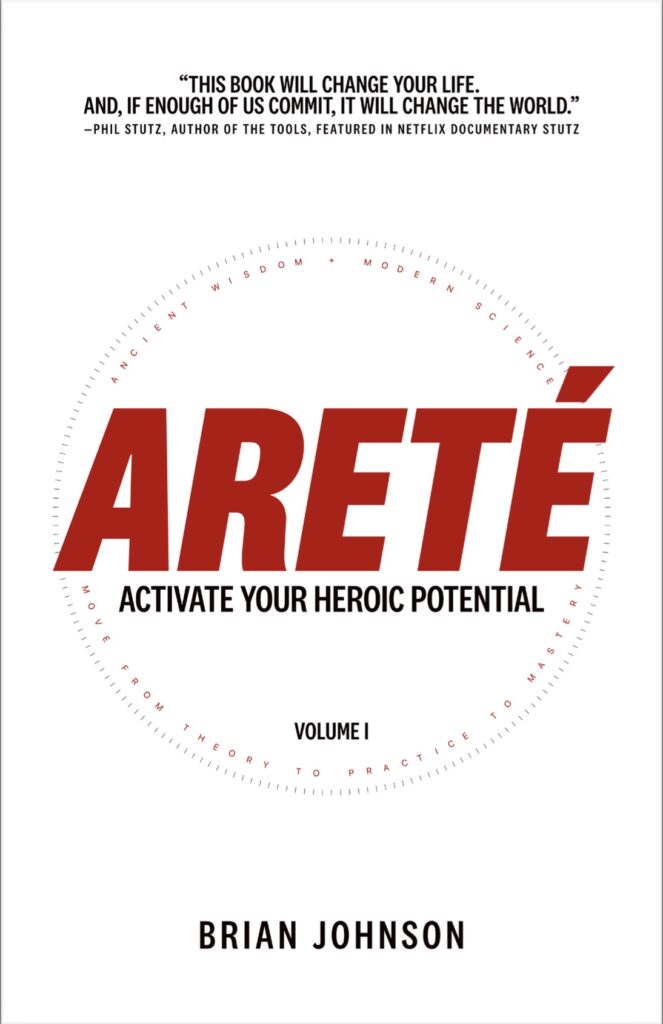
Heroic CEO and app creator Brian Johnson is back to discuss his new book Areté: Activate Your Heroic Potential. Since we last spoke a lot has happened including a challenge that nearly sank his business — and millions of dollars — just two days before their product launch.
Today, we dive into what he calls The Ultimate Game, we learn how our daily choices invite the circus to town, and we hear about the impact of putting his protocol into practice.
In this interview:
- What is Arete?
- Expressing the best version of you
- What is The Ultimate Game?
- Seeking fame, wealth, and hotness
- Are you playing the wrong game in life?
Plus:
- Feeling overwhelmed by personal growth books and podcasts
- Myth: doing it right means life will be easy
- Dealing with a major challenge from the SEC
- People who were planning to end their lives and then turned things around with Brian’s protocol
Mentioned in this interview:
About Brian Johnson

Brian Johnson is the Founder & CEO of Heroic Public Benefit Corporation. He’s 50% Philosopher + 50% CEO and 101% committed to helping create a world in which 51% of humanity is flourishing by the year 2051. As a Founder/CEO he’s made crowdfunding history and built and sold two social platforms. As a Philosopher/teacher, he’s helped millions of people from around the world, trained 10,000+ Heroic Coaches from 100+ countries and created a protocol that science says changes lives. He lives in the country outside Austin, Texas, with his wife, Alexandra, and their two kids, Emerson and Eleanor.
Transcript
Greetings and Getting Started
Tripp: How you doing, man?
Brian: On a Monday morning. Like, who got into my 8:30 a.m. on Monday? Oh, only one guy can do that. Tripp Lanier here. What's up, brother?
Tripp: Aren't you, like, a 4:30 a.m. guy? I figured this is lunchtime for you.
Brian: Yeah. I never schedule anything before ten. I'm stoked that we are connecting and excited to see you, dude.
Tripp: How are you doing, man?
Brian: I'm doing great, dude. Hour meditation this morning. Going deep.
Tripp: Right on, man. Great to be back in the saddle with you. Good to see you again.
Brian: Good to see you, brother. Always have great chats. So many people reached out to me and said, "Wow, that was such a great chat you had with Tripp." I'm looking forward to another one.
What Is Areté?
Tripp: Alright. So the book, Areté, let's approach this as if somebody's never heard of you, never heard of Areté, and isn't familiar with Heroic. The book you've got coming out is going to impact a lot of people, and it's probably going to be the first time that people hear about your work and everything you've got going on. So let's start at floor level. What is Areté? That's a word a lot of us haven't heard before.
Brian: Yeah, which in itself is kind of an interesting reflection on our cultural norms. Areté is the one-word summation of my life's work, my philosophy. It's also the one-word answer that Aristotle would give us if we asked him how to live a great life. It's what the ancient Greeks, the ancient Stoics, talked about. The word translates as virtue or excellence, but it has a deeper meaning, something closer to expressing the best version of yourself moment to moment to moment.
I've got my thousand-second timer going off, which gives me the opportunity to make sure I'm moving. I was sitting and working.
Tripp: Let's do it literally.
Brian: I'm a little behind on my burpees this morning. That would have been the cue, the trigger, the prompt to go bang out eleven more burpees. But anyway, when we live with Areté, we experience what Aristotle calls the summum bonum, the greatest good of life. The word they use in ancient Greece is eudaimonia, which means good soul. We loosely translate that into English as happiness, but it means something closer to flourishing.
I like to say, close the gap. This is obviously just audio, but I draw a line with my hand parallel to the ground at eye level. I say, look, if you're capable of being this in any given moment, and now I've got my other hand coming in a foot below that line, there's a gap between who you could have been and who you are actually being. It's in that gap that regret, anxiety, disillusionment, and depression exist. It's more nuanced than that, but that's where those things live. You close the gap. You actually show up as the best version of yourself in that moment. No one's going to do it perfectly, but the more consistently you live with Areté, the less room there is for all the negative stuff. You experience a deep sense of joy, eudaimonia, et cetera. So that's the long answer to your short question.
Knowing the Ultimate Game
Tripp: I want to come back to the best self, because in our culture we're given an idealized version of the guy that's successful. He's thin. He's got the girl. He's got the title. That's what a lot of us think the best version of ourselves is. How do we approach the best version of ourselves so that it's not this idealized or superficial version?
Brian: Dude, goosebumps already. This is objective one of the book, of our coaching program, of everything I do. Objective one is you've got to know the ultimate game. We've been seduced to play that game you just described. It's extrinsic motivation. The way I describe it is: if you want to be happy and fulfilled, then you need to go for fame, wealth, and hotness. And if you aren't succeeding at that, then you're just not winning.
This is really important, though. Aristotle tells us the ultimate game is to be your best self in the true, virtuous sense of the word. Scientists call that intrinsic motivation. Even if you're successfully pursuing the extrinsic stuff, meaning you have all the Instagram followers and all the square footage you ever wanted in your house, you are less psychologically stable. That phrase always moves me. You're less psychologically stable than people who know the real game, which is: become a better person, deepen your personal relationships with your friends and family and community, and make a contribution to the world, however modestly. Science says those things are unequivocally how you create a life of deep meaning and purpose.
Of course, we've been seduced to play fame, wealth, hotness. But we've got to step back half an inch and realize, oh wait, I was playing the wrong game. Stephen Covey said twenty, thirty years ago that it's like getting to the top of a ladder and realizing you put it against the wrong wall. David Brooks, The Second Mountain, same thing. You get to the top of the first mountain and you're like, "Yeah, I made it." But wait, this is it? This is what I've been working so hard for? It's on the second mountain that we embrace these ideas and realize the ultimate game we've been seduced to play was the wrong one. Then you get excited. You realize, all right, I'm going to focus on these things and create the freedom, the aliveness, the love, the peace, activating your heroic potential in service of your family and community, the way we frame it up.
We've got to start there, because if you don't, you're heading in the wrong direction. And the more successful you are, the faster you go in the wrong direction, and the further you get from where you actually want to be.
Psychological Instability and Joyless Urgency
Tripp: I want to come back to that phrase, psychologically unstable. We're pointing to instability, right?
Brian: Yeah.
Tripp: How do we know if that's us? A lot of times we're just looking in the mirror, checking the box. Hey, I've got the money. I've got the status. I'm important. I must be doing alright. But I may not be paying much attention to my internal experience, that psychological stability. So what does psychological instability look like? How do we know?
Brian: Well, we all experience it. It's the enervation, the burnout, the overwhelm, the "meh, really? This is it?" Eighty percent of us are experiencing some level of anxiety, depression, disillusionment, mental angst. So I think the felt sense is there for most of us. I have it, you have it. We all have it at times. And it's not about getting rid of all extrinsic motivation. There's nothing wrong with fame, wealth, and hotness per se. But you want to know what game you're predominantly playing. We don't need to go 100% Gandhi on it and strip down to a loincloth.
Tripp: What do you think I'm wearing underneath this, man?
Brian: Well, you and I both. Let's go. We've stripped down right now.
Tripp: Me, you, and Ted Nugent. We're in our loincloths.
Brian: Let's go. But all of us are experiencing that on one level or another. For some of us, it's nearly catastrophic. Perhaps we're binge drinking or eating or watching Netflix. Those would be indicators that you're feeling that and trying to numb yourself from an underlying pain you don't know how to describe. So again, step back half an inch and see: yeah, wow, I've been seduced to play that game. How's that working for me? It's not quite it. There's that angst of, I'm capable of more.
Once we get that distinction locked in, we can talk about how you go about winning the ultimate game, playing that one well, and experiencing a lot more joy in the process, more psychological stability, less joyless urgency. That's a phrase I picked up recently. We're just chasing things, including the eudaimonic stuff, like "I want to be my best self," but you can do that joylessly. So how do we bring more freedom, aliveness, love, peace? Those are synonyms for joy and flourishing.
Tripp: I like that we're bringing this up, because for a lot of folks, we can get up in our head about this stuff. But if I say things like meh, depressing, overwhelm, anxiety, it's like, well, yeah, I do have that. And maybe I've been thinking I need to double down and do this stuff more. I'm not doing enough. What you're proposing is that there's another game, another mountain, another flavor on the menu, and we can take a look at that instead of investing even more of our time and energy, which we won't get back, into a game that's not the ultimate game.
Brian: Yep. And that's not going to be easy, but you put the proper amount of effort into the proper game, and then you experience the deep, meaningful, sustainable gains of living a good life. It isn't that it's easy. It's that if you're playing the wrong game, you've been taught that it should be easy. So you go after all the fame, wealth, and hotness, and whenever you face a challenge, something must be wrong with you. Which is objective two in the book. Rule number one is: it's supposed to be hard. So know that you're supposed to face challenges. Nothing's wrong with you because you're experiencing whatever you're experiencing. But yeah, fully aligned.
Potential and Time Horizons
Tripp: One of the things that gets mentioned a lot, even in the subtitle, is Activate Your Heroic Potential. Let's talk about potential a bit, because I can think back to my early days as a personal development jackass, as you called me early on.
Brian: I think you called me that.
Tripp: No, you called me that. It's recorded. You were totally right.
Brian: No, no. Just to be fair, my recollection is I love that phrase and I thought you coined it. Maybe it was in the context of a conversation we had, but I thought we were talking about that version of both of us, and all of us, when we're on that track. Okay. Cool.
Tripp: Yeah, we're on the same page there. It's that part of us that, and this is what happened to me, I read a book. Wow, I get excited. Of course these ideas make sense, and I want to integrate them. And that becomes part of this idea I have about my potential. Then I read another book or listen to another podcast, and it just keeps stacking up. This idea of my potential keeps getting larger and further out of reach, until suddenly it becomes overwhelming. It's no longer inspiring. It becomes, oh my god, I'm a piece of crap. I'm not living up to my potential. Every book I read, every podcast I listen to is making me feel further away from who I think I "should" be. As someone who's read gazillions of books and documented all these great ideas, how did you navigate all of that without it screwing up your sense of potential? Then we'll get into what you mean by potential in your book.
Brian: Well, I didn't. I went through the same thing you went through. I think part of cultivating wisdom is to realize the constraints of our reality. The opposite of wisdom is being foolish. You can bury your head in the sand and not even think about these things, or you can go manic on it and try to do everything you possibly can. Both sides of that virtue of wisdom are vices, of deficiency and excess. You can be foolish in wanting it too much and not embracing the constraints of reality. This is one of the big challenges of self-development: to bring joy to the process. But I would argue that for me, my experience of suffering came when my time horizons were wrong. So what I'm suggesting with Areté…
Tripp: What does that mean?
Brian: I'm going to walk that out. There's this moment in which I can be my best self or not. Then there's where I think I should already be. So I look back and I'm like, dude, I've been such an idiot. I have not shown up the way I should. I'm now 49 years old. I can't believe I haven't done this and this and this, because that person's done that and that and that. And I hate myself. That's the wrong horizon. And then in this moment, what do I do? I don't close the gap. I go drink. I don't drink, but I would go drink or watch Netflix or do whatever to numb myself, yell at my kids, or whatever. Because my time horizon's wrong, I'm looking back and saying I'm not enough yet. I should have already achieved all these things. And I'm ignoring this moment, which is the only moment in which we can show up as our best self.
I'm talking potential right this moment, right this moment, right this moment. If you string enough of those together, that big opportunity to grow into your best self becomes more likely. Then, on the other horizon, there's looking forward and feeling such a huge gap between where you are and where you want to be that you just give up. Again, you forget that this is the moment to put on your socks, John Wooden style.
The way I'm trying to frame it up is redefining what it means to be a hero. As you know, the word means protector. It's not a guy with a million Instagram followers. We can all be the hero we've been waiting for. It's this moment in which we close the gap and express the best version of ourselves, and then we are heroic. You don't need to wait until you're a bestselling author. You don't need to wait until you're on Oprah. You don't need to wait until you've checked everything off your bucket list. We've all felt the moments in which we've shown up powerfully. We've strung together a few days of doing the things we do and being our best.
When I felt overwhelmed and just wanted to give up, then you go nihilist on it. You say, screw it, everyone who's into that is an idiot. Then we get really weird with our ambition. We see everybody else who's doing those things and think something must be wrong with them, they had an unhealthy childhood or something. That's our own disintegrated sense of what's possible. But don't ignore the fact that, as Maslow says, what one can be, one must be. Your potential is there knocking on the door no matter what, and it's not going away. If in a given day you choose not to step forward into growth and you do the thing you know you shouldn't have done, you're going to want to numb yourself at the end of that day. There's always that whisper of potentiality in any given moment.
We need to do the hard work to figure out how to integrate that without either giving up on everything and becoming a nihilist, a cynic, an overcritical person who disassociates from their ambition, or going the other way, burning ourselves out, bringing a joyless urgency to the process, always chasing the next thing but not savoring who we are, what we've done, and what we're experiencing in this moment.
Tripp: My takeaway, and I'm a bit more of an experiential type, is that I've got to pay attention to what's going on in my body as I approach this stuff. If I'm feeling that overwhelm and that yuck, that's information. That's an indication that something's off and I want to take a look at it. If I'm going in the other direction and I'm feeling that yuck, I'm off. But if I'm finding my lane, then there's a bit of zest there. There's a bit of "oh, this is fun and I can do this." But I've got to be willing to be more in my experience instead of stuck in these comparisons in my head about where I'm not and where I "should" be.
Brian: A hundred percent. But then your felt experience, both the meh and the "God, I just want to do addictive things," or whatever it is for each of us, is an indicator that your thoughts are off and almost certainly that your behaviors are off. So you want to use those sensations as cues, triggers, and prompts to do some cognitive behavioral therapy on yourself and ask: what thoughts do I have right now that are leading to the opposite of freedom, aliveness, love, and peace? Oh, I have the thought that I should have already been more than I am. Is that helping me? No. And I'm also binge-watching, drinking too much, or spending too much time on my phone when I should be with my kids. Is that helping me experience freedom, aliveness, love, and peace? Oh, no, it's not. The thoughts, the behaviors, and the feelings are downstream effects of something disintegrated, unhealthy, unwise. The cardinal virtue is wisdom, then discipline. You need to know the game you're playing, then you need the discipline to play it.
What happens for some, and I've been in that crowd, though not as much, is you become a nihilist about it. You're like, "F it. All these fundamentals everyone's talking about, those aren't important." I feel more strongly about the fundamentals now than I've ever felt. And there's a joy in the process of connecting the feelings, which I believe are indicators of thoughts and behaviors that can be tweaked. Then you go to BJ Fogg and you realize nothing's wrong with you per se. The fact that you haven't been able to install these habits isn't a character flaw, he says. Perhaps it's a design flaw. I tell a story in the book about me playing laser tag. I had no idea how to play the game and I sucked. It was a lot more fun when I realized how you play laser tag. Life's a lot more fun when we realize, oh wait, this is the ultimate game, and this is how I play it well. And yeah, I feel better when I eat and move and sleep and breathe and focus my mind in certain ways. Then we can control the dials of life. Not in a self-help jackass way or a nihilistic way, but in a very wise, calm, confident, grounded, energized, tranquil way.
But there's no getting around that impulse Maslow talks about. As you satisfy certain needs, and anyone this far into this conversation has satisfied those basic needs, the need to actualize your potential and become that which you are capable of being is as real as your need to breathe. That's how I frame it. It's soul oxygen. If you aren't living in integrity with that, you're going to suffer. But it's not because you didn't do all the things you thought you should do to win the extrinsic games. It's because you're not playing the ultimate game well right now. And you can change that right now, overnight. Let's get a better night of sleep tonight. Turn off your electronics, get an extra hour of sleep. You literally can change your life overnight. It's not easy, but it becomes a simple game. Then you feel more of the freedom, the aliveness, the love, the peace. The avenue to do that is Areté, moment to moment to moment. Am I stepping forward into my best self or not?
You know that too. I know when I'm getting impatient with my kids that that isn't me being my best self. I know when I'm going to email again for the twentieth time in the last seventeen minutes that that's probably not what I need to be doing. My old thing used to be ESPN, and I can give you a hundred other things I currently still do. But it becomes a fun game for us to close the gap more and more consistently and feel that eudaimonic joy that's a byproduct of it.
Energy, Work, and Love
Tripp: So potential from the extrinsic motivation perspective is the stuff, the status, the fame, the significance. And shifting potential, in this language or to this game, is more about honoring who we are on a soul level. There's going to be a rub there. When I'm working with people through this, there's this addiction to "I want the big swing. I want the big impact. I want the big reward." They don't want to do the small things every day. There's a resistance to that because they're so focused on where the juice is. It reminds me of The Matrix, when Neo wakes up and they're eating gruel and he's like, "F this, I want to go back to eating steak and living in the illusion." But it doesn't have to be gruel. There is that point of, wow, it's these little things? What about the big, exciting things? But it sounds like, without the fundamentals, we don't have access to the bigger potential.
Brian: Yeah. We like to break it down to energy, work, and love. I want to take the ambition that one has been putting into all the extrinsic stuff we've talked about exhaustively, the fame, the wealth, and the hotness. I'm not saying get rid of it. I'm actually saying that if you play the game we're talking about, you're going to get more of that. But you're going to realize it wasn't the actual game you should be playing. Paradoxically, happy, joyful people make more money. They experience more success. So all the things you may predominantly want now, you'll get more of when you focus on the things that actually matter. And, oh, bonus, you're going to feel great now, and you don't need to wait until those things happen.
I like to channel the ambition: all right, who are you at your best? Soul level is cool, but even I would look at that and go, what does that mean? So I want to break it down into practical terms. A good life comes down to two things. Freud says, in one of the very few times I agree with him, work and love. If you can show up powerfully in your work, in how you create and serve the world, and in your love, for me as a husband and a father and a friend and a teacher and a leader, you get those two things, and Freud says that's the essence of a good life. I say yes. And if your energy sucks because of poor lifestyle choices, good luck showing up powerfully in your work and love. So let's start with energy, which science says is the number one virtue most highly correlated with your well-being. If your vitality sucks, to be crass and blunt, your life sucks. So prioritize your eating, your moving, your sleeping, your breathing, your focusing, et cetera.
Then let's think about who you are at your best in energy. I'll take all that ambition you have. Maybe you're a triathlete or an Ironman. Cool. But really, is that the proper distribution of your energy, work, and love? Perhaps we take ten hours of training a week out of your energy, do just enough to be dialed in without having to impress everybody with all your outcome goals, and bring some of that into your love. That's almost always the case for the men I work with and anyone who's hyper-ambitious like me. Energy and work are easy for me. For a lot of guys doing what we're doing at a high level, maybe there are some tweaks, but we're okay there. It's the love. How do you operationalize being a good husband and a good father and doing the little things that matter? No one's going to tell you they prefer square footage over connection with their kids. No parent whose kid is going through depression and anxiety or suicidal ideation thinks that's awesome. So let's connect it to the behaviors you've engaged in or haven't engaged in that might be contributing to that instability in your kids. Let's see if those little moments you're giving away in the day to things that aren't that important could be brought back, and you could close the gap this evening with your wife and your kids, or whatever the case may be for your idiosyncratic expression. This is where the freedom, the aliveness, the love, and the peace come from.
There is that gruel trade, of course, but you quickly learn. Seneca talked about this two thousand years ago. How much better, he said, to pursue a straight course, where doing what is best for you is what you most enjoy. You couldn't pay me to not go to bed early. I got nine hours of sleep last night. I'm working harder than I've ever worked. I went to bed at 7:30 after we tucked the kids in, got up at 5:30, no alarm, and I feel great. You could not pay me to stay up and watch some pseudo-hero on a sports field or a Netflix show and sacrifice the joy I have right now, so I can show up powerfully with you. My entire life is architected around this. The things I used to think were chores are gifts. Me working out, the 55 burpees I've done so far, and I'm behind Tripp by 55 burpees. Those are not chores. It's not "oh shit, I've got to do them." It's "oh, I know I'm going to feel alive when I'm connecting with Tripp. Let's go." Each of those things that used to be a pain in the butt now becomes the very way we achieve the things we want in life, on the important yet mundane things. You're getting me fired up as always, but I'd love to hear your thoughts.
It's Supposed to Be Hard
Tripp: I want to come back to a myth I often bump into when folks are getting into personal development, which is that if I'm doing it right, then it's easy. It's a really nuanced conversation. Somehow we're waiting on easy to be the validation that we're doing it correctly, or that we're on the right path. I can see so many instances in my own life, and in yours, where that's not been the case, and yet we're stepping into more challenge in service of freedom, aliveness, love, and peace, in service of eudaimonia, as you say. So let's talk about this myth that if I was doing it right, it would be easy. And how do we make sure we're not doing the thing just because it's hard? There are guys who need to make life complex and hard. There's that thing going on too. How do we figure that one out?
Brian: There are so many threads we can pull on there. There's simple versus complicated, and then there's easy versus hard. I'd start with that differentiation. A good life is simple. It's not easy to create, but it's not complicated. Asterisk, of course it's more complicated and nuanced than I'm describing. But we've all experienced our best. The exercise I do with people is: get a piece of paper out, draw a line down the middle, and put "do" on the left and "don't" on the right. Think about when you were at your best. We've all experienced peak moments and weeks and months. What were you doing? Perhaps you were eating a certain way, moving your body a certain way, prioritizing sleep, spending time with your family, or creating in a certain way. What did you do? And, frankly, more importantly, what did you not do? Those probably weren't the moments in which you were binge-whatever, drinking, eating, watching. So a good life is: do more of the stuff you were doing when you were at your best, and less of the stuff you weren't. The good news is you've already created an experience in your life in which somehow you did those things. We just need to reinstall them and quit giving away your gains. Then you build scaffolding where you're no longer so up and down. You'll still have highs and lows, but that's one way to simplify it.
But before we get to that, your point is the essence of objective two in the book, which is forge antifragile confidence. I have fun with all-caps bold moments in the book. The first one is: rule number one of a good, noble, heroic life is it's supposed to be hard. We've been seduced to play the wrong game, intrinsic versus extrinsic. Then we've been further seduced to think that game should be easy. So you've lost twice. You're playing the wrong game, and you were told it was supposed to be easy.
You had a great line on this in one of our conversations. If you're reading a book and for the hero everything's just going great, or they're not doing anything of interest, would you want to continue reading that book? No. If your life is that, and you're either not challenging yourself or you're the hero who constantly complains about all the challenges, do you want to read the book that is your life? No. Create an authentic life. Embrace the fact that it's supposed to be hard. Then use those obstacles to get stronger.
Since our last chat, I had the best opportunity to practice my philosophy ever. We got a letter from the SEC two days before I launched the Heroic app. Literally two days before I'm ready to finally celebrate. I'm a reasonably high-strung dude before I give big talks, and I was giving a big talk to launch our app. I told Alexander, my wife, on Thursday night, I'm ready. I'm going to enjoy this talk. And then the next morning, my team's out at our house, and I get a delivery from the UPS dude. "Hey, what's up? Made out to Heroic legal department." I'm like, we don't have a legal department. It's from the SEC. I'm pretty sure that's not a winning combination, legal department, the SEC.
In that moment, literally Epictetus comes to mind. He says, when life challenges you, see it as an opportunity given to you by the gods to get stronger. Imagine you're an Olympic wrestler and God gave you a strong wrestler to make you Olympic-caliber material. So for me, I don't reject challenges. I'm trying to do things that are hard. We're going up Everest, me and you and everybody on this call. You don't expect easy. That's the whole point. The weather is supposed to suck at times. But the question is, what do you do when life kicks you like that? For me, I doubled down, tripled down on my fundamentals. That thing that would have crushed the old me challenged the bliss out of the new me. I used it as an opportunity to get stronger, which is a longer chat on how to forge antifragile confidence, where you have what it takes to meet whatever life throws at you.
I have found nothing more powerful in my own personal transformation than the algorithm that Phil Stutz, with whom we've both worked, taught me, which I've operationalized in my own way: the worse you feel, the more committed you are to your protocol. The worse you feel, the more committed you are. Whereas most people, when life challenges them, think it shouldn't be happening. This challenge in my relationship with my kids, at work, with my health, shouldn't be happening. That's a great way to suffer. What if you radically accept it, the art of acquiescence, Stoic style, and say, well, it should be happening because it is happening? Now, rather than spiral out into vicious behavior, I'm going to have the wisdom and the discipline to work my protocol at the highest possible level, because I'm a hero on my quest. God gave me a chance to practice my philosophy. Long, winding answer, but we've got to embrace the fact it's supposed to be hard. Then we use those challenges, Ryan Holiday, The Obstacle Is the Way style. The obstacle becomes the way. It becomes the fuel for your fire if you use it appropriately.
Choosing from Your Best Self
Tripp: There have been places in both of our lives, and in many of our lives, where it gets hard and it's an indication that it's an opportunity to course correct. So I'm wondering if we can speak to that. Knowing that, you know what, this is the end of this cycle. I don't need to double down here. Just because it's hard doesn't mean it's the correct thing. Can we speak to that a little bit?
Brian: Really important distinction. We've trained 10,000 coaches in 100 countries. I do daily coaching at 1:01 p.m. every single day. I show up for everyone in our community and I coach someone. They'll say, "Hey, life is happening to me. It's really, really hard." And they want advice on the specific thing. Of course there are times in which we leave the thing or the relationship or whatever. But I always start with the same exact question, which is: all right, cool, how are your fundamentals? Because if you are being pushed to make a decision like that, you'd better be connected to your best self.
Again, eudaimonia means good soul. The ancient Greeks and Stoics believed you had a guiding spirit, your daimon. The Romans called it your genius. It wasn't "you are a genius." Everyone had a genius or a daimon, a guiding spirit. Your job in life, Desmond Tutu, Richard Rohr, the great Franciscan monk, says, is just to plug in. You're the little light bulb experiencing life, but you want to connect to the divine force. Ken Wilber would say the same basic thing. So your job in general, and especially when you're getting your butt kicked, is to slow down and do the simple things that allow you to create a really clear communication channel between your best self and your little self. The diminutive of daimon is demon. So it's virtue, daimon; vice, demon. We each have those voices in our head. The question is which one is driving the show? If you're following the demon, good luck.
To conquer any challenge, and mine are different than yours, everyone is facing challenges, independent of the specific tactical decisions, we want to dominate our protocol. When I say double down, it wasn't doubling down on that thing that maybe I shouldn't double down on. It's: I'm going to double down on making sure the best version of myself is showing up. And it's silly things. At the time I was meditating for an hour in the morning and an hour in the evening. I'm eating clean. My protocol went up at that time, not down. That's an important thing the old me would not have done. I'm going to bed right when I say I'm going to go to bed. I'm moderating my tech inputs. I'm not blowing my consciousness up. I'm trying to be a good husband and a good father in those moments in which I used to break and I was fragile. I want to become antifragile. The opposite of fragile is antifragile. It's exhilarating when we make that algorithmic shift. The decision your daimon counsels you on might be to leave that job or that relationship. But you can't make that wise decision from my vantage point alone. You need to connect to the best version of yourself. And, paradoxically, do it via the most mundane, unsexy, simple fundamentals that help you feel alive and connected.
Tripp: My big takeaway from that is: who's answering the question? If I'm thinking about making a big change in my life, to leave or stay, I want to have the biggest, best version of me there, the core self as much as possible, the deepest wisdom available, instead of the reactive part of me that's exhausted and poorly resourced. It's my job to make sure I'm bringing the biggest, best version of me to that significant conversation. Then I can lean in on that and say, okay, from this perspective, how do I want to approach this challenge, instead of "I'm tired, I'm over this crap, I'm out."
Brian: "Screw it." And then you're showing up, and the joke I have is that you invite the circus into town. Then the clown show comes up: "Hey, I'm going to go do this and this and this." Everybody knows that's not the time to do that. But if we can muster just a little bit more of the self-mastery and discipline, and practice a lot more intently and aggressively… It's weird, because it's not easy, but it becomes more effortless. This is the ancient Chinese philosophers. Effortless action was effortless, virtuous action. It was effortlessly expressing the best version of yourself, where these guys didn't need to work at it. I'm not working at it now. My basal ganglia is programmed, not all the time, but 80% of the time. It would be harder for me to not do the thing that used to be impossible to do than to do the right thing. Confucius, Lao Tzu, that's what they were trying to do: cultivate this ability to effortlessly show up as your best self, to live with virtue, to live with Areté.
When you do that, you have what they called moral charisma, which I call soul force, the seventh objective. We all have the same superpower. Right now you have this sense, and it's why people come to you, of integrity between what you say is important to you and what you're doing. You are showing up, not perfectly, but more and more consistently as your best self. The ancient Chinese philosophers trained the ancient Chinese leaders because they all wanted that, because we're neurologically programmed to follow people like that. As you do these things, you'll still have challenges. Hopefully they'll get bigger, frankly, and more frequent, because you're taking on bigger challenges and you're capable of dealing with them more gracefully. People want to follow you, whether that's your clients, your colleagues, your supervisors, your spouse, your kids. They'll feel something in you. It's exciting. Now we're jumping around to basically everything we've framed up in the book, but this is it.
Coaching and Being Client Number Zero
Tripp: When I work with other coaches, that's where I drum it home. Our job is to tune ourselves to that frequency. Our job is to invite people into that. It's not so much that we have to have the answers for them. We just invite them into that space with us, and then they can access it for themselves. We don't have to do the heavy lifting. When they can access that deeper part of themselves, they can drive their lives or find their way in that. But it's our job to create that environment and that container for them to meet us there.
Brian: And to be the demonstration of it. The way we frame it up for our coaches is: client number zero is you, always. As you know, with our program, you have to do the things that we say, theory to practice. You need to meditate every day for eleven minutes if you want to be a certified Heroic coach. I'm not aware of any program that challenges the coaches to actually do the things. It's all theory. We've got to move from theory to practice. You are the embodiment of the ideas and ideals. The only reason someone pays you, or any coach, is that you have something they want more of. So be the embodiment of that.
Help them create the space through your demonstration and through your humble inquiry. I rarely give tactical, prescriptive advice. I always do what I described, which is: how are your fundamentals? "Oh, I'm still eating this and that." Well, what do you think you might be able to do to get a little more energized? "All right, well, my sleep, I think I can dial in." Then I say, see if you can get a good night of sleep tonight and ask your daimon tomorrow morning after you get up. Don't blow up your brain with emails and texts. Ask your daimon what they think. Then do that, not once in a while but consistently, and let's see what we can chip away at. The follow-on question is: what do you want?
At the end of the day, the move from victim to hero is really simple. The victim complains about everything. It's not working the way I want. They're critical, they're gossiping, they get cynical, perhaps even nihilistic, and boom, it all sucks and everyone sucks. Victim to hero is: what do I want? We call it targeted thinking. In any given moment, literally, and in big life decisions, the question is: what do you want? Relationship-wise, job-wise, et cetera, if you could wave a wand and create your ideal, what would it look like? Then what do you need to do to get it? What price are you going to need to pay? What behavior do you need to engage in right now to hold that tension and move toward your ideal? Get the data in as you take action. Your plan won't survive contact with the enemy, as the military says, but evolve and continue to come back to: what do I want? What do I need to do to get it? My number one target every day is getting my own soul force activated, moment to moment to moment. Then I can show up with you right now, and with the other big decisions I'm making throughout the days and weeks as I strive to go out and do something meaningful.
Stories from the Community
Tripp: Let's come back to the book, which is not just a collection of big ideas but the culmination of what you've been learning that actually works. You have the app. You have this community. I'd love to hear some stories about the ways people have turned their lives around or made big shifts as a result of actually doing the things you talk about in this book.
Brian: For some reason, we're able to affect people who are performing at the most elite levels, who are into this and who feel my intensity and passion, like, "Damn, okay, cool, let's go." We take them from already extraordinary performance to the next level, in sports, in the military, executives, et cetera. But what really moves me is the people who wanted to end their lives, who had plans to end their lives. We have a couple of videos that come up in particular, of a couple of women. One woman said, "I was going to kill myself. I had the plan. The vultures were going to come get me. No one was ever going to find me." Goosebumps, tears in my eyes. Then somehow she found me and the work, and it gave her the stability to move through.
I talk a lot about my own challenges. I wanted to end my life, as you know, twenty-five years ago. That was all I could think about. I know what it feels like to grow up in a household with an alcoholic father whose father was an alcoholic who killed himself. My joke is I lost the environmental and genetic lottery on that one. I know what it feels like to want to end my own life. I also know what it feels like to still have highs and lows, because I'm human. Everyone does. But I know what it feels like to create a life of deep meaning, and I know what it felt like to feel I never could. I have a decent sense of what I did to step out. That's the heart-opening reason why I work so hard, dude. Let's go train people to show up as their best selves and help people across that spectrum. Those are some of the stories that really impact me and drive me: to ground our ambition in something bigger than ourselves, to have our kids in mind when we're making decisions, which is my biggest challenge, being the guy I want to be for my two kids, 11 and 6, thinking of these people we're serving, and then going all in unapologetically.
You're in the book, you know. You're the longest passage in the book. I could have paraphrased it. I thought, all right, my buddy Tripp said this, let me give you my take on it. I'm like, no, Tripp said it so great. Here's what Tripp has to say. You hold the intensity with the fact that you're not that big of a deal. None of this stuff matters at all, and simultaneously nothing is more important than us showing up in this moment, especially today, with the circus that is our world as it continues to go next level in horror show and tragedy, just when you think it's reached its apex of terror, literal and metaphorical. That's what I think of with the community.
The Heroic App and Its Impact
Tripp: I've had a chance to meet a lot of folks in your community. I've interacted with them on the coaching calls, and it's exciting to hear people's stories and how you've inspired them, and how the community as a whole is lifted up by it. It was really inspiring. We haven't had a conversation on here since the app was launched. When we were having those conversations, we were talking about your process of raising the money and how it was impacting you individually in your own growth. In a nutshell, what has been the impact on you since the launch of the app and now into the launch of this book? What's been going on underneath the hood for you?
Brian: Growth. We mentioned the letter I got two days before the app launched. Then, of course, the markets completely changed. They went from historically frothy, liquid capital markets to one of the worst, at the same time that we received this letter. We navigated that process. It usually takes twenty-four months. We did it in eight. The firm we retained, who's the best in the world at this stuff, hired me to keynote their partner talk after we went through the process, because they were juxtaposing emails they got laced with F-bombs against how we were showing up. I was trying to work the protocol, antifragile-confidence style. That was fun. It gave me an opportunity to triple down on my protocol. We launched the training side of the app, as I discussed, right before we got that letter. Then we just launched the social private beta literally last month.
The app, to recap, helps you get clarity on who you are at your best in your energy, work, and love. We help you create identities. Identity literally means repeated beingness. You have a self-image and an identity that you will never outperform. You want to get clear on who you are at your best. You want to identify the virtues you embody when you're at your best. Then you want to know the do's and don'ts that you will do consistently. So: energy, work, and love, identities, virtues, your top three targets. It's hard to have a bad day if you know who you are at your best and you do the few simple things in energy, work, and love. You'll still have highs and lows, but you're not going to go off the rails if, after a kind of bad day, you recommit. It makes it more explicit what you're specifically going to do.
For example, in love, I look for moments to connect with my kids without the phone, with my wife, and with my mother-in-law, who spends part of her time in the little tiny house on our property. She didn't know I had the app. In the morning I was saying, all right, I want to make sure I create a moment of awesome with my kids and with her. I'm a reasonably introverted guy who can get stuck in my head. It's easy for me to miss opportunities to connect with her and with my kids. So I use the app to commit in the morning. It takes me seconds. I'm going to find a moment with Nama, which is what the kids call her. Three days in, my mother-in-law says to my wife, goosebumps, tears in my eyes, "Something's different with Brian." She's amazing. I'm a decent guy, Tripp, but I can be that guy who's busy and just doing my thing. That moment was one of the most profound for me. It gave me confidence that we've got something.
We've had science that's proven it. Depending on the study, if you use the app, you'll be 23% more energized than if you don't, if you hit one target in the app. We can move people, scientifically, from the fifty-third percentile to the seventieth in thirty days. Fifty-third percentile is average. These are normal people who'd never heard of me before. I'm really proud of that. It's affected me deeply. I hit 101 targets. I do the things we're talking about. I know who I am at my best and what I do, and I do those things every single day. It's given me a sense of calm confidence, an antifragile "let's go," a groundedness, and a joy that's been exhilarating.
Now we're really excited about the social side. I think that's going to be the most powerful thing, where your community can connect with one another and with you. Outside of TikTok and Facebook and Instagram and Twitter, or X, or whatever it is now, what if we had a social platform where we're sharing these ideas? You're seeing my protocol, I see your protocol, your community sees other people's protocols. Our coaches are using, and will use, the app to coach their clients. One of our guys coaches some of the most elite sports professionals in the world, and he's using Heroic. Who are you? Energy, work, and love. Before coaching sessions, he's looking at whether they did the things they said they would do. It's like a habit-tracking tool, but it's virtue-based, with all the other things we've talked about. I think this time next year is going to be super cool as the social platform launches. And I hope the book is helpful and lets people know more about who I am beyond a podcast chat like this. The app's a bit abstract. The book is a very concrete way of saying, hey, people read books, well, here you go: 451 of my all-time favorite ideas that will hopefully help you move from theory to practice and come closer to activating your heroic potential, as we say.
Facing the Near-Catastrophe
Tripp: Right on, brother. By the time our conversation comes out, the book will be available, and it's a great addition to everything you've created. I just want to say that you continue to inspire me, especially in how you deal with challenge. I remember all that happening a while back, and I was like, wow, that would just be a real punch. And it all happened right before you headed on stage. I was there watching you go through that challenge and manage all of that stuff, and all of the people, all the energy, knowing that you're not quite the people guy that some others are. I really appreciated your ability to lean in during that time, because I think it would have devastated most folks.
Brian: I appreciate that. And just to give concrete numbers to it, I was raising $15 million. I had built the entire business assuming I'd raise $15 million. I had that money committed. I had $5 million in. I literally signed contracts and built the business to support that. And it wasn't there, because the letter we got prevented us from doing the fundraising. So I had to rebuild the entire business in that moment. I want to be really clear: it was hard. I did the hard work to show up, but I tattooed my body with Heroic, dude. There were moments where I'm like, what did you do, man? It was potentially catastrophic. The metaphor was on Everest, huge storm. People got blown off the mountain. Supplies were gone. What are we going to do? I nearly wept more than once. It was hard. And yet I practiced the philosophy harder than ever. There was no going off the rails for me.
This is what gives me so much, at the risk of being immodest, personal confidence that I can handle whatever life throws at me. Anything that comes up, there'll be harder personal things, losing people and all those things. But whatever, dude, nothing is going to be harder than that entrepreneurially, at similar levels, et cetera. Most importantly, it works. These ideas, expressed idiosyncratically at the highest level, work. It's not because it's me. It's ancient wisdom, modern science. As you know, and we've talked about so many times, I've read I don't know how many books, and it's what everyone has said across all time: live with virtue, be your best self, here's how. I'm blessed to be in dialogue with you to bring these ideas to life, and I appreciate your kind words. It's me trying to do the thing we talked about, be client number zero, try to practice your own philosophy idiosyncratically, as intensely as I am, with you being all calm and cool and me being me. It's a cool opportunity for us to show up as us and demonstrate different pathways that embody the same ideas to create better, more noble lives and be of service in a profound way.
Tripp: This makes me want to go back to our very first conversation. You were in Bali, and I remember hearing the rain in the background. You'd packed a trunk of a hundred books, and you were going to do a hundred notes. That was a chunk of time for you at that time. I don't know if you remember that guy. It makes me want to go back and listen to that and revisit where you were at that time, because this path and this story has been extraordinary.
Brian: That's so funny. Two of my buddies, former baseball players, make fun of me. I'll make sure they listen to this, and they would have anyway. They used words I don't use in public. I've been told that I've evolved in a few different ways.
Tripp: I did think you were a bit weird. You were the only guy I've ever met who went to Bali to read books and not surf. I was like, wow, that's strange.
Brian: That part of it I'm cool with. I'm just trying to master the craft and get more comfortable communicating all those things. But yeah, love you, brother. I appreciate you. Thank you for doing you, and always great to connect.
Tripp: Yeah, brother. Much love to you. Give your kids a tackle for me and a hug to Alexander.