
Podcast: Download
Subscribe: RSS
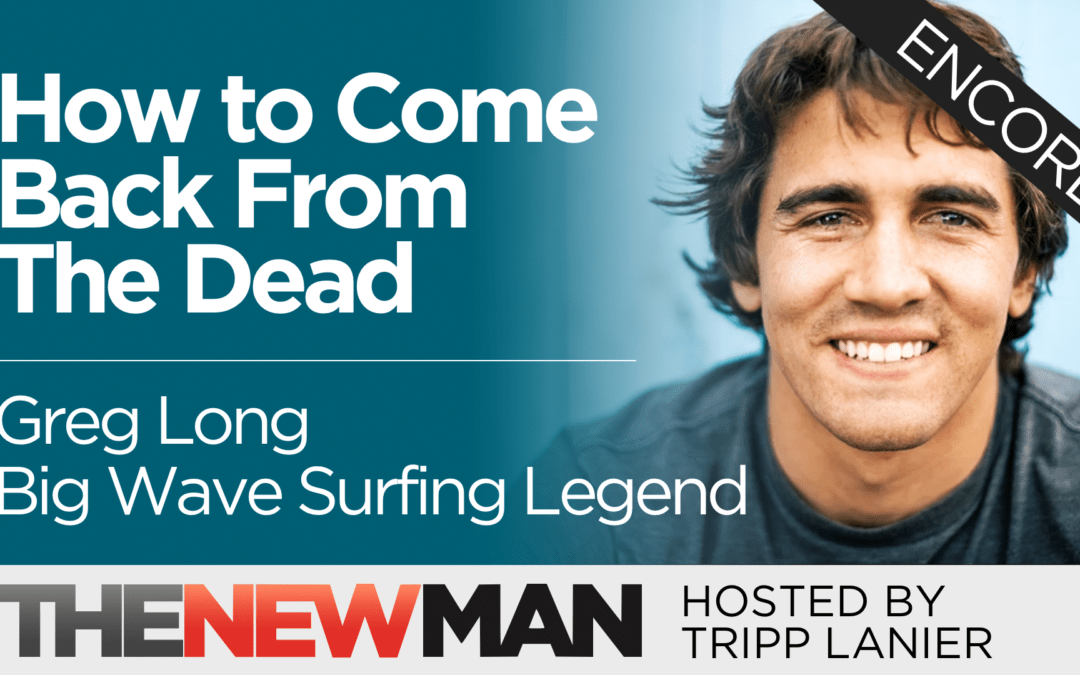
Please enjoy this encore episode of The New Man Podcast.
Are you waiting to get your confidence up before trying something scary?
Do you feel like you need to hide your fears from yourself and the world?
And how does avoiding risk zap your energy and kill your enjoyment for life?
In this encore interview, we learn how Big Wave World Champion Surfer Greg Long nearly drowned and then went Christmas shopping the very next day. While his body may have recovered quickly, his fears and confusion about living took a far greater toll.
In this interview:
- What it’s like to drown in huge surf at Cortes Bank
- What to do when you lose your fire
- How to take the power away from our fears
- Why the best preparation in the world won’t protect you from getting knocked around
- Why avoiding risk and fear is killing you
Plus…
- How ego keeps us playing small
- The trap of attaching our identity to what we do in the world
- Getting stuck in jobs or relationships that don’t serve us anymore
- Controlling our thoughts
- Letting go of negative feelings
About Greg Long — Big Wave World Champion
Greg Long is by any standards one of the sport’s most celebrated big wave surfer. In a career that now spans two decades Long, 35, has been awarded virtually every title in the big wave riding arena, including multiple XXL Global Big Wave Awards including Biggest Wave, Ride of the Year and Performer of the Year, as well as two WSL Big Wave World Championship titles in 2012 and 2015.
His list of accolades also include the SIMA “Waterman of the Year Award”, a National Geographic “Adventurer of the Year” nomination and has been voted one of Men’s Journal magazine’s “50 Most Adventurous Men”. In 2012 Long was featured in the Fox Pictures Hollywood release “Chasing Mavericks” both performing surf stunts and as a story character.
Transcript
The Day Greg Drowned at Cortes Bank
Tripp: Today, we're talking with Greg Long. He is the current Big Wave World Champion. Greg, thanks so much for being here.
Greg: Thanks for having me, Tripp. It's an honor and a privilege.
Tripp: Well, we're gonna have some fun today, but we're also gonna talk about some very, very serious stuff. We're going to talk about how you almost died. We're going to talk about how that's impacted how you live now. And for the guy listening, the guy on a treadmill in Chicago, let's help him see his own thoughts and fears from a different perspective, because I've read some of the things you've been writing and sharing about this experience over the last year or so, and I think anybody can gain so much from it. But let's just dive in. Tell us what happened to you on 12/21/2012.
Greg: I guess before we get to that, in a nutshell, my passion has been riding big waves since I was about 14 years old. That's what I dedicated my life to. It's my life's work, my passion. It's been a global pursuit ever since, from about 18 until now. I'm 30 years old.
Tripp: I don't think guys really get what you put into it. You're traveling pretty much year round following the biggest storms and the biggest waves. This isn't just Jeff Spicoli and his stoner buddies hopping in a van and going down to Baja.
Greg: A professional big wave surfer is essentially doing that twelve months of the year, tracking the most significant storm events in the oceans around the globe, traveling at the drop of a hat, going to these different breaks that we know of, and trying to find new ones to ride the biggest possible waves in the world. So it's the life's work of physical preparation, mental preparation, ensuring that you're at peak form for every one of these sessions, because there are serious consequences, as I came to find out on December twenty-first last year, when it was a perfect storm of a situation. I wiped out on a wave and I essentially drowned. That's the short clip-notes version of it. I've lost very close friends in this pursuit of riding big waves, and I've had a couple of close calls myself. But that day went beyond anything I'd ever imagined.
Tripp: You're one of the more prepared guys. You have a lifeguarding background. Is that right?
Greg: Yeah. My father was a lifeguard, so from the youngest age we were instilled with a detailed respect for the ocean and with approaching it from a safety standpoint, minimizing the risk you're taking before you go out there. That's something I've applied to every endeavor in my life when it comes to dealing with the ocean, whether it's diving, surfing, swimming, and especially big wave surfing, because there are significant risks, as I was speaking of earlier. The possibility that you could go out there and drown is very real. It's happened to a number of our friends before, and we've all had close calls. So before going out there, what you wanna do is eliminate all of the controllable variables: your physical preparation, your mental preparation, the equipment, the safety you have in place. If something does go wrong, everything you can actually control to help remedy the situation is there. That was one of the key factors in my big wave surfing career, and what ultimately led to my life being saved that day at Cortes Bank.
Tripp: So you weren't being reckless. You brought your own safety crew. This wasn't just, "Hey, let's go have some fun." You were known for your preparation and for pushing the sport forward in this way. And even with all of this preparation, the uncertainty is still there, the risk is still there, and you still almost lost your life. Describe what a two- or three-wave hold down is.
Inside a Three-Wave Hold Down
Greg: In big wave surfing, when you fall on a wave, you're dealing with such an intense amount of water. Everyone knows how strong and powerful the ocean is. When you put yourself out there at its biggest, wildest state, with waves in excess of 40, 50, 60 feet on the face, you're dealing with volumes of water that you have no physical control over. When you fall, it's a matter of what the ocean is gonna do to you. That usually means being held down a very long time, your body torn around in this ragdoll motion, appendages flying every which way. Sometimes the hold downs are so long that you won't get back up to the surface before a second wave washes over you. That's what we call a two-wave hold down, and those are commonplace in big wave surfing. Anyone who's been doing it for a significant amount of time has dealt with one. That day at Cortes, what I experienced was a three-wave hold down. I blacked out right before getting to the surface after the third wave, and then a fourth wave came over me. But in between, swimming for the surface after the first wave, I had the second wave knock all the wind out of me. That's really what took something I probably could have survived and turned it into the grave situation that led to me being pulled out of the water essentially lifeless by my rescue team.
Tripp: So let's go through this. You're climbing your leash back up to the surface, you hear the wave coming, and that second wave knocks the air out of you. Then you're climbing up the third time for the third wave that's coming. Your body's convulsing. What's going through your mind as you're talking to yourself and telling yourself not to take a breath? Because if you let your body take over, you know you're gonna die.
Greg: Right. I went down on the first wave, and that wave pushes so deep and holds me down for so long that I'm actually contemplating, do I just relax? That's the key to surviving a big wipeout: you have to relax. If you struggle, if you panic, if you start fighting, you're gonna burn up the oxygen you have, and you're not gonna be able to stay under the water as long as you need to. So it's all about controlling the mind and relaxing. I'm down there so long after the first wave that I start to think, okay, the second one has to be coming any second now. Do you stay down here, or do you swim for the surface to try to get that breath? I decided to make a break for the surface. It was about six or seven really big strokes up. As I'm getting close, the second wave lands right on top of me and knocks all the wind out of me before I'm able to get that breath. So I'm pushed right back down to where I was probably fifteen seconds before.
Only this time, everyone knows that feeling when you have the wind knocked out of you. There's this insatiable desire to hit that precious air and reinflate the lungs. But I know if I do that, that's it for me, because I still have a long time at this depth before I'm ever gonna get to the surface, and if I inhale and flood my lungs with water, that's the end of the game. So it became a total game of mind control. I've been in really bad situations before in big waves where I'm thinking, okay, I'm running out of air, I need to get to the surface, but never one so intense that my body's instantly convulsing, just begging me to inflate my lungs. I know I can't. The only way I was able to hang on as long as I did was that I simply did not admit to myself that I needed to breathe. There was this repetitive mantra in my head: I'm okay. I'm gonna get to the surface. Just relax.
And it's amazing, through the training I've gone through over the years of learning to hold my breath for extended periods, and knowing what's actually happening physiologically inside of me, that even when you don't have any air, your bloodstream is still so saturated with oxygen that you can hang on a long time before you'll black out. It's just a matter of overcoming that physical sensation, your body checking in with you and telling you, hey, you need to breathe, you're running out of air. That was knowledge that came through years of training and preparation. But the hardest thing in this world is this mental chatterbox. Even in situations like this, if you take a second to slow down and mindfully process what's happening around you, you still have this ego chatter saying you have to do this, you have to do this, when you know it's not in your best interest. When you're able to overcome that mentally, you open up a whole new world of potential, as I did down there, simply knowing that I can hang on longer than my body is physically telling me to, and going into that space where you're not questioning yourself.
After the second wave pushed me back down, I was so deep that I didn't have a chance to swim to the surface before the third wave came over. Being pulled down like that isn't really heard of in big wave surfing, and that's usually what results in drowning. With a few of our friends in other situations, we haven't been able to get to them in time. So I climbed my leash hand over fist for the surface, and I fought my way all the way up. My body at this point is going into full seizure convulsions, my extremities are starting to tingle, and I'm very close to blacking out. Right before I got to the surface, I did lose consciousness. I never got up there under my own power.
All the while, at the surface, I had a rescue team in place, tracking my board, which is still attached to my leash, attached to my leg. The entire time, they knew exactly where I was and that I never actually made it to the surface. I had three different ski operators following my every move. The fourth wave washes over me. We're surfing at this place called Cortes Bank. It's an underwater seamount a hundred miles off the coast of Southern California. There's no landmass in sight. The very inside of this wave is this tumultuous array of churning water and foam and waves coming in every direction. It's a terrible place you don't want to be, and that's where you end up after a series of wipeouts and successive waves.
My team's following my board, and they know something serious is happening. After the fourth wave washed over me, I got pushed way inside, to where they thought I would have come up, and it took them a few minutes to track down where my board was. Because I made it so close to the surface under my own power, I floated up relatively quick, and they saw that I was lifeless. I was unconscious, floating face down in the water. One of them rushes in, dives off the ski, bear hugs me through another wave, and then the other two rescue operators come around and help extract my body out of the water. We have these rescue sleds on the back of the skis, and they transported me back to the main boat. Had they not been there, that was it. I had drowned, and that was the end of this life as I knew it.
But fortunately, they got me in time, and there's a whole series of biological, physiological reactions your body goes through when it blacks out in water that led to me being saved. One of them is called the laryngospasm reflex. When you lose consciousness in the water, if you don't give up and take that breath and flood your lungs, your throat muscles and face muscles constrict. At that time, the last of the oxygen in your bloodstream is drawn up to your brain to preserve it, and this reflex hangs on until the very last moment, when all that oxygen's been used up. At that point the muscles release and you take that breath. If you're still in water, then you enter a whole world of emergency resuscitation, getting water out of the lungs, and a whole new world of complications. But they got to me before that happened. I had checked out. I wasn't conscious, and it was about five minutes before I actually came back, when I was on the boat. They never had to give me CPR. My heart had basically slowed to a complete stop, and they got me back there and were checking for a pulse. For a long time I didn't have a readable pulse, but I was starting to move and still subtly breathing. So it was about as close as you come to drowning and dying and being able to come back and play the game again.
Waking Up on the Boat
Tripp: I'm just stupefied. I don't know what to say. You talked about the physiological, the biological part. Most of us think about death, but we're really most afraid of dying, and you got to experience what could have been your death, consciously. What was going on in your mind? Were you just so focused on "don't breathe, don't breathe, don't breathe, you're fine"? Or were other things going through your mind? Because you knew, as you were counting waves, that you were up shit creek. What was going through your mind, and what was happening for you emotionally?
Greg: At that point, I knew how serious the situation was. I didn't even allow myself to start thinking, okay, I'm gonna drown here, or think about my friends. The reason is simple: I knew my life was seriously compromised at that point, and those thoughts are wasted energy. When you're down there, anything that wasn't gonna be constructive to me getting to the surface, which is where I needed to be, I wasn't gonna give an ounce of my energy. Even something as subtle as the thought, "Oh, what about my family?" didn't come into the picture. There'll be plenty of time to contemplate that after you die, I'm sure of that. In that moment, all I could do was relax and pay such close attention to… It's weird. It's like one foot was in the game of, okay, I need to stay present and fight and get to the surface, but the other part had removed itself from the physical stress I was under, that insatiable desire to breathe and the body convulsing, because it's the most agonizing feeling in the world. Anybody who knows what that's like when they're holding their breath and you start getting those diaphragm contractions, I was at such an extreme state of that for so long that I couldn't be entirely present in that physical body. So through a sort of practiced meditation, I checked out from that, but all the while kept one foot in the reality of what I needed to do to get from point A to point B, to the surface, to get that breath. It was total focus and concentration on the task at hand, but almost from a distance.
It was like nothing I'd ever experienced. I always knew I was capable of it, but until your life's actually on the line… You hear these stories of people who have superhuman strength, lifting cars off people in moments when they need to. As cliché as it is, I found my greatest mental potential at the time I needed it most, because I had no other choice and I wasn't going to give up.
Tripp: Wow. So in that moment, all the story kind of stuff went away. You just stayed focused on the task at hand, which was to not breathe, to get to the surface. They airlift you back, because you're a hundred miles offshore. The Coast Guard comes out and gets you and takes you back in. When did it start to hit you, the enormity of what happened, that you almost lost your life?
Greg: It hit me as soon as I regained consciousness on the boat. They got me back to the main support boat. I'm on the back swim step for a minute or two. They can see that I'm subtly breathing. And then all of a sudden, the lights come back on. There was a very euphoric, spiritual sort of journey that happened between the time of losing consciousness and then, which is a story for a whole other time. But as soon as…
Tripp: So you were having an experience while you were unconscious? Is that what you're saying?
Greg: Yes. It was beyond words, and again, that'll be a whole other hour-long discussion we'll have at some point down the road.
Tripp: Okay.
Greg: Absolutely. So I regained consciousness and I just started vomiting blood, coughing up blood and foamy water that I had at some point aspirated, though it wasn't the full lung-fluid purging of the water. The blood was coming from ruptured internal capillaries due to the stress of holding the breath. There's another biological explanation of what happened internally, but I'm struggling to breathe. Every exhale is blood. Every inhale is just a little bit of oxygen. It was the worst physical sensation I'd ever been through. I've had broken bones and all sorts of injuries, but this was horrendous. And I knew instantly what had happened. I asked who got to me first, which was actually one of my really good friends from Hawaii who had specifically flown out to do rescue, D.K. Walsh. In those moments, there's this rush of emotion. When you come that close to losing your life, you sit there and think about how lucky you are to still be here. It was difficult, because at that point my one goal was to focus on breathing and just relax.
The Coast Guard had flown out a hundred miles. They were actually on another call, so it took them about six hours to get there. I'm inside the boat at this point, hooked up to oxygen, just trying not to move, trying to relax, and I'm thinking about my life, everything that led me to that point, the looks of concern and love on my friends' faces. My brother was right there. I listened to him call my family from the satellite phone and basically say, "Dad, Greg drowned. They got to him in time. He's still coughing up a lot of blood. We don't know if he's punctured a lung or what sort of internal injuries he has. The Coast Guard's coming to fly him home." In those moments, you're just like, how the fuck did I get here? This is my life's work and passion that's led me to this point of putting all of my friends and my family through such a heavy emotional situation, and all for what, really?
Tripp: Was it like anger or frustration or a sense of betrayal? How would you describe that?
Greg: It was really just total confusion. I get asked all the time, why do you actually ride big waves? You've lost one of your best friends doing it, there've been other people who've drowned doing it. "It's so selfish of you to go out here and do this for your own satisfaction when you've got people that love and care about you, family and friends." Those are common things people ask me. Do you just not care about the rest of life, that you're going to take these risks? I've always had an answer for it, and it still holds true: you have to be doing what you love in this world, what drives you, where you feel alive. A big part of that, in different contexts with different people, is taking risks and challenging yourself. That's our purpose here in this life as human beings, to continually push and challenge ourselves to grow physically, mentally, and spiritually.
Big wave surfing became my means of doing that. I do think this often: I was born into this life and meant to do this. I wouldn't have had all the opportunities leading me to the comfort I have in the ocean, and being exposed to riding big waves, if I wasn't meant to do it. It became my arena for challenging myself to find out what I'm physically capable of and, more importantly, what I'm mentally capable of. In those moments out there, it's complete and total concentration, and you're dealing with so many fear-inducing situations. When you're able to understand the emotions that come from those events in the ocean and how to control that fear, not let it take control of your life but actually use it as a means of motivating you, you take that, and I've taken what I've learned from the ocean and applied it to every other aspect of my life. It's been one of the single greatest gifts for me. That's always why I knew why I'm out there doing it.
Yes, there are risks involved and dangers involved, but as we've spoken of earlier, you're able to manage the risks we take out there, so you're doing something that, yes, is risky, is dangerous, but you're doing it in a way where you're managing the risks. It's something risky done in an unrisky way. I love it because it's where I feel alive, so that's why I can do it, and why I eventually went back and I'm doing it again. Although it took me a long time to get back to that place of actually enjoying being in the ocean riding big waves, and having the confidence to do it. And I'm still not even close to having the same mindset I did prior to that accident.
Christmas Shopping and Going Back Out
Tripp: What's shifted for you? I've been reading and following you through this. There was the event that happened on that day. You recovered physically, relatively quickly, but then there's been this road of coming back mentally, emotionally, spiritually. And talk about this doubt. I can imagine the guy out there listening, like, "Well, I've stepped off this path of safety and certainty, and now I'm in the unknown. I'm following my passion. I'm following a life of purpose. And shit, it's hard. It's confusing, because isn't it supposed to be the yellow brick road that just kinda leads me on its way? And this almost killed you." It's like, wait a second, how does this work here? I'm following my passion, and it seems like we're expecting that things would open up at that point, and instead we could lose our lives doing the things that we love. Was that confusing for you? Walk us through how you were putting the pieces back together this last year.
Greg: Absolutely. I was airlifted from Cortes Bank to the hospital. I spent the whole night in the hospital, CAT scans, X-rays, everything. I'm fine. And I walk out of there the next morning, I go home, I get in my car, and I go do my Christmas shopping.
Tripp: Oh my god. Twenty-four hours later, you're out Christmas shopping?
Greg: Literally twenty-four hours later. I hadn't done the Christmas shopping because I was so focused on the swells and traveling and all the rest, and I'm literally walking around the freaking mall just going, so this is life.
Tripp: I could be in a box right now. I should be in a bag right now.
Greg: Exactly. Less than twenty-four hours ago, I was… It just didn't make sense to me. There were so many questions of how and why, and you essentially became the observer of life in general. I was always very attentive and mindful of my surroundings, even more so in those moments. It actually took a while for it all to settle in. I was processing all this over and over and over again. I speak of it as if I'm done doing it, but I'm not. I still am.
To lay out the sequence of events, less than a month later, there's one of the prominent big wave contests up at Mavericks in Northern California. I got home feeling good, started training again, really strengthening my lungs. I'd been through a lot of physical trauma, so there was a bit of work to do there. A month later, I paddled back out to this contest at Mavericks, and I ended up getting third. Then I surfed another one up in Oregon a week later, and I got second in that one. I never slowed down for a second to think about what was happening. I went back out there and went through the motions of riding big waves, but I'll tell you, I was so fearful. I didn't want to be there. The second I touched the water, it felt so foreign, like a place I didn't wanna go back to. Everything my life had been built upon had been pulled from underneath my feet. I went through those contests, and I know it was only because it was a contest with people watching, my ego saying "you have to do this," that I was able to paddle into those waves. Because after those two events, having that extra pressure of "you have to perform," my confidence was gone.
The next session after that, I paddled out where there was no pressure of performing. I literally sat out the back, beyond the lineup where everyone was sitting, another 10, 15 yards, which is kind of what I do sometimes, waiting for the biggest waves. I sat there and I didn't even wanna paddle for a wave. I didn't wanna catch a wave and I didn't wanna be there, yet here I was putting myself out there because that's what I do.
Tripp: Was it like the gym coach or the football coach we had growing up that was like, "just rub some dirt on it and get out there"? Was this part of you, like, I just need to fight through this? You mentioned ego a little bit ago, but really, what were you doing sitting on your board out there?
Greg: That was all I knew. My life had been 100% dedicated to big wave surfing. It was my love, my passion, my one road that I knew and always felt I was meant to walk down, and that's what I had done. You ask any one of my friends, I was probably the most intense, dedicated, driven of anybody to be riding these swells around the world, to be everywhere every possible time and catching the biggest waves. So that's what I did.
Tripp: So who am I if I'm not riding big waves? Is that the question?
Greg: Exactly. Yeah.
Ego, Vulnerability, and Strength
Tripp: I can imagine for some guys out there, just to put it back into perspective, they lose their job, or they get to the end of where they feel they are in some career, and that's what they're up against. Well, shit, who am I if I'm not married to this woman? Who am I if I don't have this girlfriend? Who am I if I don't have this job or this career? And we'd rather stay in that shitball place where we don't feel great, we don't feel like ourselves, than step into that next phase of uncertainty. Does that resonate for you?
Greg: Exactly. That's exactly it. So I tried to get back on that horse that I'd ridden for so long, and I was out there with zero confidence and no love for it at that point. That was the hardest thing for me to come to terms with, because that's what it was all about from the very beginning, and how I even got into this, because I enjoyed it so much. So I started questioning who I was, what I was doing, why I was out there, and that lack of confidence that I'd always had was gone, and it started to permeate every other aspect of my life. I was in a relationship at the time, and I became, in a way, almost a depressed person. We ended up separating. That girl broke up with me because I wasn't that happy-go-lucky person anymore, and I started to struggle.
The worst part was that it was an internal struggle with myself. I wasn't going to let the world around me know what I was going through, because of that ego of, "I can't outright admit that I'm having a hard time, that I question if I can go back and surf big waves." Because that's my job. That's what everyone knows me to be, this great big wave surfer, inspirational figure, and what if all of a sudden I say I can't do it anymore? Then what's gonna happen to my career, to people's perception of me? That's the worst thing in the world, Tripp, when you aren't truthful, number one to yourself and then to the rest of the world. If you're not speaking and living your truth exactly how you feel, and you're just bottling it up and keeping it inside of you, having gone through that, that absolutely sucks.
Tripp: It's just amazing to put this in perspective, because you just described your almost literal death, and now we're talking about the ego death here, and how the ego is just clawing and holding on, and it's miserable. And you're describing this one as even more painful, if not more, because it's drawn out.
Greg: It is, because you're defeating that fundamental purpose of growing, and you're never gonna do that if you're living in this confined place. What I came to learn… I'd always known it, but again, it's this ego thing, and I'll say it time and again, that keeps you from actually living these truths that we know inside of us.
Tripp: What do you mean by that? Wait, wait, wait. That was big. Go back to that. The ego is what keeps us from what?
Greg: From really expanding and growing, in these diverse or abstract situations that we're put in. The world is always changing every single moment around us, and you have to be able to adapt and grow and go with the flow and accept that everything that's happening is for a reason, and that reason is for that personal, mental, physical, spiritual growth we talked about earlier. Rather than fighting it, rejecting it, and living in a state of denial, whatever it is, you've gotta just embrace it with open arms and accept everything that's happening, or the lesson it's there to teach you. Sometimes it's obvious straight away, and other times you won't realize it until down the road. But it's about simply being okay and being able to adapt and go with the flow of life.
Tripp: And what would that have looked like for you at that time? Just embracing, like, okay, I'm depressed, I'm lost, I don't have it figured out right now, and I don't have to be Greg Long. Would that have been a version of being okay with it?
Greg: Simply put, yeah. Telling my sponsors, "Hey, guys, I need to take some time off and really reflect on my life and what big wave surfing means to me right now, because right now I'm not enjoying it and I don't feel good when I'm out there doing it." Yet here I was still going to every single swell around the world with my friends, pretending, trying to fight to get that confidence back. Meanwhile, I'm not having fun, and the more I was fighting and struggling… That's not the way to get through life, especially in sensitive situations like that, to fight your way back. It got to a point where I didn't have the energy to go anymore. I was fighting, fighting, fighting, and eventually I was just exhausted, emotionally, physically. So literally, just admitting where you're at. Nothing is ever gonna change until you openly accept the situation, the circumstances around you.
Tripp: I just wanna dovetail on that, for that guy that's listening right now. If we're trying to avoid looking weak, because that's really what it comes down to, I don't wanna appear less than, I've gotta portray myself as a guy that's got it together, the real move towards strength is admitting where we are instead of posturing that we're not going through this or that. I'm sorry to interrupt you, but that's such a big point. That's actually the strength.
Greg: That's it. Exactly. And the reality is that's again our ego, our worrying about looking vulnerable or weak. That's the greatest bunch of bullshit in the world. And I'll tell you why. The only thing that matters is your perception of reality. Everyone has a world of circumstances that's led them to seeing, thinking, perceiving the world from their unique point of view. People may judge, or they may see things completely differently than you. It doesn't matter. The only thing that matters is what's inside of you, and that happiness, and then eventually being able to share that with the rest of the world. So this fear of being judged by others, it's fucking bullshit. That's one thing I laugh at now, and I laugh at myself: why would you actually care, Greg, if somebody's like, "Oh, Greg's quitting. He's giving up. He can't do this anymore"? Why does it matter? If someone reading one of my stories from across the other side of the world, or even my biggest fan, because I was such a good big wave surfer, now thinks less of me because I can't do it anymore, why does it matter? It doesn't, to me, because what matters is my happiness and me being fulfilled, because until you have that, you can't give it away and share it with other people in this world. And that's part of life, being vulnerable. It's something I've come to love and enjoy since this whole experience, because that's when you're being forced to slow down and reflect and question where you're at, and you find that real growth.
Tripp: I always think of it like a video game. The first phase of the video game is the shit we learn on the playground growing up. We gotta posture. We gotta puff ourselves up. You can't be a pussy, that whole thing. And then we hit a wall with that at some point. Wait a second, this only takes us so far. The whole thing flips at some point. We've reached the end of that level, and we know we've reached the end of that level whenever we're exhausted, whenever things don't make sense anymore, things that used to work don't work anymore, and life seems to be really fucking hard now. And then it's like, oh, well, if I'm willing to step into that fear, if I'm willing to step into that vulnerability, that takes real strength. Wait, that's everything I've been told not to do. But that's where life starts to open up again. It seems to flip and go in this whole new direction. And it sounds like that's where you found your life again, when you were willing to step into that vulnerability and be honest.
Greg: Exactly. For me, the pivotal moment was that I'd been in my head so long, and only a very specific few close people, my closest friends and family, actually knew what I was going through. It wasn't until I literally wrote the whole story in an international publication, to the world, saying, "This is what I went through and this is what I was feeling, and I still do question whether or not I actually wanna continue this pursuit of big waves." In that moment, I felt liberated from all those constricting emotions I was holding on to. I stepped into this world of freedom. I'm like, okay, you put yourself out there, you walk through those doors, and now the world of opportunity is before you to do whatever you want, because you've let go of that attachment to your past. There's the analogy that you can't bring anything new into your life if you're clutching to all those things and pieces of the past. You have to let go of something in one hand in order to bring in something entirely new. In that moment, I felt like the world of expectation, all of this stuff, had been lifted, and I instantaneously felt lighter and happier. And I was like, all right, you went through all of that, and you may not pick up where you left off ever, or go back to that confidence ever again in big wave surfing, and it doesn't matter.
Tripp: I just want to point out that the freedom you got didn't come from arriving at some new place and saying, "Now I've got it all figured out and it's all perfect." The freedom came from "I'm scared and I'm not sure where things are going," and then you felt free.
Greg: Exactly. Before I even had my feet back on the ground and a direction of where I was going, it was literally just opening up my arms to the world and saying, "Bring it." Whatever's happened in the past that's led me to being here now, with a world of knowledge and opportunity and experience, there's been a serious twist to the whole plot of this game of life, this story, so roll with it, because that's all you can do. I spoke earlier of life constantly evolving and changing. You can stay stuck in the past, the old story, what's happened, but it's going to keep twisting and turning and going in different directions, and you need to just adapt and move with it. So, what feels good in that moment in time? Often it takes some time to figure out what you want to be doing next in life. And that's where the scary part is, the uncertainty. We've been taught to have this sense of direction, comfort, stability in life, that we know where our financial income is coming from, that we've got a house, that the world's solid around us. We've got cars and all the rest of it. There are elements of reality there. Those things do add to the comfort of our life and we can enjoy them and enhance our happiness, I guess, but they're not what makes the foundation of who we are, or the most important elements of life, which are love and true happiness. That comes from within you, not from these peripheral materialistic possessions and things.
So I sat there and worried about my career. Was I still gonna get paid to travel, this dream job of being a professional surfer? But at any one of those moments, I would have gladly given up that financial stability and that job of a professional surfer if it meant that I could be fulfilled and happy inside again. And if I didn't wanna go back out in certain big waves again, I wasn't gonna force myself to do it just to keep it as a job, because I wasn't gonna be happy doing it. Why would you? You're defeating one of the fundamental purposes of the thing, and that's to find joy and happiness.
Returning to Cortes Bank
Tripp: Beautiful. You talked about thought control earlier on, and it saved your life. And then it sounds like it's also the thing that, if we're trying to control ourselves, and I want to say we're playing defense here, we're playing defense about what we could lose, how people could see us, the way we don't want to see ourselves. So it's playing defense in our lives instead of staying curious. But it's all in our head, so it's a matter of watching when it's time to have that kind of constricting thought. At one point it actually saved your life, literally, but it was also the thing that was stifling you and killing your vitality and energy, whether you realized it or not. So you've been in this place, you've been more curious, and then you ended up going back out to Cortes Bank a year or so after you drowned out there. What drew you to come back? Was that ego again? What was that about?
Greg: I thought about it. Why would I wanna go back out there? All the while, once I did admit to the world that I questioned whether or not I still enjoyed doing this, I continued to do it, but under my own rules. I wasn't doing it because I felt expected to do it. I was doing it because I wanted to explore those ideas and concepts of fear, and in a way, rise to the challenge. I interpreted all this as: you've been presented probably the greatest mental challenge, to overcome what's happened to you in the past. It was a very traumatic incident that in a way felt like it had taken from me this world that I'd built around myself. And it wasn't because I wanted to go back and regain that life as it was. I wanted to fully understand my thought processes, and essentially the fear, which is one of the single most paralyzing emotions in our lives. You talked about not being good enough, being judged by others, fear of failure. I accepted everything that happened, and once I slowed down, I was able to mindfully process it simply as another challenge to further grow and explore my mental capabilities.
So I kept riding big waves, trying to do it without the expectation that I had to go out there and perform or be the standout of any session, only when it felt good for me. Then I started thinking about going back to Cortes Bank and what that would be like, and what I would go through mentally out there. It was either gonna be the greatest experience ever or potentially the worst, but I always knew there would be something out there that would bring back the hardest of emotions. The greatest challenges in our life are where we grow the most. So I was gonna go back out there and face those extreme fears, put myself in the exact same place where all I had were some pretty traumatic memories, and see if I could process those in a mindful way and turn them into that same positive motivation that big waves had given me all along. And I was able to do it. There was a ton of fear. But fear is only a fabrication of our own minds. I think a lot of people know it deep inside of them, but actually implementing that idea in their everyday life and actions is a different story. We create the world around us in our own minds, in the way we perceive things. Fear is this stimulus-response reaction: okay, something's coming at me, it's intimidating, it's scary, these big waves. You choose how you're going to process that information coming to you and, essentially, how you're gonna react to it. It can be experienced as something positive or something negative. "I'm scared of this big wave, I'm gonna flee and go for safety," because that's instinctively what I want to do. Or you can do the opposite: "All right, I'm intimidated, I'm scared, but I know I'm ready to do this. I'm confident in myself. I'm prepared, and I'm not gonna let it affect me, because I know I'm capable of this." In that moment, it turns from something negative to something inspiring.
I went back out there to Cortes Bank, and that's exactly what it was. The most frightening experience, but so beautiful at the same time, because I was able to turn it back into that positive motivator and overcome it. The second you do that and realize you can control all these situations around you, the ones where you question if you're good enough or you're afraid of failure, taking that fear and using it as an inspiration instead of an inhibitor, the world opens up. A world of opportunity is presented to you like never before.
Tripp: Would you describe the difference in you and your day-to-day life after going back out to Cortes Bank?
Greg: It just kind of reaffirmed what I had realized throughout this year of processing everything. In general, the whole event put into perspective what really matters in this life.
Tripp: I'm sorry, Greg, that was breaking up there. Could you start that over again, please?
What Really Matters
Greg: Yeah. If I were to sum up everything, a lot of what happened in that session at Cortes Bank was just reaffirming what I had learned throughout the course of the year. Two key things put into perspective what really matters in life. It's not material possessions. It's not the job titles that we hold. It is the true happiness that's within us, the beautiful company of friends and family that we're so fortunate to be a part of, the opportunity to love and experience life and, at the same time, experience failures and the challenging times. Because there's duality to everything in life. You can't know what hot is without having cold. We can't have success, or really enjoy it the way we do, without knowing what it feels like to fail. It was building throughout the year, these ideas and this knowledge, and going back out there, since we're speaking on the topic of fear, I feel like you can't appreciate the enlightenment of overcoming it unless you've succumbed to it before as well. Just knowing that, looking at the bigger picture of life and embodying it all, the ups and the downs, has been the greatest gift for me, and this whole experience has given me the opportunity to really see and feel and learn about it in depth.
Tripp: You've mentioned that this process is still unfolding. Where you are currently today, what's an insight into a challenge that you're up against?
Greg: Right now, I've gone back and I'm surfing big waves again. Still not with the confidence I used to have, but it's slowly coming back, to where I'm enjoying it and having fun again. As I spoke of earlier, I feel like I've stepped into this world of new opportunities, and I have my sights set on a few things I would like to create in my life. But even though I talk so diligently about this concept of fear, I'm still hesitant on a couple of things, to fully take that dive and move into it, because it's so new and foreign to me. All I'd really built… If you ask me anything in the world about riding big waves, I can tell it to you, because that's what my life has been. There's still this hesitancy with these other ideas and things I'd like to do, and I'm not fully diving in head first because I'm questioning. It's hilarious. I laugh at myself all the time, but I guess that's part of the growth process.
Tripp: Well, I'm glad you brought it up, and I'm glad you brought up the laughter too, because I think we can get precious about this. The first fallacy is that somehow we've got to get confident and then we can do something, but that doesn't work. And even if we have a pattern of how we deal with fear, it's like expecting that to go away. Even though the challenges change and the things we're doing change, it sounds like you're able to recognize, "Oh, there I go. I'm doing my thing again. That's my thing I do with fear." That's not going to go away throughout the rest of your life.
Greg: I feel like if it ever did, you would have reached enlightenment and ascended into the heavens. It's always gonna be there, and as subtle as it is sometimes, that little bit of ego is gonna jump out at you with these deconstructive thoughts, or self-ridicule, or questioning: you can't really do that, you're not good enough. But just being able to acknowledge that that's all it actually is, and that you don't have to let it stifle your creativity or actually moving forward with any of these things. I catch myself all the time, even still, and laugh. The key to overcoming that is slowing down and mindfully approaching whatever it is with rational thought processes. It's not just the reactive mind of the ego, but, okay, which of these emotions is actually real? Then it's the same way I approached my big wave surfing, which was a very diligent, methodical manner of assessing the risk versus the reward, what I need to do to manage any of the risks, what I need to do to get from step A to step B, and is it feasible. It's really assessing all the encompassing elements of whatever it is I'm looking to do next, and then moving forward, whatever direction it is, actually acting upon those ideas.
Tripp: I love it. Acknowledge what's going on, don't try and bullshit yourself, but also acknowledge the fear and move forward. And there was another thing in here, of what's really driving us. Is it that egoic thing? Is it that fear-based "not enough" thing? I'm really glad you didn't get stuck in "okay, big wave surfing sucks for me, I don't big wave surf anymore." It's more about what's driving me. If I'm going to do something, what's the mindset I'm bringing, or what's the motivation I'm bringing there? I think a lot of us can close off huge aspects of our life because we get stuck on the thing instead of the mindset or the experience we bring to it. And that's where it gets redefined. We get to have a second act in that area. I can do this in a frantic, fearful, defensive place, which is draining, or maybe I can find the fun. Where's the curiosity? Where's the playfulness? I'm really glad you touched on that.
Greg: No matter what you're doing, it has to be from a place of fun and love and enjoyment. That's one thing I've learned from all of this: that's what we're here to experience. If you start doing things for the wrong reasons, the wrong motivation, you may be able to sustain it for a while, but it's eventually gonna catch up to you, to where you need to either change that motivation, or change what you're actually doing, or find a way of encompassing that fun and lightheartedness into whatever your activity is. We're here to be happy and love and enjoy this life, and if you're not doing that and you're not surrounded by that, then at the very least you need an occupation that gives you the opportunity to experience it, maybe not necessarily in the workplace, but beyond it. Otherwise you've missed the point.
Tripp: I agree with you. I appreciate you bringing that up. It's so easy to get caught up on achievements and stuff, but as you said, those are…
Greg: The achievements, in the end, are secondary to that real happiness that comes from inside you. There's this kind of self-gratification of accomplishing things, and whatever else, but it's about the bigger picture and the whole journey in the end. It has to be based around love and happiness and respect and gratitude and appreciation for where you're at and what you have in your life. If you're basing it solely upon achievements, that can bring some sort of gratification, but there's a lot of deeper fulfillment that comes from those other aspects.
Tripp: Exactly. My coach and I were talking the other day, and I don't know where this quote came from, but he says, "We can't get enough of what we don't really need." I think of that in terms of so many things, like the accomplishments, but also a sense of certainty or security. I wonder if we really need that much certainty and that much of a false sense of security, because it never seems like it's ever enough. Especially with the achievements, it's that longing, that bottomless pit of desire for things we really don't need anyway. Greg, I really appreciate you. We've been all over the place today, and you've really opened the kimono, especially in a sport that can be, in a very subtle way, some chest thumping and big balls out there. You've really shown true strength, in my opinion, to reveal what's really been going on for you. So I'm just excited you're on here to talk about your experience. Thank you so much.
Greg: Well, thanks again for having me, Tripp. The challenges are never going to stop, so enjoy them and use them as a next stepping stone to learn and grow from. I appreciate you having me on and taking the time and sharing your insight as well.