

Podcast: Download
Subscribe: RSS
Mental App Co-Founder Anson Whitmer
Have you ever thought Andrew Huberman’s approach is a bit over the top?
Why should you “never go full Goggins?”
And who said personal growth had to be so clinical and serious?
Today we talk with neuroscientist and founder Anson Whitmer. After leaving academic research he went on to help the Calm app become one of the most successful apps in the world.
But as a result of some family tragedies, he realized he wanted to do something more meaningful with his career.
He’s recently launched an app called Mental which brings neuroscience, Navy SEAL designed toughness training, and a sense of humor to your pocket. Anson believes we need mental training for men that isn’t stuck in macho bro-science or bullshit level expectations for what it means to be a human.
After all, what’s the point of growing if it’s not helping us feel more free, purposeful, and alive?
In this interview:
- Neuroscience and getting stuck in negative thinking
- Always looking for distractions
- What’s underneath your anger?
- Why constant comfort is making us more anxious
Plus:
- Working on the Calm app ($2+ billion valuation)
- Does personal growth have to be boring, clinical, or serious?
- Is Huberman a bit ridiculous?
- “Never go full Goggins”
- When personal growth turns into a religion
And:
- The Mental app approach to personal growth
- Can we train our mindset to avoid crisis?
- Having Bruce Lee in your corner
- Why we can’t wait to do our meaningful work
- Finding a middle way that honors purpose and security
Click here to learn more about the Mental app.
About Anson Whitmer, Ph.D. (from the Mental website)

When I was young, two close male relatives of mine killed themselves.This experience drove me to pursue my PhD in Neuroscience, and to build the Calm app. I’ve seen first-hand how our cultural conversation around mental health is not resonating with men. It’s not geared towards men. Men commit 80% of suicides, so to solve this crisis, we must innovate on new ways to help men.
I founded Mental because I care deeply about helping men realize their full potential, using science-based and action-oriented tools. The tools we use at Mental are beneficial not just when you’re down, but also when you’re already excelling and looking to find your edge.
Out of all the 20,000+ mental health apps out there, Mental is the first one designed from the ground up with men’s needs in mind.
Click here to learn more about the Mental app.
Transcript
Anson's Background and What Rumination Is
Tripp: By training, what's your profession or what's your expertise by training?
Anson: By training, I have a PhD in neuroscience and psychology, with more focus on cognitive and clinical aspects of science.
Tripp: Okay. So for somebody like me, what does that mean? How do I know what that means?
Anson: Basically, I was doing MRI studies where I was looking at brain function while you were doing cognitive tasks, so seeing what part of the brain is active for you versus other people. Mostly, the goal of my research was trying to understand why people get stuck in ruminative forms of thinking, where they just can't let go of things that happen to them, and how that could lead in turn to different forms of mental illness like depression and anxiety.
Tripp: Interesting. How do you describe rumination from your perspective?
Anson: It's repetitive thinking. It's typically focused on something negative or your emotions. Like, why do I feel this way? What's going on? It could be something that happened to you when you were younger, or something hard that you went through, and you just can't let go of it. It could be a breakup you're going through and you just can't stop thinking about the breakup, or your ex. You're just ruminating on that person. It's tough because when people do it, it's very predictive of people falling into worse mental states, and very predictive of eventually having forms of mental illness like generalized anxiety disorder, major depressive disorder, etcetera.
Tripp: So if I've been wronged, or I feel bad about something I did, it's just spinning in this loop and I can't get out of it.
Rumination vs. Distraction, and Gender Differences
Anson: Yeah. And it is fascinating because people have different tendencies. Some people are pretty likely to do that, and other people are unlikely to do it. There are also gender differences. The original reason people started studying rumination is they wanted to understand why women are more likely to become depressed than men. It was posited as a cause that women are more likely to focus on their feelings and not let go of something, and that's what leads to depression. There's now a ton of research showing that really is one of the biggest causes of increased depression in women in particular.
We've come over time to realize that women are not actually depressed more frequently than men. It just shows up really differently in men. They're less likely to say they're depressed in a way where they're not feeling pleasure, feeling hopeless. Instead, with men, it tends to come out as irritable and angry, or they're distracting from depression by using substances, drinking too much. That can often be a sign that a man is depressed, which is a very different way of manifesting depression than in females.
And it makes sense, because men, when they're going through something hard that could ultimately make them depressed later, go the opposite direction from rumination. They go toward distraction. They say, I'm not gonna think about it, or they drink too many beers after work so they can ignore it better. They play video games nonstop. They find ways to not deal with it, and that also is not good. It's kind of fascinating. If you spend too much time in emotions and how you're feeling and what you went through, that's bad for you. If you distract and don't spend enough time in it, that's bad for you either way, and it starts showing up differently. If you're distracting a lot, the way it'll probably show up as depression is irritability, anger, frustration, and maybe substance abuse. If you're really focusing on how you've been slighted, or something bad that happened to you, or how you're feeling, maybe it shows up as hopelessness and despair.
So it's kind of fascinating when there's this cultural conversation telling men, hey, you need to be more in touch with your emotions. That's generally because men distract so much. They're better off if they tip back over towards the middle. But there's a limit there. It's not just, focus on your emotions and your problems all the time, because then you tilt into rumination. And you're then also likely to become depressed. And for women, there probably is a reason to say they have the bias to spend too much time in those emotions, and they should spend less time focusing on their feelings and their problems and tilt over. Not all the way towards distraction, because that would also be bad.
So there's this fine-tuned level. If you're going through something hard, say a breakup or a loss, someone close to you died, how much do you actually think about it? If you totally ignore it, pretend it didn't happen, it's gonna be bad for you. If you spend all day thinking about it and never get out of your mind and go do other things, that's gonna be bad for you. There's this tightrope you need to walk in order to recover from those tragedies, or whatever you're going through, as quickly as possible. I've long found that fascinating. There's this great nuance and balance there, and balance is so often lost in our cultural conversation. A lot of my research was trying to understand how we cope and respond to those hard things. If we're over-responding or under-responding, what's that balance point? What's our brain doing? What's going on genetically? Why are some people predisposed to do more of one than the other? And therefore, what can we actually do to start fixing it?
Letting the Tiger Eat You: Anger, Primary Emotions, and Pain vs. Suffering
Tripp: That's fascinating. And I'm curious, because from my own personal experience, I recognize there's a difference between me thinking about something, ruminating about it, like I'm on the outside looking in, and actually experiencing the thing I'm ruminating about. I might be ruminating, like, oh, this happened. Why? Why? Why? I'm usually asking why questions, or building, like, this is stupid, as I'm pointing fingers at it. And then oftentimes I find the relief when I actually feel, holy shit, I'm just sad. And I actually feel the sadness or feel the anger. Is that separate from rumination? They're separate in my world, but I'm curious about your perspective.
Anson: One way to deal with problems effectively, instead of being like, why? Why me? and being fully immersed in it with no perspective, there's some research showing that even if you just talk about yourself in third person, that's really helpful for dealing with hard emotions. I think of that old Seinfeld episode where Jimmy says… It gives you this perspective that is so easily lost. You're like, hey, it's alright, Anson. You got this. This happens. Otherwise, we get lost in it. And it does make sense that underneath all that talk, at the base of it, there's just that sadness that you're caught up in.
Tripp: That's where I tend to find the relief. The phrase I get is, let the tiger eat you. I'm doing all this stuff to try and keep the tiger away, all this rationalizing in my brain, trying to explain it away and think it away. And then there is this release. It's like, I don't wanna fucking feel this, but then I do. And I might shed a tear, or I might laugh, or I might cry, or I might get angry. And then it's like, ah, something moved. The wave moved through, and it does seem to shift something for me.
Anson: What you're saying reminded me of how, for a lot of men, if someone has really frustrated them, they've gone through something tough, and they feel angry about it, they're like, why the hell did this happen? They're pissed. But for a lot of men, anger is a funnel emotion. It's one kind of emotion where it's totally fine for men to feel like, ah, he's angry. That's a very male type of posture. It's very defensive. Potentially strong. Because that's acceptable, and that's one emotion we've had through our lives, it becomes this funnel emotion where if you're actually feeling sad, it will come out as anger.
So if you're in a relationship with someone and you're exploding with temper and anger, is it that you have a problem with anger, or something's really pissing you off? Often, underneath that there's a sadness or some other emotion. If you could open yourself up to it like you're talking about, and just be okay with that emotion and experience it, you can release whatever it is that's driving all that anger and fury. You just can't do that until you open yourself up to what's underneath it.
Tripp: I've heard it described as primary emotion and secondary emotion, that anger can be considered a secondary emotion. It would be the smoke to a fire, let's say. I can get really comfortable in my anger, but I'll just stay stuck there, and it can become my identity. But if I'm curious about what is perpetuating that anger, I can look underneath, and the primary emotions are typically fear, hurt. I was hurt by something, or I'm really concerned about something. If I yell at my kid, "Don't go out in the street!" that can come out as anger, but it's really just deep concern. A form of fear in there. I've found that if we really wanna shift it, and we're willing to look at what that primary driver is, then the anger can be released if we're sick of hanging out in our anger. What scared me? What hurt me? What am I really concerned about? Those are really vulnerable places for men. We don't wanna be transparent that something actually impacted us. We'd rather show that armored exterior. But I found it extremely helpful to just get curious: if I'm so pissed off, what might have hurt me? What might have scared me? And what might I be deeply, deeply concerned about?
Anson: The reality is that often when you look directly at the thing that really is underneath it, it's not quite as terrifying as you think. I've meditated on and off since I was 18, and one of the big lessons from it is that just about anything, if you look at it and accept it as it is, is not nearly as awful as you think. Even pain. If you break your leg, there's the pain from breaking your leg. But most of the pain is all the turmoil around it. What's going to happen now? I won't be able to get to work. I won't be able to carry my kid up the stairs. I won't be able to compete in basketball this weekend. You cycle all these hypothetical questions around the pain, and most of the suffering is fighting against what's actually happening. But if it's just the pain and you don't have all that mental turmoil about it, you're like, oh, it's just the broken leg. And it's actually not that bad.
There's this great equation. Most people think suffering is equal to pain: more pain, more suffering. There's some truth to that. But the better equation is pain times resistance equals suffering. When you fight the pain, you resist it, your suffering is magnified, multiplied. So even in that very moment of the broken leg, you could choose not to resist the pain, and you won't experience as much mental suffering, just because you stopped resisting it. And if anyone doesn't believe me, go hop into really cold water. You could fight that and be like, oh, this is horrible, horrible, horrible, and you will be suffering badly. But if you switch your mind and you're like, hey, this cold is actually good for me, it's good for my health, I'm gonna accept it, this is something that's working with me, and you relax yourself into it, that cold's still painful, but it's not that painful. It's way less painful than when you're resisting it.
Tripp: This is huge. This distinction between pain and suffering, I think of the old Buddhist tale. There's the first arrow that comes in from wherever. I can't remember the tale perfectly, but then there are all the arrows that we put into ourselves. Why is this happening? This shouldn't be happening. That person's wrong for doing this. That's where the suffering comes from. So pain is inevitable, from that lineage, but suffering is a choice in some ways when we stack onto it. And this is tying together a lot of what we've been talking about, where rumination sounds like this suffering, this spinning around, when we might be able to get curious about where the real pain is and just be with that. Then the rest of that suffering can relax a bit. It's not that we don't have any discomfort or pain, but we're not stacking on top of it. Is that a fair way to tell it?
Anson: Yeah. With rumination, people often think, I'm trying to resolve it and fix it. If I could just understand why, I'll make it better next time. It's really clear from research that you're not problem solving. You're going the opposite direction, and you're really quickly falling into what you're saying. You're putting new arrows in yourself and making yourself feel miserable. We're not actually helping ourselves out. We're making it worse. Ultimately, if we step back from all those whys and problem-solving diatribes, and just saw that thing that's making us afraid or sad or whatever it is for what it is, often it's manageable. You can deal with it. It's like the broken leg without all those mental thoughts about it. It's like cold water where you're just like, I'm okay with this. Once you do that, you'll stop poking yourself with arrows. That stuff will turn off, and it will be resolved by itself.
Acceptance, Fear, and the Vagus Nerve
Tripp: I think this is where folks get confused about surrender or acceptance. Acceptance doesn't mean "I accept defeat here." It means I accept the reality that I've been wounded, instead of "this shouldn't be happening." At least for me, I'll go into the spin. Oh, goddamn, why is this happening? The thing's broken, and now this is gonna happen, now that is gonna happen. But I'm not in reality, like, here we are. What's actually happening? This feels this way. I can get curious and go into the feeling, like when you're sitting on your meditation cushion for hours at a time. What does it feel like? My knee's going to come out of my skin. Just actually feel it. And then it can transform if we get curious about the reality of it, instead of being up in our heads fighting that reality or trying to explain it or think our way out of it.
Anson: That is a point that's kind of confusing to people. Acceptance, where it's like, oh, then you're fine with bad things happening. And it's not. I don't even think it's that way in the meditation Buddhist tradition. There's a story I've heard from ages ago of a monk who's enlightened coming into town on the back of a cart. Someone tried to steal something off the cart, and the monk hit that person on the head with a cane. The people were really surprised. They're like, but you're enlightened. You just hit a guy in the head with a cane. His point basically was that just because you're enlightened and you can be present with what is, it doesn't mean you're okay with someone stealing something or doing something bad. You can still prevent that. But that's different from our ability to stop resisting our pain and actually move through it so that we stop feeling it.
Tripp: So if I'm resisting reality, I'm gonna go distract myself. I'm gonna drink or play video games or whatever. I'm fighting reality. I'm not willing to turn into it and just say, this is what's happening, or X happened, or X is going to happen, and then learn to actually be with it and feel it. And as you're saying, if I'm willing to get curious, the feeling isn't that bad. It's usually not as intense or difficult as we make it out to be.
Anson: I think sometimes we have resistance because there's fear around it, particularly around hard stuff we've gone through. That's why we distract. I don't wanna deal with that. That's tough. But fear used to be a really helpful emotion. A saber-toothed tiger is attacking you, you need to get away and get your family away. It's very helpful that way for survival. But now fear is omnipresent in our life. Most people have this overactive fight-or-flight reaction going on. The vagus nerve is a really big nerve in the body that, when turned on, does the opposite and makes you feel relaxed and calm. There's research showing that in a lot of people it doesn't have enough tone. It's like an under-exercised muscle. It's not on enough, because most of the time people are in this fight-or-flight system where it's, did my boss give me a sideways look? All the different things we could be afraid of.
When we feel fear, we're trying to figure out if we gotta fight it or run away from it. But often fear, to me, is actually a signal of, this is something we should go towards. This is an opportunity for growth. If you're afraid of this thing that's underneath, driving the anger and the resistance, you're often afraid to go close to it. But if you use that fear as a signal in the opposite direction, it should be a siren call that pulls you in. Because if it draws you over to it and you can see it for what it is, then you're able to be present with it, sit with it, stop fighting it, and turn off the root problem that is causing you so much pain in your life.
Tripp: I talk about this in my book: success seems to be our ability to run away from discomfort, from uncertainty, and from looking like a moron. We get more and more fragile as a result. Fragile rich guy problems. We're getting better at avoiding these things, and we're getting more and more fragile. You're actually saying that it's impacting us on a physiological level, that our nerves are responding to this. The vagus nerve is responding to this.
Anson: Nonstop being comfortable is probably problematic, because we have these chronic stressors. If we instead had some real acute stressors like we used to, like a saber-toothed tiger, we would have a fight-or-flight system that would take off, and we'd ramp it back down. And that vagus nerve that ramps it back down would become stronger, and we'd be really good at handling those fight-or-flight responses and stressors. But instead, we don't have anything intense enough in those short little bursts like we used to. We're always kind of comfortable, or we have this chronic low-level stress. So we don't actually turn it off. It's slightly always on, and we don't push on that vagus nerve.
This is why things like cold water are becoming popular. It's eustress, a hormetic stressor, a good form of stress that temporarily turns the fight-or-flight system on. It's not too hard that we can't handle it. And then when you turn it off, you train the vagus nerve to activate. You tone it up. So there's a reason people are starting to search out discomfort actively in their life, because if you don't, you're not training yourself at a neural level to handle discomfort. And as you said, you just become more and more fragile. You can't handle any kind of discomfort. You're unable to turn off those chronic stressors. You feel like it's safer because you're always comfortable, but the total consequence is a lot more misery and suffering than if you would go towards it a little bit more often.
Are Humans Wired to Be Neurotic?
Tripp: From your perspective, are humans just wired to be a neurotic mess? I could imagine we weren't relaxing and having barbecues all the time millions of years ago. So is it that we've evolved, and we've got phones in our pockets, and we can watch anything at any time and sit in our cushy homes with air conditioning, and we just have to be neurotic? Is that part of it?
Anson: It's a great question. It's something I think about. Before humans had language, when we were like cavemen, we must have been much more present and less neurotic. As we've had language and then high levels of education, we're able to think abstractly about a lot of things we weren't before. We're able to think about what's going on with climate change, and what's going to happen if too many people have nuclear bombs. We're able to understand all these abstract risks that are out there, and it can be very overwhelming. If you take away language, or probably even education, there might be some blissful ignorance where we'd just be a little more present.
Then you add modern-day stressors, which are clearly even worse. It's nonstop news. They know that emotional news is what makes people click, so it's nonstop emotional news designed to alarm you. You're on social media constantly comparing yourself to somebody else. You're never in that present state of mind where you're just being. So in the last ten, fifteen years, it's no wonder we're seeing rates of mental illness go up tremendously. We're seeing rates of loneliness skyrocket. The pressures right now are tougher than they've ever been before. So it's not surprising that humans will be neurotic given the current conditions.
But we also aren't going back. We're not gonna go back to a time where we don't have education, where we don't have words. That's happened. The only question is how we go forward through it. And to me, that's the really important question. A hundred years ago, if someone asked you, hey, do you exercise? Do you go jogging? People would think that was an absurd question. Right? Because…
Tripp: I think they called it yawking. I just remember that from Ankle Man. Apparently, you just run.
Anson: If you're out in the field all day tilling the soil, you're not going for a jog at the end of that. You're active. You don't need to. But once we became really sedentary and were in offices all day, it was like, hey, remember that thing we used to do where we were moving around a lot? Turns out that was actually good for us. And people in the sixties and seventies didn't say, alright, everyone back to the fields. What they said is, let's figure out ways to get it in smaller doses so we actually get some of that goodness. So let's start running. Now it's becoming even more clear that just running's not enough. If you sit the rest of the time, you're basically what they call an active couch potato. You need to move a little between meetings. But we figured out a way to handle office life around that physical component.
Now I think we're at the same point mentally. We have this nonstop ability to be entertained. We sit on the couch comfortable nonstop with light. We need to figure out ways to mentally handle that tech and incorporate it into our life, but move through it and beyond it, the same way we do with jogging. That's partially why things like meditation have become popular, and partially why getting into cold and training your mind is becoming popular. Modern life is stressful in brand new ways, and if we don't figure out ways to start training our mind to move through it, we're going to suffer. We're gonna be held back. It's a different environment than a hundred years ago, so we need to respond differently.
Why Anson Left Academia, Calm, and the Case for a Men's Approach
Tripp: Right. Well, let's talk about that tech, because you were involved with the Calm app for a few years, and now you've come out with Mental. You've dropped hints throughout our conversation today about where Mental is going. But what brought you to create Mental?
Anson: The major reason I ended up going into neuroscience and wanting to understand rumination is that when I was 19, my uncle, who'd been living with us, killed himself. He basically couldn't let go of things that happened to him when he was a kid. He ruminated on them, and ultimately it led to struggles with depression, anxiety, and then suicide. He tried therapy and different solutions that are out there, but none of them really resonated with him. I wanted to understand what caused that and what we could do about it. That's why I did my PhD, and my postdoc at Stanford. I think we made tremendous strides in understanding the causes of mental illness. But it was becoming really clear to me that we were doing so little to scale up its solutions. Academia is a very slow-moving institution, so I started becoming disillusioned with it.
Around that same point in time, my cousin, from the other side of the family, who I grew up with, who shared the same house with us for a long time, reached out to me and asked me a question that only later, in retrospect, did I realize was a call for help, because a few days later he killed himself. I never got back to him in time, so I was unable to help him. A week later, we're at his funeral, standing outside, and by a surreal, wild coincidence, in this Minnesota suburb, a group of 30 or 40 people walked by holding up signs protesting the suicide rate. They didn't know my cousin, and we didn't know them. But all of us were very aware that we are not doing enough in this country to reduce the suicide rate.
That became a really big motivation for me to move over to working at Calm. I was a founding data hire, employee number 10. My co-founder at Mental was a founding engineer. I knew then that meditation is tremendously impactful at reducing rumination and preventing mental illness from starting, and even if you are struggling with mental illness, at helping you address it. It was really niche back then. In our Series A, we struggled with that fundraising round because investors were like, meditation is just too niche. It's done on college campuses, or by new-agey old ladies. Over the next few years, we really proved that was just not the case. It had never been presented in a more commercial, less incense-heavy way.
Tripp: Just how big did Calm get? To put it in perspective for somebody listening here.
Anson: Our last valuation was over $2 billion, and millions of people are meditating now. I used to say to the head of user acquisition at Calm, you've probably gotten more people to meditate than any single person in the history of mankind. It used to be pretty niche. Now people do it, or they know it's a tool they could use and have tried it, or know it's something they may try at some point. What was beautiful there is that I'd wear Calm gear, or people would write in, and people would even approach me on the street and be like, you literally saved my life. They were going through a dark period, and meditation made them able to do what we were talking about earlier: approach the pain and see that it actually wasn't that bad, and they were able to move past it.
But what was really clear to me then is that we weren't getting through to guys. Calm also has sleep stories that help you fall asleep, and tons of guys fall asleep in front of a TV. It's like a TV on, but built for falling asleep. Perfect. But that's kind of a Band-Aid, and the meditation is more like the medicine. A lot of guys didn't go into the meditation part. We tried tweaking it. We said, hey, let's get a male meditation teacher, maybe it's that. And it was really clear to me that it's not enough to tweak one of the existing approaches, like paint the room blue and say, okay, now it's for men. Now it's for dudes. We need to really fundamentally rethink this. So when I left Calm to take a sabbatical, I started thinking about it. Seventy-five, eighty percent of suicides in the country are men. If we don't figure out a way to get through to guys, we'll never bring the suicide rate down. So it was important to me that we figure this out.
The reality is that a lot of our approaches in the mental health space are female-oriented, especially in the mental health app space. There's one report that there are 10 to 20,000 mental health apps, and if you look at the space, they're almost all explicitly or implicitly for women. Even apps that say they're for general use, like Calm or Headspace, if you look at the users, the messaging, the imagery in the app, it's for a woman, and that's why your dominant demographic is women. But there are so many ways you can improve mental health that are more male-oriented. People just aren't aware of it, because the female-oriented approach is so dominant that it's hard to even see there are alternatives.
Tripp: It's really building on that. When we started this podcast going on fifteen years ago, we were still buying books in bookstores, and it was whatever Oprah was talking about. That was the whole section. Any of the personal growth stuff, the self-help stuff, was all women, and there was no way you were gonna get a guy to read that stuff at all. It's amazing how much things have changed since then. There's so much stuff that's specifically for guys, and I see it helping. I can see it generationally, how it's much more accessible: oh yeah, this is for me. This isn't for my girlfriend or my mom. Coming back to the suicide thing, Mental's not for me if I'm at that place where I'm struggling and I think I'm suicidal, necessarily. It seems like it's more about getting these foundational pieces in place so I have a strong foundation to deal with stress and those types of things. Is that correct?
Anson: Yeah, exactly. If you're in a crisis state, you really need hands-on help. Go see someone, talk to someone. An app maybe could be supplementary, but it's not gonna be enough. The tool isn't the right tool for it. But also, if you're only trying to help people when they're in that state, you're very reactive. If my goal is to reduce the suicide rate, we must be more proactive. For a lot of people, the time to actually work on yourself is when you're doing okay, or maybe even a little better than okay. That's what our app is for: guys who are like, hey, mostly I'm doing okay, maybe I'm dealing with a lot of stress, or I feel disconnected from my purpose in life. There are certain things I need to work on. That is the time when training your mind could be hugely impactful.
It's what I was talking about before. A hundred years ago, maybe it wasn't as critical. But in our modern times, with everyone trying to steal your attention and fill you full of emotions, making you angry, if you don't figure out ways to train your mind when you're doing okay, find ways to get good forms of discomfort in your life, find ways to address stress better, you are opening yourself up to falling into a crisis spot, or what we call a danger zone. So how do we prevent you from falling down there? Well, change your mind. But it's not even that. What Mental is about is less about trying to escape the negative and, to me, more about, hey, I'm doing okay, I'm a little disconnected from my purpose, I have some stress, but how do I live a really full life? How do I live a life of purpose? I just want to remove the stress because it's holding me back from being who I can be. That's, to me, what Mental is about. Open yourself up to your potential.
Humor, Huberman, and the Problem with Over-the-Top Discipline
Tripp: I love the implementation of it. I've been able to play with it, and it's very playful. It's not like I'm in a crisis and my life's going sideways. It's very much like, come on, let's get going, let's do some things. Tell us a little about the protocol. It's very simple, and it's very familiar.
Anson: Of those 20,000 mental health apps, we're the only one to hire a comedian as one of our first hires. So much of the space is either you feel like you're in a monastery and you need to light some incense, or you're in a clinician's office. Maybe there's a space and time for that, but I don't wanna do that every day. I wanna have a laugh and have some fun. So it's infused in there. And certainly with Huberman, you've seen our website: if you want Huberman in two minutes instead of forty-seven hours… That guy supposedly also does four to six hours of morning routine every day, which is just like, alright. It's good to be a healthy guy, but…
Tripp: I'm curious, because I don't pay much attention to him, but there's this level of certainty. Do this, and X will happen. When you listen to him, do you have a "well…"?
Anson: Yeah. I've found more and more that there's a lot of confidence in things where there's some research behind it, but not always. There's a lot more confidence than is normal for a scientist, anyway.
Tripp: Normally it's, this will improve it. Well, I wanna know, like, 0.2%? What are we really talking about here, for that extra hour a day to get the 0.2%?
Anson: And what's the effect size? Because I'm all about eighty-twenty. If you're doing four-to-six-hour morning routines, who has time for that? That is not eighty-twenty. That's like, I'm trying to get 99.9999% of the juice out of here, and most people don't have that. If they think that's what's needed, they won't do it. But if you say, hey, a few tweaks in your normal routine could shift your mentality for the rest of the day, you could do that.
Tripp: There's a downside I've seen over the years, which is usually achiever types in a scarcity place, where it's like, if I don't do these things a Huberman would say, if I don't check all these boxes, then I'm falling behind. They're missing that eighty-twenty perspective. It's like, I'm gonna fucking have nose cancer and my feet are gonna fall off and I won't sleep. And it's like, dude, you're fine. You're rocking it. This is cherry-on-top stuff. It's unfortunate. They stress themselves out.
Anson: It's kind of like the men's approach versus the female space. When I talk about female-oriented apps, often it's about pampering, making women feel good however they are. And the men's approach is more like discipline. Toughen up. Come on. That's why we like Goggins so much. But discipline can be really great. It can change people's lives. If it becomes all about it, well, you're not necessarily living your life when you're just going through all your routines, doing all the things, disciplined all the time. When do you listen to your wife? When are you dancing, or enjoying the sunset, or living? There needs to be spontaneity in your life too. I think people get so caught up in the discipline side that they forget you have a short life. You're not getting to somewhere. The discipline should be in service of something, and that is to live a full life. It gets lost sometimes.
Tripp: Absolutely. I think definitely for the Enneagram threes and ones, the high performers and perfectionists, the point is to do all the stuff and to do it well. Instead of, no, I do this stuff so I can go have more experiences, and get out of my own way, and not be ruminating or sick, so I can go out and actually have a life. We miss that point. We turn everything into a routine.
Anson: We're different from female-oriented mental health, but there's also this guy social media advice that's happening. There's a lot of good to it, but…
Tripp: It's out of perspective.
Anson: Balance. It's out of perspective. And we're also not that. We're trying to bring some balance to the space.
Tripp: It's one of those things. You're not that, so you suck as a guy, which attracts a lot of low-self-esteem dudes. And then there's the "pick your archetype. Who's your guy?" To me, that was an indication that you decide what the bar is for you. You decide where you're heading, instead of "we've decided: it's the muscular guy with X percent body fat, and he makes X million a year, and he gets six girls a week," whatever these things are. Which is like, just tell me what to do. It becomes a religion. For me, the work that I do is all about empowering you to be who you're becoming, instead of "here's the path, go follow the rules."
How Mental Works: The Daily Deuce, Cold Shower, and Shave
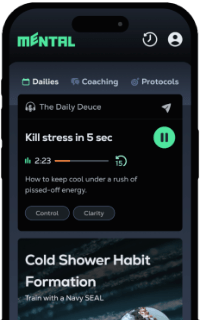
Anson: Compared to the female space, we're the only ones who hired a comedian early on, and compared to the social media male bro-advice space, I'm the only leader of an org who isn't a jacked muscle guy. I'm pretty strong, but I'm not the Liver King. Even our tone… We try to build what our app is into men's daily routines. What's most men's routine? Well, it's the shit, shower, and shave. So we said, let's create a little content for the part of your day where you're taking a deuce, and we'll call it the Daily Deuce. Instead of doom scrolling, you just have a two-minute audio that gives you a mindset nudge, how to control stress and reconnect with your purpose. It's so short. You don't know where your time is needed in your day, but it infuses your mind for the rest of the day, and your self-talk has shifted.
Then you go into the shower, and we have this protocol. A lot of people know cold is good for you now but haven't tried it or struggle to try it. What we've done is the first-ever guided cold shower protocol, where we have a Master Chief Navy SEAL. This guy is a total badass. He created the Warrior Toughness program for the Navy along with a clinical psychologist, and now every sailor in the Navy has to go through this program. It's basically about how to perform under pressure, how to take a hit, get back up on your feet, and keep going, and how to have grit, how to keep going through that middle part of the race when it's starting to turn into a slog. How do you keep pushing at that point? So it's all these tools that came from the Navy SEALs, that he used under pressure.
What we do in the cold shower is train you in these mental tools in a situation when you're stressed, because cold water literally stresses you. So you train these tools under stress, and what that means is they become your automatic, reflexive response to stress in everyday life. People write in, like, my kids are yelling in the back seat of the car as I'm driving, and they suddenly find themselves using these mental tools, not even thinking about it, automatically, because they get a dose of adrenaline and noradrenaline in the shower when they practice them. Then when their kids are yelling in their ear, same thing, the tools turn on. You train these tools under stress so they show up in everyday stress. For a lot of guys, it's actually been really transformative in their daily life.
Tripp: So there's the nudge, the deuce, and then there's the cold shower. What's the third component?
Anson: When we talk about shave, we have a part of the app where we get you to reflect for a moment, and the reflection is on the deuce. The deuce is this insight.
Tripp: I'm breaking up as we call it the deuce, by the way.
Anson: It's an insight where you're like, oh, that's meaningful. But where people often stop when they hear that stuff, like when you hear Goggins be a badass or something, you're like, that's cool. But you don't apply it to yourself. You don't think about, in my day-to-day, what could I actually do to make that part of my life, or how does that apply to me? So we have a follow-up from the deuce where we get you to reflect, and we call that the shave bit, where it's just reflection.
Tripp: You're in the mirror. Right? It's perfect.
Anson: Yeah. Think about it for a second. And if you take the time and actually write your thoughts into that, we also have AI that takes who you are, what we know about you, and converts it into what we call the Daily Do. A real micro-action. Like, you're just reflecting about how this applies to you. If you wanna do one thing today that pushes you in that direction, just a small thing, this is what it is. So how do we take action? It's not just about reflection. If we wanna improve our lives, we need to act. And talking about male versus female oriented, that's what feels missing from a lot of men's approaches. We'll go deep in understanding what's happened to you, where you're at, what your emotions are. But a lot of guys are like, tell me what to do. What's the action? I'm ready to start. So that's what we try to get to right off the bat.
Tripp: That's where we feel a sense of autonomy. I'm doing something about this. This isn't just something happening to me. I'm grabbing the wheel. So I wanna commend you. With your background in neuroscience and a Master Chief Navy SEAL on board, you guys are Trojan-horsing a lot of cool shit into this app, but it feels more fun and light, whereas there's so much stuff out there that's the tough guy macho shit or the super high achiever, very serious. I love how you give a wink and a nod to the Gogginses and the Hubermans out there. It's like, we know where we fit into this space, and it's for those of us who wanna do something, but it's a bit more playful, and I really appreciate it.
The thing that cracked me up, though, is the Ask a Legend thing, where you pick your legends. Right? And then you can ask them questions, and I guess it's AI-powered. I got coaching this morning from Bob Marley, and I was laughing out loud. Bob Marley was coaching me on distress. I could just hear his voice as he was reading this to me. It was just in my head. It was just something shifting. It's a nudge to go in the right direction, breaking that pattern. If I was ruminating, it would jar me and break me out of that pattern a bit.
Anson: When you onboard, you get to pick the archetype that fits you, or that you aspire to, like Bob Marley or Elon or Ryan Reynolds.
Tripp: There were all the typical stoic guys and all these badasses, and then Bob Marley was in there. I was like, hell yeah.
Anson: Bruce Lee is our top-picked archetype right now. Men really aspire to Bruce. But you have those voices, and you're like, I'm going through something. What would they say? And this comes back to that early point about rumination. If you talk to yourself in third person and get out of your head and have a little perspective… When we're in our head, we're usually assholes to ourselves. Men's self-talk is harsh. It's one of the biggest things holding us back. We wouldn't talk to our friends that way, or our wives, or our children. We're so much harsher on ourselves. If you tell yourself, hey, talk to yourself as a friend, you'd be more encouraging, and you'd work through it better. That's almost what Ask a Legend really is. It's like, you're one of these guys you aspire to be. How would they talk about this? How would they talk to you? They give you that kind of feedback on what you're going through, and it's like, boom. That's right. I should stop being an asshole to myself.
Tripp: Right on, man. If somebody wants to check out Mental, how do they go about doing that?
Anson: Our website is getmental.com. We tell everyone, it's time to get mental. There's almost a stigma around being mental, like, oh, it's crazy. But it's like, screw that. Let's get mental. Let's go in there. But also get the app. If you're in the App Store and you search for Mental, it should show up as well.
Leaving the Safe Path: Risk, Security, and Your 89-Year-Old Self
Tripp: I could imagine the life on the academic track you were on, and feeling removed from that. We didn't get to go into this, but I imagine there were hooks and incentives for you to stay in that place. I'm appreciating how you have steered your life to more and more impact and meaning, where you could have just stayed in that place and been elevated and known and revered for that, and written your papers and gotten published and all that. But you've chosen to go with this risky path and try to meet people where they are. For so many of the guys I coach and talk to, they're wanting more of that impact and meaning, but it takes guts and the ability to steer into uncertainty and try shit and experiment. I'm appreciating that that's been your story here. Maybe we'll have to unpack that at a different time.
Anson: It's very easy, if you're seeing success in your career, to just run harder. Opportunities start presenting themselves, so you just try to seize them. There's food here. But why are you running so hard? Life is really short. We all like to imagine we're gonna live to 90, but that's not the case for most of us. And even 90 is not that far away. So what do I actually want to do? I'm willing to run hard, but taking the time to reconnect with that is really important. I know so many people who leave one job and go into the next, sometimes with a weekend between them. They just see the next rung up the career ladder, or a new opportunity, and they're probably gaining some things. But is it what they want from life when they're that 80- or 90-year-old on their deathbed? Are they like, hell yeah, that was a good move, I'm glad I did that? Or not. I think most of the time it's not. They're just running. They don't know why they're running.
Tripp: I think for most of us, we can get into that herd mentality, which is make the money, jump through the hoops and the hierarchy, and then we wonder why we're lacking any real connection to the work we're doing. I think there's also a built-in fear. We go, if I do the thing I really wanna do, I'll go broke. I'll lose the stability and the lifestyle I've come to enjoy, and that's a huge fear. So it becomes this either-or. Either I do something impactful and I go broke, or I stay in this safe zone but don't feel any connection to meaning and fulfillment. Was that ever the case for you? Did you battle that part that was like, no, just play it safe, stay in your lane? Did any of that come up?
Anson: Oh, yeah, for sure. There were opportunities. I could have gone on and had a comfortable job at a great company. The problems there would have been interesting, though maybe not rewarding in a lot of ways, and it would have paid better. A better standard of living and less stress about money was possible there. But I had to think about where I'm at in my career and what I want now. Those types of problems, maybe later in my life, would be fun problems to tackle. But where I'm at now and what I'm passionate about, I realized it's not that right now.
And then there's the financial side. I get it. If you're at risk of not being able to pay your mortgage, maybe for you that is too big a risk, and you need to find a middle zone. But there are ways to find that middle zone. With me, I'm not gonna risk being houseless with a family. I was thinking about security because I had a three-year-old, and now I have a five-week-old. I knew I was gonna have another kid, so maybe security is the best thing, just maximize that. But what I was able to see is what risk level I'm comfortable with. How deep can I go? I looked at that logically and was willing to take a certain amount of risk, and I knew I had enough buffer to do it. I knew now was the time. If I didn't do it now, I sure wouldn't be doing it five years from now. So I realized what comfort zones I was willing to go with, and decided, can I handle that level of stress? And I was like, yeah, I commit to that, because of all the potential upside, and knowing this is a moment that's not gonna return.
I think there's no balance in so much of the cultural conversation, and that's what we come back to at Mental. Goggins just does it so over the top. I always joke, never go full Goggins. But how do we get a bit of that? It's the same thing in your life. Can you take risks? You don't have to go wild and risk the house. But that also doesn't mean you work a job that's not in sync with your purpose or what you care about. Find that balance zone. Figure out what works for you, logically, coming from a place other than fear. Can I do this? For a lot of people, I believe we can. I see tons of guys charging hard, saying, only once I make a certain amount of money and basically never have to work again, then I can do it. But then I think they're scared of losing the money they've accrued, and they're stressing about that. And if you can't start when you have the buffer you need, you're just not going to. So now is the time.
Tripp: You're naming this all-or-nothing mentality, and it's very similar to all the fear stuff we were talking about, how lousy we are at assessing what's really at stake. Part of this is, no, no, no, you can't go in that direction at all, just stay safe at all costs. But what I wanna highlight is that part of you that got curious and said, well, what's possible? Security is still necessary, and I also still wanna do this other thing. Given that this is my scenario, what could I do? That willingness to get curious, to actually open up a document and start working the numbers, getting into the nitty-gritty of it, is far different from living in a world where there's that thing over there that might kill me, versus this thing where I'm just safe all the time. I'm gonna use the word lazy, because I think it is a lazy way to think about life. So the encouraging thing I wanna put out there for the listener is just get curious. What would it take to do a little bit? It doesn't have to be the thing you pay your bills with just yet. Maybe phase one is just learning about it and getting involved and engaged in something, but you're no longer waiting. Your head can hit the pillow at night knowing you're doing something and building towards whatever the next phase might be.
Anson: I love that. I would add, try to connect with your 89-year-old self. What would he be telling you to do? He knows you can't just throw away the house, and there needs to be a certain amount of stability through life. He's not a gambler. But what does he want you to do? And it's usually something different than what you're doing right now.
Tripp: Exactly. I love that. There's something about looking at our lives as a whole, as a unit, and then seeing, oh, this is just a blink. It might be a pain in the ass, relatively speaking, for a little while. It might be uncomfortable for a little while. But in terms of the whole picture, how do I wanna look back at this stage? Will I be happy that I kicked the can down the road and made excuses and sold myself out, or will I be happy that I gave it a shot and started leaning in, and did it in a way that wasn't stupid and reckless? Hell yeah. Beautiful, man. Anson, I'm so stoked that you guys are creating this, and that I see all the brilliance behind it, and all the ways you're trying to make it accessible and fun and playful for everyone. Thank you so much for doing this work.
Anson: Appreciate it. It's been awesome talking with you today.