

Podcast: Download
Subscribe: RSS
Is Psychedelic Therapy Worth the Hype? Will Van Derveer MD
Are you tired of fear, scarcity, and anxiety being a normal part of your life?
Do you think trauma only comes from combat or some crazy intense experience?
And if you’ve got some emotional challenges, will doing magic mushrooms with a backyard shaman make them go away?
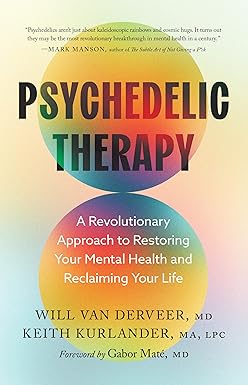
Today I talk with Will Van Derveer MD, a psychiatrist who got tired of doing what he was trained to do because it wasn’t actually working. Through his own healing experiences in clinical trials and ayahuasca ceremonies, he became a leader in psychedelic-assisted therapy. He and co-author Keith Kurlander just released Psychedelic Therapy — and it’s anything but a dry clinical textbook. In this conversation, we explore what really helps, what not to do with psychedelics, and why losing your shit in traffic is an indicator that you could benefit from some help.
In this interview:
- Admitting the limitations of therapy and psychiatry
- Big T trauma vs little t trauma
- Running on fear and scarcity vs inspiration/creativity/joy
- Are you hoping success will help you finally relax?
- Treating symptoms vs going to the root
Plus:
- Medicine ceremonies vs psychedelic assisted therapy
- Respecting the medicine
- Tripp’s challenging 5-MeO-DMT experience
- Who should stay away from psychedelics?
- Carl Jung and how mysticism and spirituality play into healing
Discussed in this interview:
About Will Van Derveer, MD

Will Van Derveer, MD is a psychiatrist and author of Psychedelic Therapy: Restore Your Mental Health and Reclaim Your Life which will be released by Shambhala Publications March 31, 2026.
He is co-founder of Integrative Psychiatry Institute, which has provided comprehensive training for 3000 mental health professionals in psychedelic-assisted psychotherapy and several thousand professionals in other continuing education programs.
In addition to his clinical practice and teaching, he has staffed clinical trials sponsored by MAPS, investigating MDMA-assisted psychotherapy for chronic, treatment-resistant PTSD.
Dr. Van Derveer is co-host of the Higher Practice Podcast, where he explores what it takes to achieve optimal mental health.
Transcript
Leaving conventional psychiatry behind
Tripp: I was really struck going through this book by how personal it was. I expected it to be more clinical. Here we are talking about psychedelic therapy, and here are these very personal anecdotes from you and from Keith, not just as people who had experiences with the medicines, but also as practitioners. Even just you sharing your own doubts and the troubling path you'd been on trying to help people before, where it wasn't effective. I was like, holy shit, this is really cool. I was kind of thinking it was going to be really clinical and hard to invite people into, but I appreciated how personal you were willing to be in this process.
Will: Well, thanks, Tripp. It's been a labor of love to finish med school, go into psychiatry, really believe in psychiatry in the beginning and commit to it wholeheartedly, and then discover that it had so many holes in it that just didn't get addressed. Things move slow in medicine. I really felt like I had to go out and fill up my tool bag with more than just a hammer and try to figure out how to help people more effectively.
Tripp: Walk us through that for yourself. Okay, I'm all in on psychiatry. I'm dedicating my life to this. This is med school. This is a big path, not a hobby. How long into that path did you realize, wait a second, maybe this isn't that helpful?
Will: I was really excited in my psychiatry training about learning therapy. It's funny to look back on it and think how far out I thought I was to want to learn therapy as a psychiatrist. That's about as far out as I got at that time. "You want to talk to people? Renegade. That's radical." So I chose a residency program at University of Colorado where I could learn therapy, and I had both talk therapy and medications in my kit. It only took about a year and a half after I graduated from training to start to realize that way too many people were not responding to this approach of talk therapy and medications.
Tripp: This was back in the nineties, is that right?
Will: This was right after the year 2000. So it was very early. And then I decided to get even more radical, and I learned how to meditate. Can you imagine that?
Tripp: Man, you were out there. Did they want to kick you out? "This guy's too strange."
Will: I had to keep it real hush-hush. Helping people learn how to be present with their experience helped to some degree, but there was a huge elephant in the room that I didn't recognize at all, which was the elephant of trauma. I had learned about PTSD, but PTSD is just one very narrow expression of trauma.
What trauma actually is
Tripp: You talk about trauma a lot in the book, and I think that word has gotten overused. It's like, "Oh, they got my latte order wrong and I'm traumatized." We've kind of belittled it in that way. And I can appreciate, especially with a lot of the guys I work with and even the upbringing I had, the attitude of "I don't want to admit that something has happened to me or that I'm struggling with something." There's this resistance to anything that can communicate weakness or damage. So when you list several different types of trauma that we can experience, can we be traumatized without going to war or falling off a cliff or something like that?
Will: Absolutely. When I'm traveling, it often comes up on an airplane. Somebody asks me what I do, and I talk about trauma, and they say, "Oh, you must work with veterans." And I say, yeah, I do work with veterans, but veterans represent a small portion of what people are dealing with out there and what they've been through. In the business, we talk about big-T trauma, like what you said: fall off a cliff, go to combat, get assaulted, single-event trauma. And then we talk about little-t trauma, which is the layers of traumas that can add up to something in your nervous system. I prefer to talk about trauma as a pattern in the nervous system that's dysregulated or out of balance. For example, someone who flies off the handle in traffic when someone cuts them off. I've had clients who get out of the car and go bang on the window of the person who cut them off. That's not a healthy range of response to something that didn't feel good to you, that maybe felt threatening, maybe felt scary. The human organism is meant to have resilience and the capacity to feel and receive experience and be present to it without going into fight or flight, or into dissociation or a freeze response. Many of us are walking around, myself included, who in childhood had a lot of experiences that maybe didn't meet the full criteria of "I went to combat or I fell off a cliff," but the nervous system responses are similar to what that person is experiencing.
Tripp: I want to draw this out, because on one hand, this could become an identity-level thing: "Something happened to me, or I had a tough childhood, and now I'm traumatized." On the other side, it's "suck it up, buttercup, everybody's got some shit, just truck through life." But what you're pointing to isn't that identity-level stuff. It's how your nervous system is handling or navigating life, and where you are on the reactivity level as you go through your day. That tells us something about your nervous system and where you are in your health.
Will: Right. The classic thing with veterans that I see is that you're either at zero on your ability to feel and respond, or you're at a hundred. People often flip-flop between flooding and numbing when they get back from combat. Flooding is feeling too much and wanting to run away and hide, because you're just feeling too much around your family or wherever you are. Maybe not panic, because that's also a trigger word for people. It might be not being able to go to crowded spaces. One friend of mine, a Marine Corps veteran, has a hard time on highways because when he sees a cardboard box on the side that blew off a truck, it's an IED every single time. Then there's the numbing, which is "I can't feel anything, and I need to drive a hundred miles an hour to feel something, or jump out of an airplane, or be a paramedic, or go to medical school to feel something." These qualities often don't oscillate in really obvious ways between numbing and flooding. Instead you're having these micro experiences all day long, and you're not even aware of them. Like, the way Tripp's looking at me right now reminds me unconsciously of the way my dad used to look at me. So I'm having an experience over here, and it's impacting my ability to be present in my life.
Tripp: So our nervous system is responding to the past. It's repeating and predicting, "This is what's happening here," so I'm reliving things in a guarded or defensive state, and it might seem absolutely normal. "This is just how life is." If that's all I think it is, I might not even seek an alternative. I might not recognize that there's another way to live. I'm just reactive to my kids or my spouse or my job. It's just normal. If I look around at the numbers of people who are on antidepressants, it's like, this is normal, we're all struggling with this stuff. We may not be talking about it, but there is another way to move through life.
Will: Absolutely. The memories that we have are meant to inform us and help us navigate. If we get into a car after we've already had a car accident, the accident should inform us in terms of how we look around, how fast we drive, and so on. But it's not meant to overwhelm or take over how we respond. A good way to think about quality of life is how much we can actually feel what's new in the present moment, versus having the memories take over and color our whole experience of it.
Running on fear and scarcity
Tripp: I talk to a lot of men who don't realize how much they're using success to relax their nervous system. It's like, "One day when I get to this place where there's plenty of money and plenty of status and I'm not vulnerable to X, Y, or Z anymore, then I can finally relax." Then they have a psychedelic experience and realize, "Oh, I'm already okay." There's a shift in reality: I've been running toward this finish line where I'll finally feel okay, I'll finally feel enough, when in actuality it's just a response to some kind of traumatic stuff. It's really just their nervous system being so jacked up. Is that something you see much in your practice?
Will: Absolutely. I can relate to that personally, big time. I like to think about it in my own life as trying to convert my engine from one fuel that burns really dirty to a fuel that burns clean. People behind me are seeing that plume of smoke, saying, "Man, this stinks. Could you please just change the oil?" It's sort of like running your engine on fear and scarcity versus inspiration and creativity and joy. For me personally, the fear that comes up is: Who's going to want to pay me to do the things I love to do? Am I going to be able to have the lifestyle I want? What's going to happen to me? Will I be safe ultimately if I just choose to express myself and be me?
Tripp: I totally relate. At my core, I feel like I know who I am on a creative-being level, who I'm here to be creatively, and then there's the voice that says, "Yeah, but you won't be safe. No one's going to pay for that. You can't support your family." Luckily for me, there's not too much daylight between that creative aspect and what I enjoy doing, but there is that lockdown of "Nope, you've got to stay on this. It's not safe to go be that free creative part of you."
Will: It's part of what really inspires me about artists. You really took that to a level that you couldn't have gotten to if you cared about what people thought. It's feast or famine, homeless or housed, and "I don't care, I'm just going to do my art." I'm feeling a little teary talking about it, because it feels so outrageous and courageous.
Tripp: Yeah. I'm always like, who paid your bills for so long?
Will: Well, I lived in my parents' basement.
Tripp: I was going to say, I had a rich girlfriend, and then I dated another rich girlfriend, and then I had a rich boyfriend, because I had to switch teams to make that work.
Will: Make it work.
Steve and the MDMA trial
Tripp: Make it work, yeah. I want to come back to this notion of trauma. You tell the story about Steve, who had road rage and would lose his shit. If I understand this correctly, he was diagnosed under your care as bipolar, and it didn't even occur to you that it was post-traumatic stress. Was that just part of the culture at the time, where there were only a few lanes and options on the menu?
Will: Yeah. The baseline assumption that I had was that PTSD is a thing, and if a person doesn't have the classic symptoms of PTSD, then trauma is not the root cause of the problem. This particular guy had what felt to me like very classic mania: rage, euphoria, expansive thinking, big energy. I was like, "Yeah, this is a mood disorder. It's clear. This is bipolar disorder, and I'm sticking to my guns." Then I prescribed him lithium, and that helped him. I try not to beat up on psychiatrists, because I don't want to beat up on myself here. But we sometimes prescribe a medicine that has been shown to work for a particular illness, and then the person is more stable, and we say, "Oh, that confirmed the illness." Well, it turns out that lithium also helps people with a traumatic nervous system like what we're talking about. It helps people feel more balanced, more able to face and deal with things. It's like having a deeper rudder in your ocean, so you're not bouncing around all the time.
Tripp: He ended up in one of the MDMA trials that you were overseeing, after you'd been with him for a few years, if I understand correctly.
Will: A long time.
Tripp: What did he convey to you while he was in the MDMA treatment?
Will: Oh, man. It was such a crazy, career-altering moment for me. He had taken the MDMA, and I was his MDMA therapist on the clinical trial. It takes about an hour and a half for MDMA to kick in, and you could tell that his pupils were dilating. He was starting to feel it, and he looked up at me and he said, "Well, God bless you. You tried so hard. You did everything in the book. Nothing you did helped me. This is helping me. And thank you. This is helping me." It was a really beautiful affirmation of the journey, of, like, here we are, and we have a tool that can help a lot of people who have not been helped by other things that are currently approved.
Why the resistance, and where approval stands
Tripp: I could imagine, years into this process and identifying as a psychiatrist in that traditional, conventional sense, that it would be activating. You'd go on the defense: "No, I was always doing it right." I appreciate your open mind: whatever needs to happen or whatever is going to work, that's what I'm willing to face. There's now overwhelming evidence through the clinical trials that MDMA therapy especially is really helping folks, even taking them off the list of being eligible for the study. Why is there still so much resistance, even at this stage, to psychedelics coming online?
Will: I think there are two buckets. There's the political bucket, which is all of the stigma from the Controlled Substances Act of Richard Nixon in 1970, which basically criminalized LSD and other psychedelics. So the stigma came from looking at psychedelics in the same way that we would look at heroin or cocaine or methamphetamine, things that really do damage to your body and your brain, and lives are lost. Then the other bucket is the medical establishment. My own personal soapbox on that is that we don't identify our own trauma as physicians, as a profession. The way we run training is based on military training. I could go on and on about all the aspects of what is traumatic about medical training. When I was working thirty-six-hour shifts in the hospital and people under my care were dying, there was no framework or relational holding around the lives that were lost, and you blame yourself. "I wasn't sharp in the thirtieth hour, and that person died, and it's my fault." Every physician I've met has stories like that, of being at the end of their rope when somebody died. That's just one example. So I think we have a medical establishment issue. It's a long tradition in medicine that we make the person with the innovation an outcast first. We humiliate them, we shame them, we put them outside the community, and then we eventually embrace what they had after they're gone and make it a standard of care. That whole process takes about thirty years in medicine.
Tripp: Where are we now? Fifteen years, ten, five, three?
Will: The good news, and we can get to this later if you want, is that where we are today, in March 2026, the FDA has a whole bunch of different medicines in the pipeline. There's a psilocybin product made by a company called Compass Pathways that is expected to go in front of the FDA by the end of this year. So we could have a federal approval by the end of 2026, which would be absolutely incredible. And there are 300 other compounds currently in the pipeline.
Clinical context versus ceremony
Tripp: We're looking at this through a different lens: let's go to the root of this. I think logically a lot of us can appreciate that we're not here to just mitigate symptoms. So why not just take the drug on its own? What is it about doing it within a therapeutic context that makes it more effective? One of the things I see that's frustrating is that, as guys, there's a tendency to isolate. I don't want to own that something's going on with me, and I certainly don't want to admit that I need help. How many veterans have put a gun in their mouth, or reached for a bottle, instead of getting help or feeling like they could be helped? So there's this tendency to isolate, and some of them would rather go do a ceremony in the jungle of South America. What's the difference between a South American medicine ceremony and what you're talking about in a therapeutic context?
Will: That's a great question. There are a number of differences, and I do talk about them in the book, so people can read more there. But one of the big differences is that what I'm standing for and trying to mainstream is a context where the person with trauma is supported one-on-one by someone who's there to make sure they're safe, to ask good questions, to not interfere with their experience, but to be there for them so they can do the healing work. I could talk for a long time about what that looks like in the room, but it's very different from a ceremonial context. I've spent the better part of a decade working with an ayahuasca shaman in South America and had a number of really amazing, beautiful healing experiences myself in that context. So I'm not here to say that context isn't worthwhile. It's incredibly valuable if you can do it. Obviously it's more expensive to travel to South America. But the instruction you would typically get from a traditional South American shaman is: "Look, your experience on this medicine is yours, and we're here running the group. We're not here to do one-on-one work with you. This isn't going to be us processing your trauma with you individually." Unfortunately, I've treated a number of people who went to the jungle and had experiences in ceremony that opened up a Pandora's box of childhood sexual abuse, or "my father beating me, and I don't remember that at all, and now I don't know what to do with that." I've had to work with those people intensively to get their life back together after coming back from a situation that opened things up but didn't help them process what opened up. People make journeys in traditional ceremony with indigenous medicines, and sometimes those journeys break people. They need months of help to feel like they're back to themselves again. And sometimes they have an incredibly beautiful and opening journey and they're back in their life a few days later. So it's a little bit like a game of spiritual roulette, how much is going to open up and how much needs help afterward.
Tripp: It's a bit like rolling the dice. Even before my experiences with psychedelics, on meditation retreats, something could crack open while you're on the cushion and there was no "Hey, let's go talk about it in the next room and process." It was just sit and cook in it. Even the teacher might say, "Yeah, just sit and cook in it, come back to the breath." That was an opportunity to work through something and transmute it into a new understanding or realization, and I always felt it was a missed opportunity. I could hear people in the room, or if something was happening for me, it was like, what the hell is going on? Is something wrong with me? And I've had experiences in ceremony too, really terrifying ones, like, what the fuck? Then coming out of it: what's wrong with me? I must not be able to do X, Y, or Z. And now I've got to go pay a fucking therapist to help me work through this.
Will: Right. Totally.
Tripp: Or call you. So I'm glad to hear it's not one or the other, but with the therapeutic context, we're really here to work on this, to help move it, rather than let's just see what the universe offers up when you take this medicine in ceremony.
Will: Absolutely. It ties into something I wanted to say about these medicines, which is that they are very strong. I like to tell people, you wouldn't give a ten-year-old a chainsaw and say, "Have fun with this, good luck," and send your kid out in the backyard with it. You need to have the right kind of understanding. You need to have the right guidance. If you do, then you can do really beautiful things with a chainsaw. But you could hurt yourself, and people do. Unfortunately, these situations not only hurt the individuals, they also hurt the reputation of the opportunity. When somebody's having a standoff with the police on their balcony on LSD, because they're inside some kind of weird space in their mind, and somebody gets shot or killed, it's incredibly tragic. First of all, that person, if they had the right support, could have moved through that experience and probably integrated the material they were working with. So there's a huge public education campaign that's necessary here to help people understand what the opportunity is. The other thing about recreational or nonclinical use is that people are orienting toward "I just want to go to the concert and have a cool experience and get high with my friends." Nothing wrong with that. I'm not making that wrong. But you could be at the concert and take the psychedelic, and all of a sudden you're in some kind of weird space, and you don't have an agreement with your friends. Like, "Hey, let's go to the concert, and I'm going to work with my trauma while you guys have fun." That's not the agreement. So you can feel incredibly isolated and scared, and you might go inside yourself and collapse inward, holding on by the skin of your teeth until the drug wears off. So I'm for safety and opportunity. Of course people should have fun with their friends and do whatever they want, but just be aware that these medicines do open things up for people, and sometimes it comes when you're not expecting it.
Who should avoid psychedelics, and Tripp's hard experience
Tripp: I'm glad you're not a proponent, and you never have been, of this being a magic bullet that just takes care of everything so you don't have to do the work because the medicine does the work. So who should avoid or stay away from psychedelics?
Will: Great question. I'm curious if you've had this experience. I certainly have, with young people taking LSD or mushrooms or something, and then they're never the same again afterward. The seventeen-, eighteen-, nineteen-year-old who might have a vulnerability, or a genetic risk factor, or a family member with schizophrenia or a major mental illness. The caution is that most of these major illnesses start around that age. So I personally think it's important for people to understand that this is not for everybody. There are certain people who shouldn't do it. Anyone who's had a really difficult experience with a psychedelic, where it took them months or years to come back to being themselves, probably shouldn't do a psychedelic again. I think that's true of anything in life: you probably shouldn't go do the thing that kind of blew you up.
Tripp: I did 5-MeO-DMT a few years ago, and it just beat the shit out of me. I'd never had anything close. It took me in a completely different direction, a hundred times whatever I'd ever done before. And it was terrifying. Absolutely terrifying. I remember thinking, god, if I was some guy who was trying to heal himself and was uneducated and read something on the internet like "this will heal you, and you'll see that this is the God molecule," all that kind of stuff, and just went on that ride, I would have put a gun in my mouth that night. It was awful. I knew I was going to be fine, even though I felt like I'd just put myself into a head-on car collision. On the other end, there were a lot of really beautiful things that came out of it too, but I didn't have enough respect for that medicine, and it did a number on me. I was just like, gosh, how often is this happening for others, whether they're young or in a place where they're really working through something and trying to heal themselves? There's got to be real regard for these medicines, and not fucking around with backyard shamans who are in their own place, like "I can heal people." It gave me an even deeper level of respect and regard for these medicines.
Will: I'm curious, Tripp, if you're open to sharing: what helped you get your feet back under you after that experience?
Tripp: Well, talking to others. I worked with some therapists and people who have experience with others who've gone through that. So the integration aspect of it, just trying to make sense of what the experiences were and what they meant. It definitely shook the snow globe in a way that I'd never come close to. But it took time. You know what it was? It was just full surrender. There were some terrifying, really ugly things that happened in there, and I wanted to push them away. And what actually happened was, what if those are aspects of me too that I just can't accept? Then it started to relax. I am all those things. If I am of the divine, then I'm of all of those things too, and I don't want to accept that those terrifying things are an aspect of me too on some level. That's when I felt like my nervous system started to relax. That's what helped. I'm curious what your thoughts are.
Will: That makes a lot of sense to me. The best framework I've come across for what changes for the better after psychedelics comes from Robin Carhart-Harris, one of the researchers at UCSF who does this work a lot, and he calls it psychological flexibility. If you think about it, in our internal mental world we're constantly trying to control everything. We like things to be a certain way. I like the traffic to be light. I don't like it when it's heavy. I like my wife to be friendly to me. I don't like it when she's sharp, or has a boundary or whatever. I like my coffee hot. I don't want cold coffee. You have these preferences that are really strong, and they can be brittle, stiff. Then something happens that's outside of our preferences, and we have a massive reaction to it. The measurement they're seeing in people who have a positive response to psychedelics for depression or for trauma is that they're more flexible. They're more able to be with things not being according to their preferences. And that includes what you're talking about: "Okay, I needed to accept that these things are part of me." Having the ability to grow, to say "I thought things were like that, but actually they're like this." To be able to make that transition is huge.
Humility, asking for help, and integration
Tripp: The part I didn't share is that I went into that ceremony with an intention along the lines of "Help me walk a heart-centered path. I really want to give over to a heart-centered path." I'm a pretty controlling guy. I like to have my life in control. And it beat the shit out of me, to the point where, well after the ceremony, at three in the morning, I got out of my bed and got on my knees and said, "Please fucking help me."
Will: Wow.
Tripp: How beautiful is that?
Will: Careful what you ask.
Tripp: That's what it was. It was like, okay, you have to get out of your own way. You don't get to lay out the terms for this. I wanted the heart-centered path, but all on my terms. That's so fucking arrogant, right? So it was really the ass-whooping into humility of "you can't do this alone." And I still struggle with that. But I saw the beauty in that. I could imagine from a much larger context that the ass-whooping doesn't mean anything, it was insignificant. It was like, "You want to walk this heart-centered path, and you need to let go of this, and we're just going to thump you in the head here until you get through it." I think about what else it would have taken for me to physically get out of bed and get on my knees and ask for help. And I got it.
Will: It takes what it takes.
Tripp: Yeah, it takes what it takes. And it was there instantly. It was like, "I'm here. I'm here to support you." And I was just like, holy shit.
Will: This programming… I'm a little reluctant to say this is all about men versus women, but speaking from that perspective, I know that I had a lot of programming around the rugged-individual tough guy. Don't need help, don't ask for help, it's bad and shameful to need other people, to need a therapist, to need your wife to put her hand on your back, to need anything from other people. It's such a tragedy, because for almost everybody the help is there. There's a place in Moab where I go mountain biking as often as I can called Dead Horse Point, where a bunch of horses were corralled onto this cliff overlooking the river, and they couldn't get to it. A bunch of horses died of thirst looking at the river. I think about that a lot with guys, because there's so much available support if we just humble ourselves, like you're saying, and ask: "Hey, can I get your reflection on this? Can I talk to you about something that's on my mind? Can I get this off my chest?"
Tripp: It's heartbreaking. It's right here, but we can't see it. It's off limits for whatever reason. Let's talk about this integration piece, because you asked me what helped, and what helped came after the experiences. In the typical medicine ceremony style, you have the medicine and you have the ceremony and then you just kind of… maybe you'll do some journaling, or maybe you're scratching your head for the next several weeks. Who knows? I get frustrated when clients of mine do ceremony and have this ecstatic experience, some huge experience, and then there's no "Okay, what are we going to do differently from here on out?" They're doing them independently, not as part of my work with them. And I've said, don't keep going on these retreats if you're not going to integrate. I've challenged guys: how about we start to integrate this a bit more? I feel very strongly about this, but I'm curious to hear more from you.
Will: I totally agree with you. There's a kind of spiritual tourism phenomenon of people asking, "What's the latest, coolest psychedelic to go do? It used to be Bufo, and now it's ibogaine, let's go do ibogaine." And then, well, then what happened? "Well, I had this really cool experience, but I'm still living in my parents' basement, or I'm still drinking myself to sleep every night, or I'm still not able to say no to my narcissistic boss." The behavior change, making our life different, is what this is about. It's not about having some kind of peak experience that doesn't become part of the new operating system. So what we like to do is prepare people from the get-go for that. The first preparation sessions are about identifying the places in your life that need to change, that we hope this catalyst is going to help you change. You said this earlier: the drugs don't change you. They give you a glimpse of the opportunity that you can realize through hard work afterward. It truly is the Jack Kornfield book title, After the Ecstasy, the Laundry. You've got to do the work.
Tripp: Which isn't sexy if it's "Hey, the medicine's going to do the work for me. I just hand it over."
Will: Yeah. I'm just going to lie back here and let the mushrooms work for me.
Tripp: It's a bit like the drama triangle with the universe. "I'm powerless, I'm going to leave it to you, I'm going to give it over to you to come and rescue me or take care of my problem for me." And it's going to be humbling: no, you've got to do it yourself. There are aspects of this that are your responsibility.
Will: Totally. It's that dance, and I love that saying, I forget which poet it was: trust God and tie up your camel. It's both. And the question is what measure of which, at what time?
Tripp: You've got to use your head. Take risks.
Self-actualization and spirituality
Tripp: We've been talking about this through the lens of people who are really struggling with trauma and reactivity in their life. What if someone doesn't necessarily identify with that, but they're interested in these medicines for more of a self-actualization? Is it still the same, or would you recommend a different way of going about it?
Will: I think there are differences from one individual to another in terms of how much deep trauma they're carrying in their body. I'm curious if you relate to this with your journey with medicine work. I would count myself in a blessed group of people who came in with a lot of trauma early, and then through a lot of healing work, I think almost all of the trauma is integrated in my body. Not all of it. It's a lifelong journey, and we're always growing and changing. But there are people who didn't have as many gnarly things happen in childhood. I'm not here to say everybody's arriving into adulthood in the same way, by any means. So there are people who can have self-guided or recreational experiences without as much risk as the next person. But if you don't know what that risk category is, I would say start conservative. Start with less risk-taking. That's typical of teenagers, right? They underestimate the risks. Hopefully, with wisdom, as we go through experiences like the ones you and I have had, you develop that wisdom and you're a little more cautious. Then you can talk to other guys or other people and say, "You know what? Taking that fifty-foot jump is probably not where you start."
Tripp: Well, fuck around and find out, right?
Will: Good luck with that.
Tripp: Good luck with that. I want to come back to the psychiatry standpoint in conventional medicine, which is void of any mysticism or spirituality. It's just not part of the science, and understandably, we can't measure it, so we don't talk about it. And yet the mystical aspects of this work, and how important they are to healing, are huge when it comes to these medicines. I'd love to hear your insights on that, as someone who has been trained as a doctor in this realm but must also hear over and over again how the healing comes through this kind of spiritual portal for a lot of us.
Will: Absolutely. We put the human ego on a pedestal. The thinking is, if you've got a functional ego, you can take care of yourself, you've got good boundaries, you know how to balance your checkbook, you've got a job, a house, a car, then you're pretty much as healthy as a human being gets. One of the reasons I like looking at the work of Carl Jung so much is that even in the eighteen hundreds he was beginning to question that. He thought there's a spiritual or mystical dimension to human health, something beyond the ego. His contribution became known as transpersonal psychology, so going beyond the person. What happens with psychedelics is that people often have an experience that's beyond the person. They go outside of the finite, boundaried ego. For certain people at some moments, that can feel terrifying because you're losing yourself, and some people call that an ego death experience. Other times, if it's supported properly, you can have this beautiful relaxation of "Oh, I'm not a small grain of sand, cold and alone in the universe. I'm connected to the whole beach, and the ocean's washing over me, and it feels amazing." You have this unity, this non-alone feeling, and that can feel incredibly reassuring. "My survival or my success or failure is not only up to me. There's all of this other stuff going on."
Tripp: If I'm in a level of consciousness where it's me against the universe, it's really fucking hard. Even a grain of sand doesn't describe how infinitely small we are in that regard. But if I can expand or find a different seat, a higher sense of consciousness, and I realize I am an aspect of the universe and this is me too, then whatever problem I'm experiencing, I get to see it from a different perspective rather than from that very small, limited, terrifying experience.
Will: Exactly. And this is just my personal opinion, but from my experiences, the core message of spirituality is: you are not alone. The universe, or God, whatever language you want, is for your success. The challenge in front of you is on the way, not in the way. You're going to be okay. These are the messages that people who are plugged in spiritually often talk about. And for someone who's not plugged in, that sounds like a bunch of bullshit.
Tripp: Sure. There can be all kinds of ways to deny that or fight that and essentially protect our separateness, because this is what defines me.
Multiplicity and wholeness
Will: It's interesting to think about another theme in psychedelic therapy, which is the word multiplicity. Multiple things can be true at the same time that appear to be contradictory. I do have a separate physical body. I'm not merged with another person's body. That's true. But it's also true that we're connected and that there are forces we can't see or even consciously feel. For example, the magnetic field of the human heart can be detected from across the room with a scientific instrument. Other people's hearts can feel that too, and there's entrainment that happens between the heartbeats of people in the same room together. So when there's a leader in the room who's well regulated, grounded, and present, it has a huge impact on the people sitting around that person. And the opposite is also true. When the leader is very dysregulated or traumatized, people can feel that, and they don't feel safe.
Tripp: Sure. So let's talk about wholeness here, because I think this points to how cut off or fragmented I am from myself. How are you and Keith talking about wholeness in this context?
Will: Good question. I'm borrowing this somewhat from the traditional ceremonies that I've had the privilege to sit in for so many years. One way to frame illness is as fragmentation or disconnection, and that can be internal, in the form of the impact that trauma can have. Many people can probably relate to the phenomenon where your partner looks at you in a certain way, or says a word that triggers a response in you, and all of a sudden you're a different person. You're reacting like the four-year-old boy whose mom just came into your room and caught you eating chocolate or masturbating or whatever you were doing in there.
Tripp: At four? You were hitting it at four.
Will: Or both. And you're just gone. So there's the phenomenon of parts work. Internal Family Systems is a useful metaphor; you and I have talked about this before. The work of Dick Schwartz is incredibly powerful around acknowledging that we all have parts of our personality. At times we don't even know who we are, because there's a younger part that's coming forward and taking over. For me, it's helpful when my wife says, "Who are you, and what have you done with Will?" Then I think, oh, wait, who am I right now? In the impact of trauma, we often have a fragmented part that goes off to the side and waits in the shadows, watching our life. When something gets scary or dangerous, it comes in to help us. We call that a protector part. There are other kinds of parts in that pantheon, if you will, of self parts. So wholeness is when these parts have developed a relationship with each other and don't need to operate independently anymore. You have a much more unified and full experience of being human.
Tripp: So wholeness is everybody getting closer to being on the same page and having more of a relationship, rather than having things all walled off.
Will: You can think of it as a boardroom. I've heard Dick say that before. Make sure all the seats are filled and all the voices are accounted for, and then we can make a decision together.
The fundamentals
Tripp: Well, I'm really grateful for the work you're doing. I love the integration that you bring, and I know that's part of the Integrative Psychiatry Institute that you and Keith run together. I love that you take account of all the things. It's not just doing this work. There's diet, there are so many other things that are huge, and they're all part of what gives us more access to our wholeness. I love that you guys represent the whole pie and not just "Here, do your psychedelic medicine and you're good." But this has been a very powerful piece of the puzzle too.
Will: Going back to what you said about people doing more and more psychedelics: are your fundamentals covered? Is your nutrition dialed in? Are you getting enough steps every day? Are you sleeping well every night? What's your relationship with alcohol? How's your relationship at home? Can you speak up? Can you open and receive what your partner needs to say to you? If these things are not handled, there is no amount of psychedelic that will ever help. The point of the psychedelic is to help you grab onto an opportunity to change those things and improve them in your life.
Tripp: That's back to the responsibility piece. If I'm looking for this to be the magic bullet and offer me a rope out, because I don't want to do this other work, I don't want to address those things, it's going to be frustrating. All right, my man. Congrats on the new book. Congrats to you and Keith both. And thank you so much.
Will: Thanks, Tripp. It's been a lot of fun, and I always enjoy our conversations. Thanks for having me.