
Podcast: Download
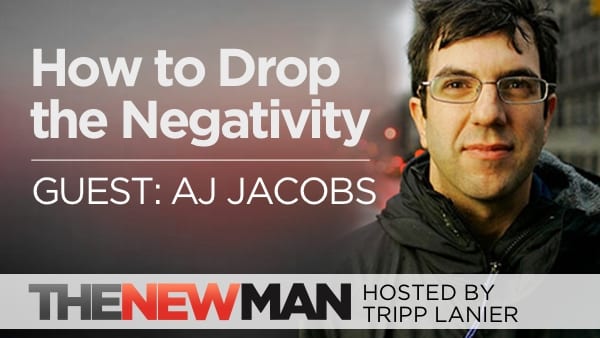
AJ Jacobs Thanks a Thousand
 Do you let one negative thing ruin your day instead of appreciating the thousands of positive things that went right?
If gratitude is so helpful, then why is it so difficult?
And how do you get a bass player off of your front porch?
Human guinea pig and bestselling author AJ Jacobs returns to discuss what he’s learned from his latest long term experiment. This time he’s set out to explore what will make him less grouchy — and it all starts with a simple cup of coffee.
In this interview:
- Are we wired to be negative?
- Why is it hard to be positive?
- Are we really happier when we’re the center of our own attention?
- What are the “bass players” of life?
- A lesson learned from Chris Rock’s Tambourine comedy special
- What happens when we slow down and notice what’s required to simply have a cup of coffee
About A.J. Jacobs
 A.J. Jacobs is an author, journalist, lecturer and human guinea pig. He has written four New York Times bestsellers that combine memoir, science, humor and a dash of self-help.
He is also editor at large at Esquire magazine, a commentator on NPR and a columnist for Mental Floss magazine. He is currently helping to build a family tree of the entire world and holding the biggest family reunion ever in 2015.
His first book is called The Know-It-All: One Man’s Humble Quest to Become the Smartest Person in the World (Simon & Schuster, 2004). The memoir — which spent two months on the New York Times bestseller list — chronicles the 18 months Jacobs spent reading the entire Encyclopedia Britannica in a quest to learn everything in the world. It was praised by Time magazine, Newsweek, Vanity Fair, USA Today, Janet Maslin in the New York Times and AJ’s uncle Henry on Amazon.com.
After trying to improve his mind, he turned to his spirit. The Year of Living Biblically: One Man’s Humble Quest to Follow the Bible as Literally as Possible (2007) tells of his attempt to follow the hundreds of rules in the Good Book. It spent three months on the NYT bestseller list, and was praised by Publishers Weekly, Kirkus Reviews, The New York Times Book Review, the Los Angeles Times, USA Today and others. It appeared on the cover of the evangelical magazine Relevant, but was also featured in Penthouse. (Jacobs is proud to be a uniter, not a divider).
In 2012, Jacobs completed his mind-spirit-body self-improvement trinity with Drop Dead Healthy: One Man’s Humble Quest for Bodily Perfection. It is the tale of his quest to be as healthy as humanly possible for which he revamped his diet, exercise regimen, sleep schedule, sex life, posture and more. He wrote the book on a treadmill desk (It took him about 1,200 miles).
He also published a collection of essays called My Life as an Experiment: One Man’s Humble Quest to Improve Himself (2010). The book contains experiments featuring George Washington’s rules of life, marital harmony, marital disharmony, multitasking and nudity – not in that order. It includes the Esquire piece ‘My Outsourced Life,’ which also appeared in Tim Ferriss’s 4-Hour Workweek.
In addition to his books, Jacobs written for The New York Times, Entertainment Weekly, New York magazine and Dental Economics magazine, one of the top five magazines about the financial side of tooth care.
He has appeared on Oprah, The Today Show, Good Morning America, CNN, The Dr. Oz Show, Conan and The Colbert Report.
He has given several TED talks, including ones about living biblically, creating a one-world family, and living healthily.
He is a periodic commentator on NPR’s Weekend Edition Saturday, where he dispenses world-shaking historical trivia, including segments on tennis, royalty, and congress behaving badly (the 19th century Vermont lawmaker who spat chewing tobacco in his opponent’s face).
He writes a bi-weekly advice column for Esquire.com called “My Huddled Masses”. Jacobs crowdsources the advice, asking his 120,000 Facebook followers for their insights on etiquette, moral dilemmas and how to deal with overabundant arm hair.
He writes another advice column for Mental Floss magazine in which he tries to make readers feel better by describing daily life past centuries. The good old days were terrible (“mind-bogglingly dirty, painful, fetid, smelly, sickly and boring”).
He is also a columnist for the LinkedIn Influencers program. His pieces include ‘The Six Most Important Business Lessons from All of History‘ and An Entrepreneur’s Most Powerful Tool: Self-Delusion.
Jacobs grew up in New York City. His father is a lawyer who holds the world record for the most footnotes in a law review article (4,812). His wife works for a highbrow scavenger hunt called Watson Adventures. He lives in New York with his family. He wonders if he fooled anyone with this third-person thing, or if everyone knows that he wrote this bio himself.
https://AJJacobs.com/thanks
Click here for A.J. Jacobs’ book Thanks a Thousand: A Gratitude Journey.
Transcript
Getting started and the human guinea pig
AJ: Hey, Tripp.
Tripp: AJ, how are you, buddy?
AJ: I'm good. How are you?
Tripp: I'm well. It's good to see you.
AJ: Good to see you. Hold on, let me do this. Hopefully this is better.
Tripp: You've got the nice fancy microphone there.
AJ: I try to be professional, but it works only half the time. Hopefully it's working now.
Tripp: Only half the time? It's temperamental, like a diva microphone?
AJ: Well, for my lack of gadget savviness.
Tripp: Okay.
AJ: So, I am thankful, of course, to be on your show.
Tripp: I was wondering when that first one was coming. You got it in there.
AJ: In there.
Tripp: You've been on the show several times, and you've come on to talk about The Year of Living Biblically. Let's try that one again. You've talked about The Year of Living Biblically. Still gonna work on that one. Drop Dead Healthy. You're this human guinea pig. Was your wife happy that you did something not so crazy this time around and just went down this road?
AJ: Yeah, this was better for my marriage than several of my other books. As you mentioned, I did one called The Year of Living Biblically, where I had to follow all the rules of the Old Testament, including grow this huge beard. I had this topiary hanging from my chin and my wife wouldn't kiss me for 7 months. And I couldn't touch her when she was menstruating. So yeah, she didn't love that. This one was about gratitude and, you know, good lesson for our kids. So yes, it bought me some capital.
Why gratitude is so hard
Tripp: When you came on and we talked about Drop Dead Healthy and all these different practices that you were into, I asked you what was the main one that really stuck out, and you mentioned gratitude at the time. So why do you think it's so hard for people to practice this thing? What's the resistance to practicing gratitude? It seems like it would be really simple. We say thank you all the time, but that's not really what the practice is. I'm just curious from your perspective, going out and writing this book about gratitude, and you do it in such an interesting, unique way. Just right off the top, why do people have a hard time expressing sincere gratitude? Not just the social things that we're supposed to say when you hold the door or something like that.
AJ: Well, I just don't think we're wired to be grateful. If you believe evolutionary psychology, it's because when we were cave people, it was much more important to focus on the negative. You want to focus on the one wild mushroom that is poisonous. You want to focus on the lion who might chase you, as opposed to marveling at all the good things. But nowadays, it's a terrible way to go through life, a cause of a lot of stress and depression. I often think about it as my battle between my inner Larry David and my inner Mr. Rogers. And the Larry David side, I believe, when I was born, I was just temperamentally, the Larry David side is really strong.
Tripp: And that means grumpy, agitated, irritated, and justifiably so. Even though everything is going well in life, we still have to find a reason to be—
AJ: Exactly. Find the negative. We are excellent at finding the negative and focusing on that, the 3 or 4 things that go wrong every day as opposed to the hundreds that we just don't notice that go right. So this book was an attempt to systematically build up that Mr. Rogers side, and it worked to some extent. I still complain and notice the negative, but it's been a radical change in perspective.
Tripp: I want to come back to this. You call it in the book the negativity bias. We have a deficit mindset instead of a surplus mindset. What do you find for yourself when you're in that place? You describe some of the scenarios, like when you miss the subway and that kind of stuff. What do you do when you find yourself in your Larry David and you want to be a little bit more Mr. Rogers?
AJ: Well, there are several strategies, and I think it's like a practice. It's like training for a triathlon. You actually have to go out and do this consciously. So it could be making a note to yourself every time something goes right. I talk about how when I press the elevator button, I'm thankful the elevator comes. I get in the elevator, I'm thankful it doesn't plummet to the basement and break my collarbone. There are hundreds of things that go right that we don't notice, and we focus on the ones that go wrong. And this whole book was kind of an exercise in reminding myself of all that I take for granted.
Thanking everyone behind a cup of coffee
AJ: The premise of the book, as you know, is that I take my cup of coffee and I try to thank every single person who made that cup of coffee possible, however small their role. And it was fascinating because you do see that it is a network. It's hundreds of people. It's 6 degrees of gratitude. I can thank the truck driver for carrying the coffee beans, but he couldn't do his job without the guy who built the road. So I gotta thank that person. And then the person who painted the yellow lines on the road so the truck didn't veer into oncoming traffic. I could have spent the rest of my life finding people.
Tripp: That's right, so interconnected, all the little things that have to fall into place to have your cup of coffee every morning. It's easy to just, like you said, shove your credit card in the face of the barista and say, here. But all the things that had to line up in order for you to have just this simple cup of coffee. When we break it down, it's actually quite a miracle that all these things happened and all the people showed up. And you call them the bass players of life. What do you mean by that? Oh, by the way, how do you get a bass player off your front porch?
AJ: How do you do it?
Tripp: You pay him for the pizza. Sorry, I'm a musician, you gotta throw a bass player joke in there.
AJ: I see the guitar in the background, and that's not a bass guitar.
Tripp: No, I got one over here though. I love bass players, don't worry about that. But what is that? You're talking about how we all want to be center stage, we want to be the rock star, the lead singer, the lead guitarist, and yet the world is built upon the rhythm section, upon these bass players in life. What do you mean by that?
AJ: Absolutely, just what you said, that the bass players are so important and so under-recognized. This actually came about because I hung out a lot with a bass player for this book. His day job is that he's the guy who tastes the coffee for my café. He samples the beans. And it's hilarious because he'll taste a cup and his face will light up and he'll start spouting adjectives like, this tastes like pineapple upside-down cake and maple syrup and hints of lavender. And I'll take a sip and be like, tastes like coffee to me. But learning from him, I did start to appreciate all that goes into it. And what I love is that if he didn't spend all this time and passion, then my life would be a little less rich because my coffee wouldn't be quite as good. He said, it's weird that you're featuring me because I'm a bass player. But bass players are important and we just don't get the recognition. And I love that because I do think, like you said, everyone wants to be the rock star, everyone wants to be the center of attention, but that's not how we get great science. We need people who are doing some of the less glamorous work of replicating experiments. And it reminds me of Chris Rock, one of his recent stand-ups that I saw a couple of weeks ago. He was talking about it in terms of marriage. He said you've gotta remember that you are not always the lead singer. Sometimes you gotta stand in the background and play the tambourine. That was the name of the special.
Tripp: Yeah.
AJ: And I loved that. And he said the key is you gotta look like you're having a good time playing. You can't be sneering and angry that you're playing the tambourine. You play that tambourine and you enjoy it. Because that's true, life does not work if everyone is the lead singer all the time.
Entitlement, meaning, and the big picture
Tripp: I think that's why a lot of people are pissed off and resentful. There's this entitlement. There's this sense like, I should be the lead singer, I should be out in front, I shouldn't be in the background. But it seems like if you're disconnected from the meaning of what you're doing… And I think that was really cool in the book, you're just calling these people up and you're offering them gratitude and they're like, who are you? They're not even really connected to the meaning that they provide. And I know the Buddhists have been on the track for this for a while. It's like the more you get over yourself, the more enjoyment you start to have, and the more you start to see how you're interconnected and contributing to one another, even if it's just, yeah, we're in the coffee business, big deal, right? But it means a lot to people.
AJ: If I can really connect to it. It reminds me of this anecdote I heard, which I looked into, and it does seem to have really happened. It's not apocryphal. JFK, when he was president, was touring NASA, and he passed by a janitor, and he asked the janitor, what do you do? And the janitor said, well, I'm helping people to get to the moon. And I love that, because he saw his job not as this terrible, demeaning job of cleaning the toilets. Instead, he saw it as part of a bigger picture. He's gotta keep the place clean and safe so that the engineers can do their job and the astronauts can do their job. And I'm sure that frame of mind is much healthier. And there have been tons of studies on this too. When you're able to reframe it… even with fundraisers, when you show fundraisers the people that they help, like the students who have gotten scholarships because of their fundraising, they're much more motivated.
Tripp: If they just write a check and it goes off and they don't really see the impact that they're having, that's one thing. But if you see the impact, it's like, well, man, I'm gonna keep going. This feels good. I can see this.
AJ: And I think almost every job has that. You just have to recognize it.
Tripp: It seems like we've gotta shift that frame of mind too. I'm gonna read a quote here. You quoted UC Davis psychology professor Robert Emmons, who's considered the father of gratitude research, and he flips it around. He says, "Grateful living is possible only when we realize that other people and agents do things for us that we cannot do for ourselves. Gratitude emerges from two stages of information processing: affirmation and recognition. We affirm the good and credit others with bringing it about. In gratitude, we recognize that the source of goodness is outside of ourselves." So on one hand, we're talking about, hey, I recognize my position here, I'm part of something larger than myself. But in order to have gratitude, I've gotta see that I'm also impacted by things. I'm not just me against the world. I don't know what part of our brains it is, this tiny little slimy thing that says I'm separate from everything else in the universe, that little disgusting part that says everything else is working against me, right? And a lot of people, if you ask them if they're supported, their first thing might be, no, I'm not. And it's like, well, look around, look at all the things that are working, like you said, the elevator, all the things that are happening that support us. It seems essential that we have to get outside of our own head in that way to recognize that we can be grateful first and foremost. Does that make sense?
AJ: I love that. I think what makes gratitude so powerful is that it's good for the thanker and the thankee. Ideally, people should be happy when you thank them, and then you feel better. So from a purely selfish point of view, gratitude is a really good strategy. And that's one of the big arcs of my life, the paradox that I was in my 20s and 30s really out for myself and concerned about my own happiness. I'm sure some Buddhist has put it better, but when you are chasing exclusively your own happiness, you're never really happy. So the irony is, as I'm older and closer to death, I'm trying to think less about myself and more about my family or my extended family or humans or sentient beings, whatever, a little bit outside of myself. And the more you can think of that, the happier you are, because it's a relief to not have everything be about your own happiness. Like, oh, I had a bad day. Big deal.
Tripp: Big deal.
AJ: I had a bad day. How are other people doing? Can I help other people?
Tripp: I bet we can go a little far, right? We can disown aspects of ourselves. But I get what you're saying. I think we are happier when we're not so focused on ourselves, when we're not looking in the mirror and thinking, how do I look? We don't deny that there are challenges in our lives, but we feel at our best when the whole story isn't about us and we can actually contribute to others.
AJ: I do. It's a lovely paradox in a way.
Thanking people for real
Tripp: You talked about reaching out and saying thank you to so many people as you traced the pathway of what actually creates a cup of coffee. You were talking about the lids and the cups and the beans, and you went to Colombia. It's an amazing story. But you called all of these people. Was it hard for them to accept the gratitude? When people say thank you to me, a lot of times I just brush it off. I don't know what to do with gratitude.
AJ: Well, it is funny. You got a mixed reaction. I would sometimes visit people to thank them. I would cold call them or email them. And some of them were like, what's going on? Is this a pyramid scheme? What are you trying to sell me? And I'm like, no. But I will say the majority of people were surprised, but in a pleasant way. I remember calling the woman who did pest control for the Coffee Bean Warehouse. And I said, "I know this sounds a little strange, but I just want to thank you for keeping the bugs out of my coffee." And she was like, "Well, that is strange, but you know what? That made my day." And it was like an anti-crank phone call. It was like penance for all of the obnoxious crank phone calls I made in high school to make fun of my principal.
Tripp: That's great.
AJ: I think there was just a study like 2 weeks ago that said we generally overestimate how awkward it's gonna be to thank people and underestimate how much it will mean to them. So my thought is, it's gonna be a little tiny bit awkward, but it's worth it. Give it a shot.
Tripp: I like that you had that sense of, let's go in there anyway. There have been times where I'm checking out at the grocery store and the cashier is a radiant person. It's like, wow, I'm in a different mood because of who this person is, but I'll keep that to myself. I'll just walk out and I'm like, man, I should have thanked her for that because she just brightened my whole day. To not give the gratitude feels bad. It has a net negative effect, or at least when I don't share, it's like, ah.
AJ: I like that.
Tripp: It doesn't feel good. It feels like, I didn't give this gift and now I'm gonna hold this burden. So it feels good to just say, wow, thank you. You made my day. You just totally lit my whole day up. So thanks so much for that.
AJ: I love that.
Noticing the hidden masterpieces
Tripp: I want to get to this part because there's another thread here, which is what happens when we get curious, right? If we're so self-absorbed and all we can think about is what's not going right or what's missing in life, we don't take into account what goes into the things that are in our life, like just this simple cup of coffee that we have every morning. I'm curious how it impacted you to start to see all the mechanisms, even the logo on the cup, and how the jacket was made, and how it was in the Museum of Modern Art. All of this stuff that we just blindly go through life with, and you started to research the lid, like it was the Tesla of lids on your cup of coffee. But there's something that happens when you slow down and you start to appreciate what goes into something so simple. Can you talk about how your experience of a cup of coffee is different now than it was before?
AJ: Absolutely. And I think you put it very well. It's this idea of noticing the thousands of little hidden masterpieces all around us. I thanked not just the coffee makers, but I needed the cup to have my coffee, so I thanked the cup makers and then the little cardboard sleeve on the coffee, which I learned has a name. It's a zarf, Z-A-R-F. And there were ancient zarfs in China made of gold and tortoiseshell.
Tripp: Oh, we gotta step it up. We gotta step up our zarf game.
AJ: And I think that's more environmentally sound, like a recyclable zarf.
Tripp: A gold zarf.
AJ: Yeah. But I interviewed the guy who created the modern zarf, and it was a wonderful story. He was just picking up his daughter from school, and the coffee he got at a takeout was too hot, so he spilled it. And then he's like, this has gotta stop. And he created the zarf. And I just love that if you look around, everything has… I'm looking now at the desk lamp and it's got this on/off switch, which has a little indentation for my thumb. It's not flat. And someone thought about that, and someone came up with like 8 different designs. And it just makes me happy to know that there are all these people putting passion and thought into everything we do. And it makes you take things less for granted.
Tripp: Life's not as mundane as it may appear. It reminds me, this was years ago, I went on a date with this gal, and it wasn't much of a date. I don't remember anything about the date other than we went back to her place and we walk in and she's got all these paintings everywhere that she's working on. They're all of beetles, not John, Paul, George, and Ringo, but actual beetles. And they're beautiful, these large beetles and the iridescent colors and everything. And I just remember I saw her differently. I was like, wow, she saw this beauty and she was interpreting it in such a way. So I had a whole new appreciation for her when she revealed that this is what she does with her time.
AJ: Oh, I love that story.
Tripp: So you can judge things to be mundane, but then you really take a look and you get to know them and you start to see how brilliant they are and how extraordinary they are.
AJ: It's related to one of the lessons I talk about in the book, which is just look up from your smartphone. That first day when I was waiting on line for my coffee, I said to myself, part of being grateful is observing and appreciating what's in front of us. And so I did the shocking thing of removing my eyes from my iPhone screen and looking around. And I was like, oh, look, that light bulb is kind of indigo colored. Isn't that lovely? I'm not a Luddite. I do love my iPhone, but I also think that looking at it for 80% of the day is not good for your health.
Where to find the book
Tripp: Yeah, I agree. I love the book. It's a much shorter book than you've written in the past and just really direct. I just love going on a ride. I drink coffee every day too, but I didn't have an appreciation for what goes into coffee. Just the basics of what goes into a cup, you wouldn't think that stuff was interesting, but it was one of those where I gotta keep going, keep seeing where this goes. And you go to Colombia and you talk to the guys that grow it. So I thought it was really fascinating. You always have great angles on things. I know if you're gonna write about coffee, it's gonna be really interesting and it's gonna be fun at the same time. It's not really about coffee, right? It's all about the things we talked about here. So where do we learn more? I know it's gonna be on Amazon. Is there any place else you want us to go if we're gonna learn more about the book?
AJ: Sure, Amazon. I love my independent bookstores, so if you actually want to go out and buy it at a bookstore, that's fine. But it's also on Kindle. And actually, I'm doing this little project where I am writing 1,000 handwritten thank you notes to anyone who has read my books. It's been hilarious and delightful and strange. I have a form on my website, ajjacobs.com/thanks. If you go on there and just fill in your name, snail mail address, and any message you want me to write, I will write a handwritten note on paper and send it to you. And that has been both a pain in the ass and a complete joy because I get to read all of these interesting people and their comments. I'm pretty much at 1,000, but I'm going to extend it to more. So if you want to do that, I'd be happy to send you a handwritten note.
Tripp: All right, ajjacobs.com/thanks.
AJ: Yeah, exactly.
Tripp: And the book is Thanks a Thousand. Get out there, check it out. AJ, great to talk to you again. Thanks so much, man.
AJ: Well, thank you.
Tripp: All right, hold on. I know I learned at least… I'm grateful that you—
AJ: There you go. Now I feel it. Yes, I am full of gratitude for you as well.
Tripp: You're feeling it. Okay.